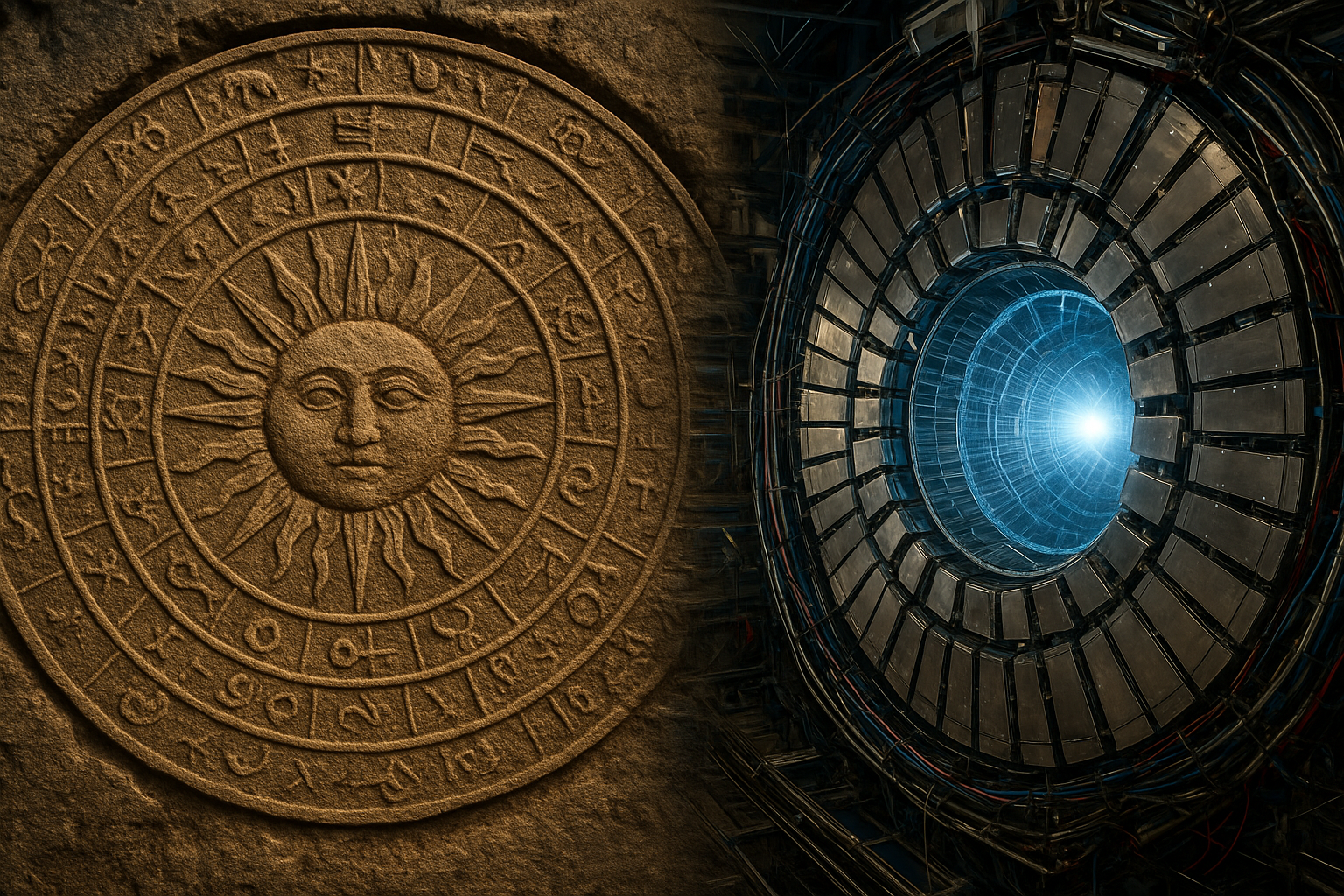
The interplay between ancient cosmologies and modern physics reveals surprising parallels that compel us to reconsider the wisdom of early civilizations. While the sciences of today are grounded in empirical evidence and stringent methodologies, many of the ancients’ ideas resonate with contemporary scientific discoveries. This article explores these fascinating intersections.
Cosmologies of the Ancients
Ancient civilizations sought to understand their world through cosmologies that often intertwined the spiritual with the physical. The Babylonians, for instance, were adept astronomers, their observations forming the bedrock of later celestial navigation. Meanwhile, the ancient Greeks offered a pantheon of theories, the most notable being the geocentric model proposed by Ptolemy, which dominated for centuries.
In the Eastern world, the Vedic texts of India introduced cyclic models of the universe, a notion echoed in the concept of a constantly expanding and contracting universe. The Māori of New Zealand described the universe’s creation as ‘Te Kore’, the nothing, evolving into ‘Te Po’, the darkness, and ultimately into ‘Te Ao’, the light – an allegorical perspective on cosmic birth that strikingly parallels the universe’s expansion from singularity.
Modern Physics: New Discoveries, Old Ideas
With the advent of quantum physics and theoretical cosmology, the universe revealed its peculiarities, often mirroring the strangeness of ancient metaphysical descriptions. One such example is the concept of the multiverse, which echoes the many-world scenarios found in Hindu cosmology, suggesting an eternal cycle of creation and destruction.
In an interview with Scientific American, physicist Alan Guth, one of the pioneers of the inflationary universe theory, describes the multiverse hypothesis as an outcome of modern cosmological models, “Just as modern cosmology suggests a multiplicity of possible universes, ancient beliefs saw the cosmos as a tapestry far richer than the visible.”
Quantum Entanglements with Ancient Belief
Quantum mechanics has provided some of the most startling insights into the fabric of reality. The phenomenon of quantum entanglement suggests that particles can be interconnected in ways that transcend space and time, an idea echoed in many indigenous cosmologies. For instance, the Indra’s Net concept from Buddhist philosophy, describes a vast net, whereby each node is a reflection of all others, a metaphor for interconnectedness that modern physics now observes through quantum entanglement.
The Cosmos and Human Understanding
The Anthropic Principle, a philosophical consideration that observations of the universe must be compatible with the conscious life that observes it, also finds antecedents in ancient thought. Many ancient cultures positioned humans as an integral part of the cosmos, not in an egocentric sense but as participants in a grand cosmic dance. This is mirrored today in modern physics, which increasingly acknowledges the observer’s role in the universe’s functioning.
The renowned physicist John Archibald Wheeler speculated on this balance by suggesting, “We are participators in bringing into being not only the near and here but the far away and long ago.” His perspective underscores the human element in our universe’s narrative, similar to the interconnected frameworks that ancient cosmologies endorsed.
Reconciling Wisdom
“The most beautiful thing we can experience is the mysterious. It is the source of all true art and science.” — Albert Einstein
Einstein’s reflection captures the mysterious allure that both ancient cosmologies and modern physics offer humanity. While ancient beliefs personified this mystery in divine or mythological narratives, modern physics offers mathematical abstraction. Yet, the goal remains the same: to fathom the unfathomable.
Despite their varied approaches, both systems share a profound insight: the universe is a mesmerizing enigma, best approached with humility and an acknowledgment of our limited understanding. The unexpected resonances between ancient cosmologies and modern physics deepen this appreciation, encouraging a philosophical openness that may pave the way for future revelations.
In revisiting and respecting the ideas of our ancestors, who viewed the cosmos with wonder, we may discover that the boundary between ancient wisdom and modern knowledge is not as rigid as once thought. As we continue to explore the universe, those timeless ancestral voices offer comfort and insight, reminding us that the questions, more than the answers, are what propel us forward.