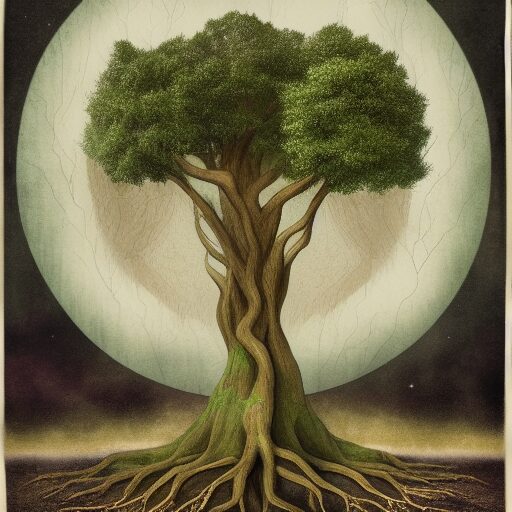
Tag: tree

  • The World Tree’s Roots – Connecting Yggdrasil to the Axis Mundi.

    The World Tree’s Roots – Connecting Yggdrasil to the Axis Mundi.

    The World Tree’s Roots – Connecting Yggdrasil to the Axis Mundi

    In the rich tapestry of Norse mythology, the World Tree Yggdrasil stands tall as a symbol of cosmic order and connection between the nine worlds. This majestic tree is often depicted with its roots stretching deep into the earth and its branches reaching for the heavens. But what lies at the heart of these ancient roots?

    The Roots of Yggdrasil

    The Old Norse poem, Völuspá, offers a glimpse into the mysteries beneath the World Tree’s roots: “A wolf was gnawing at the root / Of that ash which is called Yggdrasill” (Stanza 27). This enigmatic passage hints at the connection between Yggdrasil and the primordial forces that shape the cosmos.

    The Axis Mundi

    In many mythological traditions, the concept of an Axis Mundi (axis of the world) emerges as a central axis connecting the heavens, earth, and underworld. This axis is often symbolized by a tree, pole, or pillar that upholds the fabric of reality.

    As Germanic scholar Rudolf Simek notes: “The World Tree Yggdrasil is not only a cosmic tree but also an Axis Mundi, connecting the three worlds of the gods, humans, and giants” (Simek, 1996).

    The Roots of Chaos

    In Norse mythology, the roots of Yggdrasil are said to be gnawed by the wolf Fenrir, son of the god Loki. This act of gnawing represents the constant struggle between order and chaos, as the World Tree’s foundations remain vulnerable to the forces of destruction.

    As Norse scholar John Lindow explains: “The roots of Yggdrasil are a symbol of the cosmic balance, with the wolf representing the destructive forces that threaten the stability of the universe” (Lindow, 2001).

    The Roots of Wisdom

    In contrast to the forces of chaos, the roots of Yggdrasil also represent the pursuit of wisdom and knowledge. The Norns, three goddesses who shape the destiny of gods and humans alike, are said to dwell at the base of the World Tree.

    As Norse scholar Anne Lecours notes: “The Norns, who reside at the roots of Yggdrasil, embody the power of fate and the mystery of creation” (Lecours, 2002).

    Conclusion

    The roots of Yggdrasil serve as a powerful symbol of the interconnectedness of the nine worlds. As we delve into the mysteries beneath the World Tree’s ancient roots, we find ourselves drawn to the fundamental forces that shape our understanding of the universe.

    As Norse poet and scholar, Snorri Sturluson, so eloquently puts it: “The tree Yggdrasil stands at the center of the worlds, connecting heaven and earth, and supporting the weight of fate” (Sturluson, 13th century).

    References:

    * Lindow, J. (2001). Norse Mythology. Oxford University Press.
    * Lecours, A. (2002). The Norns in Norse Mythology. Routledge.
    * Simek, R. (1996). Dictionary of Northern Mythology. Boydell & Brewer Ltd.

    Additional Resources:

    * “Völuspá” translation: [https://en.wikipedia.org/wiki/V%C3%B0lusp%C3%A1](https://en.wikipedia.org/wiki/V%C3%B0lusp%C3%A1)
    * Snorri Sturluson’s Edda: [https://www.sacred-texts.com/neu/edda.htm](https://www.sacred-texts.com/neu/edda.htm)

  • The Tree as Guru

    The Tree as Guru

    The Tree as Guru: Nature’s Silent Teacher

    In a world that races towards technological advancement at an unprecedented pace, the soul can often feel neglected. Amid the noise, there exists a universal guide that has been inadvertently overlooked: the tree. For centuries, the tree has served as a profound symbol and teacher, silently imparting wisdom to those willing to listen.

    The Tree: A Universal Symbol

    Trees have always held a venerable position in human history and culture. Across various religions and philosophies, trees symbolize knowledge, growth, and resilience. Consider the Bodhi Tree under which Siddhartha Gautama, the future Buddha, attained enlightenment. It is a powerful emblem of awakening and spiritual nourishment.

    In Norse mythology, Yggdrasil is the cosmic tree that connects the nine worlds, portraying the interconnectivity of the universe. Similarly, the ancient Celts revered trees as sacred beings, crucial to both their daily lives and spiritual practices.

    Lessons in Patience and Persistence

    Trees are paragons of patience and persistence. In their steady growth over decades, sometimes centuries, they teach the value of long-term vision and resilience. As the author Ralph Waldo Emerson once said, “Adopt the pace of nature: her secret is patience.”

    A sapling may take many years before it reaches maturity, often enduring harsh weather, disease, and human disturbance. Yet, despite adversities, it continues reaching upwards towards the light. This resilience invites us to ponder our own struggles and the patience required to overcome them.

    The Cycle of Renewal

    One of the most inspiring teachings of trees is their ability to adapt and renew. The cycle of shedding leaves each autumn and budding anew in spring exemplifies transformation and resilience. This annual cycle reflects the natural process of letting go and renewal, crucial for personal growth.

    As the poet Rainer Maria Rilke beautifully noted, “If we surrendered to earth’s intelligence, we could rise up rooted, like trees.”

    This eloquent line prompts us to trust and embrace the seasons of our own lives, knowing that with each ending, a new beginning awaits.

    The Wisdom of Community

    Trees also teach us about the richness of community. Below the surface, trees communicate via a complex network of roots and fungal mycelium, often referred to as the Wood Wide Web. This network allows trees to share nutrients, aid one another, and even warn of potential dangers.

    According to a New York Times article, this interconnectedness highlights the inherent communal nature of trees, reminding us of the strength found in supporting and relying on each other.

    Environmental Guardianship

    Besides their metaphorical teachings, trees play a crucial role in sustaining life. They provide oxygen, sequester carbon, and regulate the climate, underscoring the essential balance of giving and receiving inherent in all natural systems. Trees serve as a vital reminder of our responsibility to protect the environment, echoing the urgent need for sustainable living practices.

    Spiritual Reflection

    Lastly, trees invite us to engage in spiritual reflection. Standing in the midst of a forest, one can feel a profound sense of peace and interconnectedness. This serenity offers an opportunity for introspection, allowing individuals to find clarity away from the chaos of daily life. John Muir, a renowned naturalist, once professed, “In every walk with nature one receives far more than he seeks.”

    “When one tugs at a single thing in nature, he finds it attached to the rest of the world,” wrote Muir, emphasizing the spiritual and physical unity of nature.

    Conclusion

    Whether considered as metaphorical teachers or critical components of ecological systems, trees stand as stoic mentors in the modern age. By observing their patience, adaptability, and communal support, we can unearth timeless wisdom that deeply resonates with both our inner and outer worlds.

    Embracing trees as gurus compels us to live more intentionally, harmoniously, and sustainably. As you walk past a tree today, pause, reflect, and perhaps consider the silent teachings it has to offer.