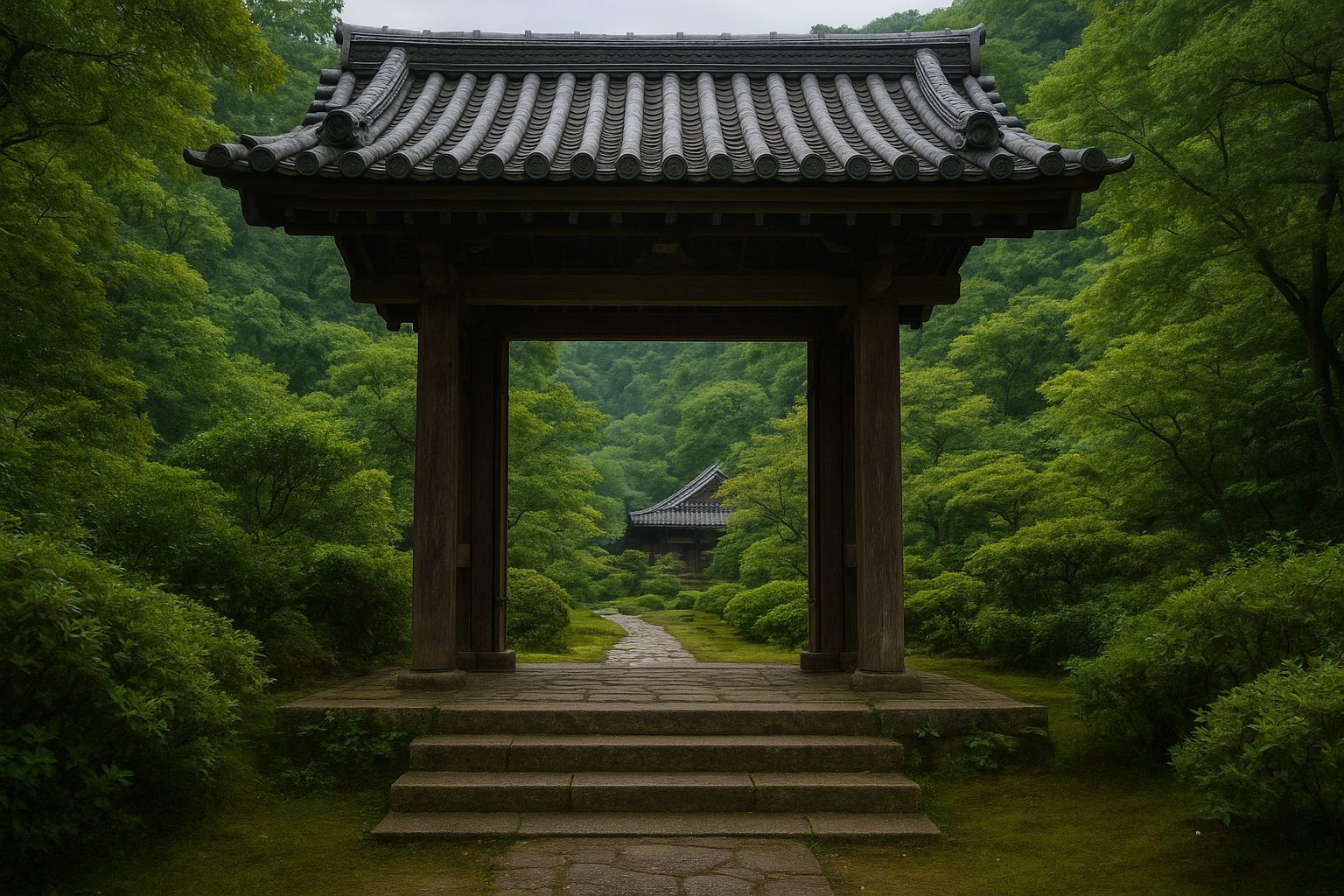
Tag: temple

  • Beyond the Temple Gate – Where Dao and Zen Become One

    Beyond the Temple Gate – Where Dao and Zen Become One

    Beyond the Temple Gate: Where Dao and Zen Become One

    As one approaches the serene thresholds of ancient temples nestled amidst bamboo groves and mist-covered mountains, the path often embodies a deeper philosophical convergence. In the silent whispers of these sacred spaces lies the melding of Daoist spontaneity and Zen’s directness—a dance of harmony between two oceans of thought.

    The Intersection of Dao and Zen

    Historically, both Daoism and Zen Buddhism emerged from distinct cultural and philosophical origins. Daoism, with its roots in Chinese thought, emphasizes living in harmony with the Dao, often translated as ‘The Way.’ In contrast, Zen Buddhism, which flourished in Japan, highlights direct experience and the meditation practice of zazen to reach enlightenment.

    Despite their different paths, both traditions converge on the importance of enlightenment, tranquility, and an interconnectedness with nature. According to The Stanford Encyclopedia of Philosophy, Daoism advocates for a life of simplicity, humility, and peace with nature—a sentiment that aligns closely with Zen’s emphasis on the simplicity of mind and heart.

    Practical Synthesis in Modern Practice

    Today, practitioners often find a seamless amalgamation of Dao and Zen principles in daily life. The Daoist affirmation of ‘wu wei’ (effortless action) finds a loving counterpart in Zen’s mindfulness practices. Bringing these principles together can lead to profound insights and a balanced lifestyle.

    “Zen asserts the inherent enlightenment in each moment and invites the practitioner to experience life with fresh eyes,” wrote John Daido Loori in The Zen of Creativity. “This call to presence and the Daoist embrace of natural flow beckon a holistic existence.”

    • Both philosophies encourage followers to embark on a journey of self-awareness and spiritual awakening.
    • The practices offer tools to navigate the chaos of modern existence with grace and patience.
    • They cultivate a sense of belonging in a world that often feels disjointed and disconnected.

    Unity in Diversity

    In understanding and applying the teachings of both Dao and Zen, one can transcend the boundaries of individual schools of thought and forge a personal path of tranquility and wisdom. This synthesis reflects the ancient wisdom of accommodating diversity within unity. To contemplate Zen is to wander the path of Zen, as much as to follow Dao is to remain with the Dao.

    Beyond the temple gates, this convergence becomes a profound journey where Dao’s graceful flow finds vibrant resonance in Zen’s clarity, revealing the unity beneath the surface diversity of life’s myriad challenges.

  • No Temple, No Path – The Zen of Homelessness and Belonging

    No Temple, No Path – The Zen of Homelessness and Belonging

    No Temple, No Path: The Zen of Homelessness and Belonging

    In a world driven by the pursuit of permanence and identity, the notion of homelessness is often viewed as a deficiency. We all crave a place to call home, a sanctuary that anchors us. Yet, for many adherents of Zen Buddhism, the path to enlightenment lies in embracing impermanence and the true nature of existence without fixed attachments. This is exemplified by the concept of No Temple, No Path, a philosophy that explores the intersection of homelessness and a sense of belonging in Zen practice.

    The Zen Garden Without Walls

    Zen Buddhism, which originated as a distinct school in China before spreading to Japan and beyond, emphasizes direct experience and living in the present moment. Its teachings encourage a detachment from material possessions and the traditional markers of success.

    “The whole moon and the entire sky are reflected in one dewdrop on the grass” — Dogen Zenji, founder of Soto Zen in Japan.

    In traditional Zen teaching, there is no need for a physical temple to practice. Instead, the world itself becomes a boundless monastery where every rock, tree, and stream is an object of contemplation. This perspective removes the physical boundaries of practice, fostering a sense of spiritual freedom and unlimited exploration.

    Homelessness as Liberation

    For Zen monks, traditional homelessness is not simply a lack of shelter, but rather a profound liberation from worldly attachments. Monks often renounce worldly possessions to follow the Buddha’s example, seeking the divine within themselves and the universe.

    • Sesshin: Intense meditation sessions that symbolize a temporary renunciation of the world.
    • Kesa: The monk’s robe, representing both poverty and the acceptance of impermanence.
    • Takuhatsu: The act of mendicancy or begging, symbolizing a monk’s reliance on the kindness of others, highlighting the interconnectedness of all beings.

    Through these practices, monks cultivate a deep understanding of the non-duality of existence. By detaching from physical possessions, they come to realize that true security and belonging stem from an inner state of tranquility and wisdom.

    Embracing the Void

    At the heart of the Zen practice is the understanding that life is transient and all worldly attachments are ephemeral. The idea of homelessness is thus reclaimed as a profound state of spiritual awareness. In his book When Things Fall Apart, renowned Buddhist nun Pema Chödrön suggests embracing uncertainty in our lives:

    “We think that the point is to pass the test or to overcome the problem, but the truth is that things don’t really get solved. They come together and they fall apart.”

    By acknowledging the natural ebb and flow of life, Zen practitioners find peace in the void. Through mindfulness practices like zazen (sitting meditation) and kinhin (walking meditation), they learn to be comfortable with uncertainty, much like waves that lap upon the shifting shores of existence.

    The Ubiquity of Belonging

    Belonging, in the Zen tradition, is not about possessing a particular place or identity, but rather recognizing one’s connectedness with all life. This universal belonging is expressed through compassion (karuna) and loving-kindness (metta), essential elements of the Zen path.

    To be homeless in the Zen sense is to walk a path defined not by the places you inhabit, but by your relationships with others and the world. It is the realization that wherever you are, you are never truly alone, but a part of the greater tapestry of existence.

    Conclusion

    The Zen philosophy of No Temple, No Path challenges us to reconsider our understanding of home and belonging. It invites us to see that perhaps our true home is not a place, but a state of being—one that is open, free, and universally connected.

    As we navigate a world that often seems fractured and homeless, let us remember that the true essence of belonging lies within us. By embracing the Zen of homelessness, we can find serenity amid chaos and build a compassionate bridge to others, no matter where we find ourselves.