Tag: such

  • Beyond the Brushstroke: New Media and Visual Expression

    Beyond the Brushstroke: New Media and Visual Expression

    In the past century, visual art has transcended the constraints of traditional media, such as painting and sculpture, evolving into a multifaceted form that embraces technological advancements. The contemporary arena of visual expression, largely fueled by new media, has surged beyond the brushstroke, offering artists innovative ways to express their creativity and engage audiences.

    The Rise of Digital Art

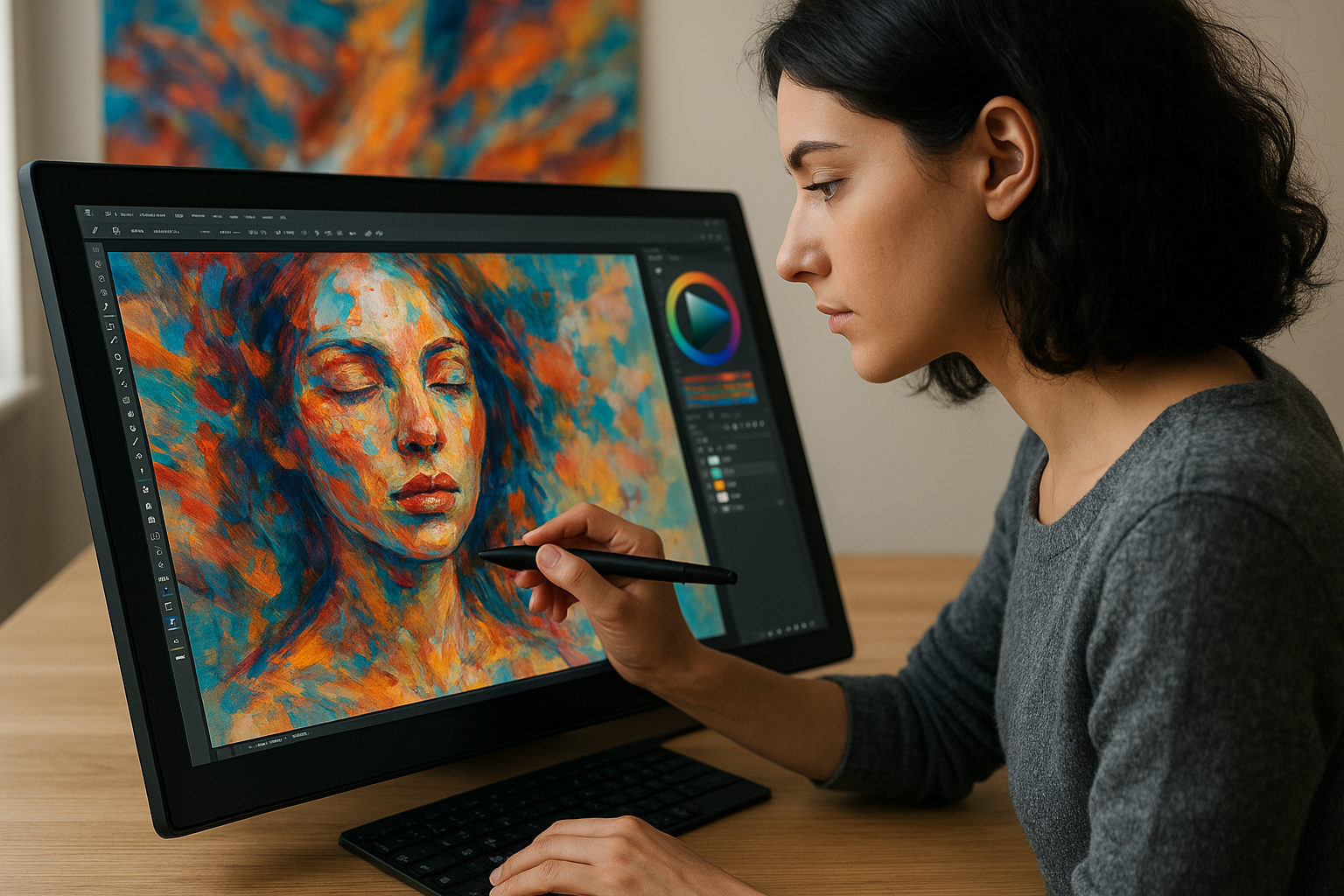
    Digital art is perhaps the most revolutionary development in new media. What began as simple pixel graphics has transformed into a sophisticated realm including digital painting, 3D modeling, and interactive installations. Artists now have access to a plethora of tools that not only mimic physical media but enhance it. Software such as Adobe Photoshop and Blender have become staples for artists aiming to push the boundaries of visual art. As Art Radar Journal notes, “Digital technologies are now providing artists with new ways to produce, distribute, and experience art” (Art Radar Journal).

    Exploring Virtual and Augmented Reality

    Virtual reality (VR) and augmented reality (AR) are no longer futuristic concepts confined to science fiction. Artists are using these technologies to create immersive environments, inviting viewers to step inside the artwork. VR, with its ability to transport users into entirely constructed worlds, allows for an experience that transcends traditional viewing. Artists such as Marina Abramović, who has embraced VR to expand her performances, are at the forefront of this transformation. According to The Guardian, “her VR piece, Rising, is an embodiment of the potential for VR to evoke visceral emotional responses” (The Guardian).

    Simultaneously, AR bridges the gap between the digital and physical worlds, enhancing our perception of the latter. Applications like ARKit and Snapchat filters allow artists to merge digital artworks with real-world environments, creating interactive experiences accessible through smartphones and tablets. The integration of AR in public art projects, such as those by JR in Paris, showcases its potential to transform urban landscapes into evolving galleries.

    Interactive and Generative Art

    Another exciting development in the realm of new media art is interactivity. Unlike traditional art forms that require passive observation, new media often encourages the audience to participate, altering the artwork in real time. This dynamism is seen in the works of Rafael Lozano-Hemmer, who creates intricate installations that depend on audience interaction.

    Generative art, which employs algorithms to create artwork, is another frontier where technology and artistry meet. Emphasizing process over result, artists like Casey Reas, co-creator of the Processing programming language, use code to generate complex, evolving patterns that challenge traditional forms of expression. With each viewer potentially seeing a different iteration, generative art becomes a living entity.

    “The beauty of generative art is that the artist can establish a framework in which the artwork evolves, a concept that invites endless possibilities,” Reas explains in an interview with Wired. (Wired)

    The Influence of Artificial Intelligence

    Artificial intelligence (AI) is another paradigm-shifting force in visual expression. AI art, created with machine learning models that analyze millions of images to create new, often surreal works, challenges preconceived notions about creativity and authorship. The controversial auction of Edmond de Belamy, an AI-produced work that sold for $432,500 at Christie’s, sparked significant debate about the role of AI in art and the definition of an artist.

    AI developments are not mere imitations of human creativity but potentially new forms of intelligence with unique aesthetic signifiers. Projects like DeepDream or GANPaint Studio allow artists to explore abstract and uncanny representations that push the limits of imagination.

    Impact on Society and Culture

    The emergence of new media in visual expression is not just an artistic development; it poses profound questions about our society and culture. As artworks become more ephemeral and digitally-oriented, debates arise about issues of preservation, authorship, and intellectual property. Furthermore, the democratization of art production and distribution, made possible by digital technologies, challenges traditional art institutions and markets, offering increased accessibility but also raising concerns about quality control and valuation.

    Moreover, new media art acts as a mirror reflecting our contemporary anxieties and aspirations. Themes of digital identity, privacy, and the pervasive influence of technology are prevalent in today’s artworks, urging viewers to reflect on the socio-political implications of our increasingly digital lives.

    Conclusion: The Future of Visual Expression

    The evolution of visual expression through new media is an ongoing journey, marked by innovation and exploration. As technology continues to advance, the possibilities for artists to delve into unknown territories of creativity are limitless. This era, characterized by a fusion of digital technologies and artistic visions, heralds a new chapter in the history of art.

    While it embraces the digital, the heart of visual expression remains the same: a quest to convey meaning through visual form. Through new media, artists are discovering unprecedented methods to engage with and challenge their audience, redefining what it means to create and experience visual art in the modern world. Indeed, as we venture further into the digital age, the future of art is not just beyond the brushstroke—it is limitless.


  • Ancient Wisdom, Modern Wire: Connecting the Past and Future

    Ancient Wisdom, Modern Wire: Connecting the Past and Future

    The evolution of technology is often seen as a modern phenomenon, yet its roots stretch far into the distant past. From the invention of the wheel to the intricate designs of Roman aqueducts, our ancestors laid the foundational knowledge that directs today’s advancements. This article explores the symbiotic relationship between ancient innovations and modern technology, revealing how time-honored wisdom continues to inform and inspire contemporary achievements.

    The Legacy of Ancient Innovations

    Whether it’s the concept of zero from ancient India, which revolutionized mathematics, or the Antikythera mechanism, an ancient Greek analog computer, ancient innovations have consistently provided humanity with the basic tools to solve complex problems. These foundational inventions serve as the bedrock upon which modern technology is built.

    • The Wheel: Invented around 3500 B.C. in Mesopotamia, the wheel is one of humanity’s greatest inventions. It laid the groundwork for the development of transportation and machinery that eventually powered the Industrial Revolution.
    • The Printing Press: Johannes Gutenberg’s 15th-century invention was not the first of its kind. The concept originated in 9th-century China. By mechanizing the process of printing, it paved the way for mass communication, influencing today’s digital publications.
    • Aqueducts: The ancient Romans mastered the aqueduct between 312 B.C. and 226 A.D., which enabled urbanization by delivering fresh water to city populations. The principles used are echoed in modern water supply systems worldwide.

    “The ancient engineers were the giants on whose shoulders the present generation of civil engineers stand today,” notes Ou, James. Engineers of the past and their contributions to civil engineering. World Engineering Journal, 2011.

    The Influence of Ancient Science on Modern Technology

    Modern scientific achievements owe much to ancient explorations. Ancient civilizations like the Greeks, Chinese, and Egyptians contributed significantly to fields such as astronomy, medicine, and metallurgy. Their discoveries provided a framework that has guided centuries of scientific thought.

    • Astronomy: The Babylonians kept detailed astronomical records as early as 1600 B.C., which the Greeks later studied. Their work laid the foundation for Kepler’s laws of planetary motion and eventually Einstein’s theory of relativity.
    • Medicine: The Ebers Papyrus, dating back to around 1550 B.C., is one of the oldest medical documents. Egyptian doctors’ insights into anatomy greatly influenced Greek and Roman medicine, eventually informing modern medical practices.
    • Metallurgy: Ancient techniques in metalworking, developed during the Bronze and Iron Ages, set the groundwork for modern metallurgy’s complexity. Today’s advancements in materials science continue to build upon these ancient principles.

    A contemporary example of ancient influence is biomimicry, where design solutions are inspired by nature. From the study of lotus leaves to create self-cleaning surfaces to sharkskin patterns used for aerodynamic swimsuits, ancient wisdom in observation continually informs technological design.

    The Digital Age: Bridging Old and New

    Today’s digital age is no different in its regard for ancient wisdom. Computer algorithms, though modern in application, often reflect mathematic principles developed by ancient civilizations. For instance, algorithms for solving complex mathematical problems borrow from ancient strategies and logic patterns, such as those formalized by Euclid in his algorithm for finding the greatest common denominator.

    Moreover, ancient stories and myths, such as the labyrinth of Daedalus, echo in the algorithms that solve modern-day puzzles and navigate complex data networks. As noted by Smithsonian Magazine, these narratives continue to inspire innovative thinking and problem-solving techniques today.

    The Role of Philosophy and Ethics

    Beyond the technical, ancient wisdom also encompasses philosophy and ethics—domains equally critical to modern technological discourse. Greek philosophers such as Aristotle explored topics of ethics that remain highly relevant in today’s discussions surrounding artificial intelligence and digital privacy.

    “The introduction of radically different kinds of technologies requires new ethical thinking,” writes thinker Ruth Chadwick, Director of ESRC Centre for Economic and Social Aspects of Genomics. “Aristotle’s emphasis on virtue ethics can guide considerations about character and decision-making in the deployment of such technology.” (“The Guardian)

    The parallels between ancient frameworks of thought and today’s ethical considerations in technology encourage a balanced evaluation of our innovations. This approach helps cultivate progress that is as ethically sound as it is technologically advanced.

    Conclusion: Remembering the Wisdom of the Ancestors

    As we stand on the precipice of further technological breakthroughs—from quantum computing to biotech revolutions—it’s crucial to recall and respect the ancient wisdom that has consistently shaped our progress. Investigating traditional solutions to modern problems ensures that technological advancements remain grounded, conscious, and sustainable.

    The harmonious blend of past knowledge and future technology invites a richer understanding of both human potential and responsibility. By connecting the past and future, we pave the way for innovations that are not only cutting-edge but also deeply reflective of centuries of human wisdom.

  • The Spirit of the Soil

    The Spirit of the Soil

    The soil beneath our feet is far more than just earth and dirt. It’s a living, breathing ecosystem full of mysteries and vital resources. It forms the backbone of agriculture, supports biodiversity, and plays a crucial role in the planet’s carbon cycle. Uncovering the intricate web of life within the soil is pivotal for our sustainability and survival.

    The Invisible World Beneath

    Delving into the soil reveals a rich tapestry of organisms, from billions of bacteria and fungi to earthworms and insects. These inhabitants work tirelessly, breaking down organic matter, cycling nutrients, and maintaining soil health. According to FAO, “up to 90% of living organisms in soils are indeed soil microorganisms.” These tiny allies help plants grow and combat climate change by capturing carbon dioxide.

    Carbon Sequestration and Climate Change

    Soil is a significant carbon sink, second only to the oceans. It stores more carbon than all the world’s forests combined. By harnessing the spirit of the soil, we can enhance its ability to sequester more carbon, thus mitigating climate change. Practices such as no-till farming, cover cropping, and agroforestry can boost carbon storage while enriching soil health.

    Agriculture in Harmony with Nature

    Agricultural practices have long treated soil as an inert growing medium, yet there’s a growing recognition of its vibrant life. Approaches such as regenerative agriculture focus on the interconnectedness of plants, animals, and the soil. The Rodale Institute suggests that “regenerative organic agriculture improves the resources it uses, rather than destroying or depleting them.”

    “The nation that destroys its soil destroys itself.” – Franklin D. Roosevelt

    The Future of Soil Stewardship

    As we move into an era where environmental challenges loom large, cultivating a deeper respect for soil is crucial. Innovative technologies such as soil sensors and precision agriculture are paving the way for sustainable soil management, offering data-driven insights into soil health. Yet, technology must align with traditional wisdom and local knowledge to tap into the true spirit of the soil.

    Preserving and rejuvenating our soils is not merely an agricultural challenge; it’s an imperative for ecosystem sustainability. By valuing the spirit of the soil, societies can transition toward a future wherein the land is fertile and the planet greener.