Tag: source

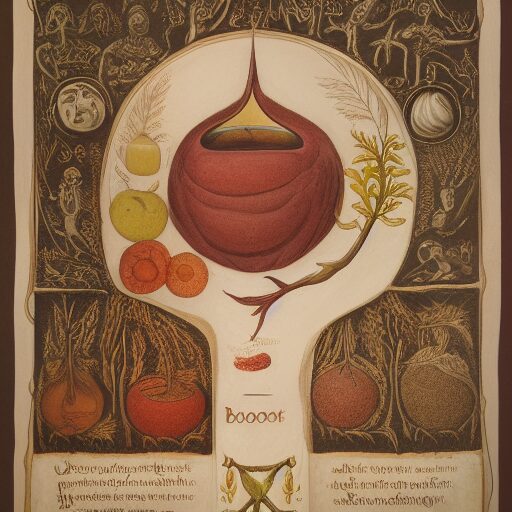
  • Blood and Nectar – The biological roots of divine food and drink.

    Blood and Nectar – The biological roots of divine food and drink.

    Blood and Nectar – The Biological Roots of Divine Food and Drink

    In many cultures, certain foods and drinks are considered divine or sacred, imbued with mystical powers that nourish both body and soul. Two examples of such substances are blood and nectar, which have been revered across various mythologies as symbols of life, vitality, and spiritual sustenance.

    • Blood: The Primal Nourisher
      • In many ancient cultures, blood was seen as the source of life and vitality. For example, in Greek mythology, ambrosia – a divine food that granted immortality – was often associated with the blood of the gods.
      • “Blood is the source of all life,” says mythologist J.G. Frazer in his book “The Golden Bough”. This idea is echoed in the ancient Mesopotamian Epic of Gilgamesh, where the gods are said to have created humans from blood and clay.
    • Nectar: The Elixir of Life
      • In Hindu mythology, nectar (amrita) is the drink that grants immortality. According to the Rigveda, nectar was created by the gods and served as a source of vitality and strength.
      • “The ambrosia which the gods eat and drink… is the nectar that comes from the gods,” writes mythologist Karl Kerenyi in his book “Eleusis: Archetypal Image of the Mother”. This idea is also reflected in Greek mythology, where ambrosia was often depicted as a sweet, honey-like substance.
    • The Biology of Blood and Nectar
      • From a biological perspective, blood can be seen as the ultimate source of life. It contains the oxygen and nutrients necessary for cellular respiration, as well as essential hormones and growth factors.
      • Nectar, on the other hand, is often linked to the idea of honey – a sweet, viscous liquid produced by bees from the nectar of flowers. Honey has been prized throughout history for its antibacterial properties and nutritional value.
    • The Psychological Significance
      • The symbolic meanings attached to blood and nectar can be seen as a reflection of humanity’s deep-seated desire for life, vitality, and spiritual sustenance. These substances represent the fundamental forces that drive human existence.
      • “The symbolism of blood is rich in psychological significance,” writes mythologist Marie-Louise von Franz in her book “The Golden Game”. This idea is echoed in the work of psychoanalyst Carl Jung, who saw the symbolic language of mythology as a reflection of the collective unconscious.

      “Myths are public dreams, and dreams are private myths.” – Joseph Campbell

  • Walking the Void – A Journey into the Unseen Source

    Walking the Void – A Journey into the Unseen Source

    Walking the Void: A Journey into the Unseen Source

    In a world bustling with noise, light, and ceaseless connectivity, the concept of walking into the void might seem daunting or even absurd. Yet, these avenues into the unseen and unknown have long been the quest for mystics, philosophers, and explorers alike. This journey into the void is not just about physical traversing; it’s about confronting the intangible, the ineffable that lingers at the edges of human understanding.

    Journey Preparation: The Bold Step Forward

    The void—abstract yet present—is not a mere absence but a fertile space of potential. To engage with it is to embark on a path less traveled, marked by introspection and silence. As the Zen philosopher D.T. Suzuki noted, “Emptiness which is conceptually liable to be mistaken for sheer nothingness is in fact the reservoir of infinite possibilities.” This notion invites those daring enough on a journey toward the center of their consciousness and beyond.

    • Understanding the Void: The journey into the void is as much about the absence of distractions as it is about the presence of insight. It asks travelers to seek clarity in spaces vacated by external noise.
    • Embracing Stillness: Perhaps one of the toughest challenges is to embrace stillness—to let go of the ceaseless hustle and find peace in quietude.
    • Confronting the Self: It is a voyage into layers of self-awareness, peeling away societal masks to discover authentic identity.

    The Unseen Source: Discovering Edges of Awareness

    What waits beyond the veil of everyday perception is oftentimes referred to as the unseen source—a fountainhead of inner wisdom and universal truths. Modern spirituality and ancient wisdom traditions both speak to this phenomenon. According to Rumi, the renowned Sufi mystic, “The wound is the place where the Light enters you.” It suggests a perspective where vulnerabilities open pathways to deeper understanding.

    Exploring the unseen source empowers an individual to perceive life in a more integrated, holistic manner.

    • Intuition Over Reason: Tapping into the unseen often involves letting intuition guide one’s footsteps. This transcends logical reasoning, venturing into the realm of the heart and soul.
    • Expanding Consciousness: Recognizing the limits of the visible world and expanding consciousness to include what lies beyond the perceptible.

    The Intersection of Science and Mysticism

    In recent years, there has been an intriguing convergence of scientific inquiry and spiritual exploration concerning the void. Quantum physics, for instance, reveals a reality much stranger and more beautiful than anything conceived by the human imagination. Dr. Michio Kaku mentions in his book “The Future of the Mind”, “In quantum mechanics, nothing is essentially something.” The quantum void, far from being empty, is alive with activity, heralding a reconciliation between ancient mysticism and modern science.

    • The Quantum Mystery: The void in quantum physics could be viewed as a microcosm of the spiritual void, suggesting a space teeming with unseen potentials.
    • Unifying Concepts: Both fields hint at realities interconnected by unseen forces, echoing the mystical perspective of oneness with all things.

    The Personal Path: Charting One’s Own Void

    How one engages with the void is intensely personal and varies widely from individual to individual. Yet, some universal elements guide this exploration:

    • Meditation and Mindfulness: Whether through traditional meditation practices or modern mindfulness techniques, these methods offer structured approaches to exploring the void.
    • Artistic Expression: For some, the void is best navigated through art, music, or writing, as these forms bridge the seen with the unseen.
    • Connection with Nature: Immersing oneself in natural environments often mirrors the vastness and mystery of the void, providing a visceral sense of connection to the source.

    Conclusion: The Unseen Beckons

    Walking the void is as much an inner journey as it is an exploration of the universe’s mysteries. In reaching out into the unseen source, one might discover not just a reflection of the cosmos but a reflection of one’s truest self. Such a path invites courage, creativity, and an open heart—qualities that, once embraced, redefine the boundaries of possibility.

    Ultimately, the journey into the unseen is not a journey toward darkness, but toward the light hidden within it, a compelling path pursued by the curious and the brave alike.

  • Echoes of the Source – Remembering the Primordial Dao

    Echoes of the Source – Remembering the Primordial Dao

    Echoes of the Source: Remembering the Primordial Dao

    In a world constantly seeking progress through technology and innovation, there lies a profound echo from an ancient philosophy—the Dao (or Tao). Originating in ancient China, the Daoist philosophy offers a contemplative approach to existence, one that emphasizes harmony with the natural world and tapping into the primordial source of all life. To remember the Dao is to reconnect with a timeless wisdom that champions simplicity, humility, and the perpetual flow of the universe.

    The Birth of Daoism

    Daoism, as a formalized philosophy, is traced back to the legendary sage Laozi, credited with authoring the foundational text, the Dao De Jing (Tao Te Ching). This classic work, written in the 6th century BCE, encapsulates the essence of the Dao through eighty-one compact, yet profound chapters. The opening lines of the Dao De Jing begin with:

    “The Dao that can be told is not the eternal Dao; the name that can be named is not the eternal name.”

    These lines encapsulate a profound paradox—while the Dao envelops all things, it remains ineffable, transcending human understanding through words alone.

    Core Tenets of Daoism

    • Wu Wei: The concept of “non-action” or “effortless action.” This does not mean complete passivity but rather allowing things to unfold in their natural course.
    • Simplicity: Embracing a lifestyle in alignment with minimalism and the reduction of material desires.
    • Harmony: Living in balance with the world by recognizing and flowing with its natural rhythms.
    • Yin and Yang: The principle that opposite forces are interconnected and interdependent in the natural world, giving rise to each other in turn.

    The Primordial Source

    At the heart of Daoism lies a connection to the primordial source—a metaphysical concept referring to the beginning and foundation of all existence. This source is not only a singular origin of the universe but also a continuous principle that every creation is drawn to and must return to.

    Zhuangzi, another eminent Daoist philosopher, expands on living life connected to the Source:

    “Know the masculine, keep to the feminine—be the valley of the world. Be the valley of the world—for you to adhere to the constant virtue and return to the realm of the infant.”

    Here, Zhuangzi directs us back to the simplicity and purity of a child, an allegory for returning to the inherent, untainted way of the Dao.

    Daoism in Modern Context

    Despite its ancient roots, Daoism’s tenets offer valuable insights into modern living. In today’s fast-paced and success-oriented society, many individuals find solace in revisiting these teachings, searching for balance amidst chaos. Daoist principles encourage a shift from relentless striving to embracing a way of living that is in tune with the natural order.

    The modern environmental movement finds synergy with Daoism’s call for harmony with nature. By recognizing that humans are but one thread in the vast tapestry of life, it becomes evident that conservation is not just a responsibility but a natural inclination driven by Daoist ideology.

    Rediscovering the Dao

    “Living through the Dao” means engaging actively with the practices that ground this ancient wisdom. Meditation, mindfulness, and Tai Chi are more than exercises of calm—they are ways to reconnect with the fluidity of life and the echo of the primordial source.

    Incorporated into daily life, these practices can rekindle our intimacy with the Dao. They remind us that beneath the surface of our modern existence lies a profound simplicity and purity. Recognizing the echoes of the source allows individuals to traverse beyond the illusion of separation and embrace the unity of all things.

    Conclusion

    Daoism, often misunderstood as mere mysticism, continues to occupy a vital space in philosophical thought. As the world rushes towards an uncertain future, the lessons from the Dao reverberate, urging a contemplation of life that is as profound as it is simple.

    By remembering the primordial Dao, we don’t just escape the frenetic pace of the modern world—we tune into the eternal dance of balance and harmony that the universe gently conducts. In this remembrance lies the possibility of rediscovering ourselves, our purpose, and our place within the cosmic order.

    For more about the philosophy, teachings, and influences of Daoism, visit Britannica’s Daoism entry.

  • The Way of Forgetting – Losing the Self to Find the Source

    The Way of Forgetting – Losing the Self to Find the Source

    The Way of Forgetting: Losing the Self to Find the Source

    In an age where self-realization often takes center stage, the paradoxical journey of self-forgetting can appear both bewildering and counterintuitive. Yet, for those seeking a deeper connection with the universe, this path might hold the key to uncovering an inner source of wisdom and peace.

    The Paradox of Self-Forgetting

    Self-forgetting does not suggest amnesia or neglect of identity. Instead, it alludes to a transcendence over conventional self-boundaries. By losing oneself, one allows for an encounter with a broader, more profound reality. As the spiritual teacher Eckhart Tolle articulates, “To realize that you are not your thoughts is when you begin to awaken spiritually.” By stepping outside of the self, one opens to the richness of existence beyond personal consciousness.[Source]

    Mythological Narratives and Symbolic Loss

    Throughout human history, myths have encapsulated this journey toward the Source. In many traditions, the hero’s journey involves a symbolic death—a shedding of previous identities. Joseph Campbell’s concept of the monomyth highlights this transition as a critical stage in the hero’s adventure, where the protagonist must abandon prior identities to achieve spiritual enlightenment. As Campbell wrote in The Hero with a Thousand Faces, “The hero ventures forth from the world of common day into a region of supernatural wonder: fabulous forces are there encountered and a decisive victory is won: the hero comes back from this mysterious adventure with the power to bestow boons on his fellow man.”[Source]

    The Zen Approach to Forgetting the Self

    In Zen Buddhism, the practice of self-forgetting is not merely theoretical but an experiential pursuit engrained in zazen (sitting meditation). The Zen master Shunryu Suzuki emphasized this practice as a means of aligning with the rhythm of the universe. “When you forget all your dualistic ideas, everything becomes your teacher, Buddha, or God,” he stated. Through the discipline of forgetting the self, practitioners often report feeling a profound interconnectedness with all life.[Source]

    “To be awake is to be alive.” – Henry David Thoreau

    These words by Thoreau encourage us to awaken to a life lived beyond self-limiting narratives. It’s in the forgetting, not the clinging to identity, that one realizes their true place in the cosmos.

    The Neuroscience Perspective

    From a scientific standpoint, the brain’s default mode network is typically active during self-referential thought. However, meditation practices aimed at reducing this activity can lead to the dissolution of ego-centric thought patterns. A study published in the journal Social Cognitive and Affective Neuroscience indicated that experienced meditators showed substantial decreases in default mode activity, correlating with feelings of selflessness and contentment.[Source]

    Practical Steps to Embrace Forgetting

    • Meditation: Cultivate a daily practice focused on breath and presence. Allow thoughts to dissipate and ground yourself in the now.
    • Mindfull Walking: Engage in mindful walking to synchronize the body and mind with the rhythm of nature.
    • Letting Go of Labels: Notice the tendency to label experiences and people. Release these labels to see the world as it is, free from preconceptions.
    • Service to Others: Engage in selfless acts. By shifting focus from self to others, one can experience unity and compassion.

    Conclusion: Realizing the Source

    The journey of self-forgetting is not about losing oneself into oblivion but about finding a more significant, universal connection. Through the lens of spiritual traditions, personal practices, and scientific insights, we see a compelling case for this path. It is a journey inward, towards the Source—a journey that ultimately leads to the discovery of one’s authentic, boundless nature.

    In the end, by losing oneself, not only does one find a sense of peace and wholeness, but also the profound realization of interconnectedness—a reminder that in the grand tapestry of existence, no thread is ever truly lost.

  • The Way of Returning – Tracing the Path Back to Source

    The Way of Returning – Tracing the Path Back to Source

    The Way of Returning – Tracing the Path Back to Source

    The Way of Returning: Tracing the Path Back to Source

    “The journey of a thousand miles begins with one step.” – Lao Tzu

    The concept of returning to one’s source is an ancient idea, explored in various cultures and philosophies around the world. It speaks to a universal longing within the human spirit—a desire to reconnect with our beginnings, whether that’s an ancestral home, a spiritual origin, or simply a return to a state of simplicity and peace. As the modern world grows increasingly complex, the attraction of tracing this path back to our roots becomes ever more compelling.

    The Philosophical Underpinnings

    Throughout history, many philosophies and spiritual traditions have emphasized the importance of returning to the source. In Daoism, the notion of wu wei or non-action implies a flow that aligns with the natural order of the universe, suggesting a return to a more primal, untainted state of being. As Lao Tzu also said, “Knowing others is intelligence; knowing yourself is true wisdom. Mastering others is strength; mastering yourself is true power.”

    In Hindu philosophy, the concept of moksha represents liberation from the cycle of birth and death, signifying a return to the divine source. Similarly, in Buddhism, the attainment of Nirvana implies a return to an original, enlightened state, freed from the attachments and illusions of the world.

    “We are not human beings having a spiritual experience; we are spiritual beings having a human experience.” – Pierre Teilhard de Chardin

    Modern Interpretations

    In today’s fast-paced world, the yearning for a return to source is often manifested in trends like minimalism, ecological awareness, and movements such as The Slow Movement. These modern interpretations reflect a collective desire to strip away the excess and complexity of contemporary life, seeking a more meaningful and authentic existence.

    Minimalism encourages individuals to remove clutter not only from their physical spaces but also from their minds and schedules. By doing so, they aim to live a life driven by purpose, free from the distractions of material possessions and unessential commitments.

    • Minimalism: Removing the unnecessary to focus on what truly matters.
    • Ecological Awareness: Reconnecting with the planet to heal and sustain our natural environment.
    • Mindfulness and Meditation: Practices that bring us closer to our true selves and the present moment.

    The Path to Self-Discovery

    Tracing the path back to source is inherently a journey of self-discovery. It involves peeling back layers of conditioning and societal expectations to reveal our innermost selves. It’s about asking the essential questions: Who am I? What is my purpose? How do I align my life with my deepest values?

    One tool to facilitate this journey is meditation. By quieting the mind, meditation offers a glimpse into the core of our being. As the Indian philosopher Jiddu Krishnamurti stated, “Meditation is not a means to an end. It is both the means and the end.” Through meditation, individuals can experience a profound sense of peace and unity with the universe, aligning their personal energies with the greater cosmic flow.

    Challenges and Rewards

    While the desire to return to source is strong, the path is not without its challenges. The journey can be fraught with doubts, distractions, and the ever-present pull of modern life’s demands. However, those who persevere often find profound rewards: a deepened sense of peace, clarity, and connection to something greater than themselves.

    These newfound insights often translate into a more balanced and fulfilling life. As individuals reconnect with their true selves and their environment, they discover the joy of living in harmony with the world and the people around them.

    Final Reflections

    Returning to source is a deeply personal journey, unique to each individual’s experiences and spiritual understanding. Whether through philosophy, meditation, minimalism, or ecological awareness, the path is as varied as those who embark upon it. Yet, the underlying principle remains the same: the quest for authenticity, simplicity, and unity with the essence of life.

    As we continue to navigate the complexities of modern existence, the stories and teachings of those who have walked the path before us serve as invaluable guides. They remind us that, at the core of our humanity, lies a longing to return to the beginning—a sacred place where we are truly at home.

    In the words of the renowned poet T.S. Eliot, “We shall not cease from exploration, and the end of all our exploring will be to arrive where we started and know the place for the first time.”