Tag: science

  • When Science Becomes a Religion – The danger of unquestioned authority

    When Science Becomes a Religion – The danger of unquestioned authority

    When Science Becomes a Religion: The Danger of Unquestioned Authority

    The relationship between science and religion is often portrayed as a dichotomy, where science represents rationality and empirical evidence, while religion embodies faith and belief. However, there are times when these boundaries blur, and science can take on a quasi-religious status. This article explores how science can transform into a form of religion and the possible dangers of elevating scientific authority to an unquestionable level.

    The Rise of Scientism

    Scientism is the ideology that science is the ultimate path to knowledge. It suggests that scientific inquiry should be the ultimate adjudicator in all aspects of human experience, including ethics, politics, and aesthetics.

    “Scientism, in its most radical form, is a worldview that seeks to eliminate or dismiss other forms of understanding and knowledge that do not conform to the scientific model.” – Stanford Encyclopedia of Philosophy

    Proponents argue that scientific reasoning offers clearer answers compared to the ambiguities or subjective interpretations of other knowledge forms. However, reducing complex human experiences to scientific explanations can lead to a form of reductionism that ignores the richness of cultural, moral, and spiritual dimensions of life.

    Authority of Science

    Since the Enlightenment era, science has gradually replaced the church as the dominant authority on truth. Scientists, and by extension scientific institutions, are often viewed as the ultimate authorities whose insights are rarely questioned. While this trust in science has led to incredible advancements, the unquestioned authority of science can also have pitfalls.

    • Lack of transparency: Scientific research often involves intricate methodologies that are not easily understood by the general public. This complexity, combined with a lack of transparency, can lead to blind trust.
    • Confirmation bias: Within the scientific community, there can be tendencies towards confirming widely-held theories rather than challenging them. This can lead to the perpetuation of incorrect assumptions.
    • Publication pressures: The ‘publish or perish’ culture in academia can incentivize the presentation of significant results over null or less exciting findings, skewing public perception of scientific consensus.

    When Science Becomes Doctrine

    There have been historical instances where science has taken on doctrinal roles, sometimes with detrimental effects. For instance, eugenics in the early 20th century was a pseudoscientific attempt to improve the genetic quality of human populations, leading to abhorrent policies and practices.

    “Eugenics was seen as a legitimate science for a long period, even though its assumptions were based on flawed and racist theories.” – History.com

    Another example is the nutritionism trend, where reductionist views have led to simplified dietary guidelines that overlook cultural and individual dietary needs.

    The Role of Peer Review and Reproducibility

    Modern science often relies on peer review as a form of quality control. While peer review is crucial, it is not infallible. Cases of fraud, data manipulation, and reproducibility crises demonstrate that the scientific process is not immune to errors.

    • Peer review limitations: Peer review can sometimes become more about gatekeeping than genuine critique. Bias can influence which studies are given priority for publication.
    • Reproducibility crisis: In many fields, particularly psychology and medicine, there has been a notable crisis where many landmark studies fail to be reproduced, leading to calls for higher standards of research transparency and methodology.

    Addressing Unquestioned Science

    To prevent science from assuming the rigid dogmatism of religion, it is essential to foster an environment where scientific inquiry is open to critique and revision. This can be achieved through:

    • Promoting scientific literacy: Ensuring that the public has a basic understanding of scientific principles and the scientific method can lead to a more informed citizenry capable of critically evaluating scientific claims.
    • Encouraging open debate: Scientists should welcome questions and discussions about their findings, offering a platform for multiple interpretations and replication.
    • Ensuring interdisciplinary approaches: Incorporating perspectives from humanities and arts can add depth to scientific approaches, allowing a more holistic understanding of human experience.

    Conclusion

    In conclusion, while science remains one of humanity’s most potent tools for understanding the world, it must be wielded with caution. Acknowledging the limitations and potential biases inherent in scientific practice can prevent the field from becoming dogmatic. As Carl Sagan wisely noted in The Demon-Haunted World,

    “Science is more than a body of knowledge. It is a way of thinking; a way of skeptically interrogating the universe.”

    Cultivating a culture where science is respected but continually scrutinized will ensure it remains a tool for enlightenment rather than indoctrination.

  • Hard Science and Soft Humans – A mismatch we ignore

    Hard Science and Soft Humans – A mismatch we ignore

    Throughout history, the relationship between science and humanity has been one of profound importance and complexity. As society progresses, the reliance on scientific discoveries and technological advancements continues to grow. However, the dynamic interplay between hard science and the softer aspects of human existence—our emotions, ethics, and social structures—often reveal a discord that remains largely unaddressed.

    The Nature of Hard Science

    Hard science refers to fields of study like physics, chemistry, and engineering that are often characterized by rigorous methods and empirical validation. According to the American Association for the Advancement of Science (AAAS), these disciplines emphasize objective data and mathematical precision (AAAS).

    “Science is not only a disciple of reason but, also, one of romance and passion.” ― Stephen Hawking

    Despite their achievements, hard sciences often struggle to incorporate the unpredictable and qualitative nature of human behavior, which can lead to misalignments when applied to societal issues.

    The Essence of Soft Humans

    On the other hand, the term “soft humans” encompasses the human-centric aspects of life: emotions, ethics, culture, and societal norms. These factors govern how individuals and groups interact, influencing decisions in often non-linear and subjective ways.

    Renowned philosopher Karl Popper highlights this complexity: “We are not students of some subject matter, but students of problems. And problems may cut right across the borders of any subject matter or discipline.” This suggests that addressing human issues requires a multidisciplinary approach that hard sciences alone may not adequately provide.

    The Disconnect Between the Two

    • Objective versus Subjective: The fundamental goals of hard sciences focus on objective truths, while human experiences are deeply subjective. This dichotomy often leads to challenges in applying scientific findings to ethical and social frameworks.
    • Quantitative versus Qualitative: Hard sciences thrive on quantifiable data, yet much of human experience is qualitative, nuanced, and not easily measured.
    • Predictable versus Unpredictable: Scientific models depend on predictable patterns, but human behavior can be capricious and varied, rarely fitting neat models.

    An example of this mismatch can be seen in the implementation of Artificial Intelligence (AI). While AI algorithms can process data at unprecedented speeds, they lack the empathy and ethical understanding that guide human decision-making, leading to potential misuse and ethical dilemmas.

    Bridging the Gap

    Despite these challenges, there’s a growing need to blend hard sciences with human-centered approaches. This synergy can be facilitated by:

    • Integrative Education: Education systems that integrate hard sciences with humanities can equip future professionals with the tools to navigate complex societal issues.
    • Interdisciplinary Research: Encouraging collaboration between fields such as economics, psychology, and computer science can foster holistic solutions to global challenges.
    • Ethical Frameworks: Developing and adhering to ethical guidelines ensures that scientific advancements align with societal values.

    “Science can flourish only in an atmosphere of free speech.” ― Albert Einstein

    The integration of soft skills with hard science does not diminish the importance of scientific rigor; rather, it enhances the applicability of scientific discoveries by ensuring they serve humanity effectively and ethically.

    Case Studies

    There are several noteworthy instances where the fusion of hard science with an understanding of human factors has yielded significant benefits:

    • Medicine: Personalized medicine, which tailors treatment to individual genetic, environmental, and lifestyle factors, exemplifies the integration of biology with patient-centered care.
    • Environmental Science: Sustainable development requires scientific insights combined with a deep understanding of socio-economic contexts, as seen in initiatives like the Paris Agreement.
    • Public Policy: Effective policymaking often necessitates the bridging of scientific evidence with social priorities, ensuring that policies are both feasible and beneficial on a human level.

    These examples underscore that when hard sciences are applied with consideration for the human condition, the outcomes are not only technologically advanced but also socially and ethically robust.

    Conclusion

    The coexistence of hard science and soft humans in today’s world presents unique challenges and opportunities. While the empirical foundations of the sciences provide undeniable advancements, there is a crucial need to remember the unpredictable and qualitative aspects of human life. Bridging this gap is not just beneficial but essential for the holistic advancement of society.

    As we move towards an increasingly interconnected global society, nurturing the interplay between science and humanity will help ensure that progress is sustainable, equitable, and evolved. By recognizing and addressing the mismatch between hard science and human complexity, we can lay the foundation for a future where knowledge and empathy work hand in hand to solve the world’s most pressing problems.

  • Why Reductionism Feels So Cold – The emotional cost of hard science

    Why Reductionism Feels So Cold – The emotional cost of hard science

    In the quest for understanding the universe, reductionism has played a pivotal role. It’s a scientific approach that breaks down complex phenomena into their most basic parts, with the belief that this dissection can help explain the whole. While this method has fueled numerous scientific advancements, there’s an emotional undercurrent that warrants attention. Why does reductionism sometimes feel so cold and impersonal?

    The Essence of Reductionism

    Reductionism has been influential in many scientific discoveries. By analyzing fundamental components, scientists have unraveled mysteries of atoms, cells, and genomes. The method is rooted in the belief that by understanding the parts, we can grasp the whole. Francis Crick, co-discoverer of the structure of DNA, famously stated, “The ultimate aim of the modern movement in biology is in fact to explain all biology in terms of physics and chemistry[Brainy Quote].

    The Emotional Disconnect

    Despite its successes, reductionism can sometimes strip away the nuances that imbue human experiences with beauty, wonder, and depth. By focusing solely on the parts, reductionism can seem to ignore the emergent properties that arise when those parts interact. This focus might lead to a clinical detachment from the very subjects that the science seeks to explain.

    “The reductionist approach has its successes, but there’s a cost. It tends to look at an organism as a machine, which may miss what it means to be human,” says Michael Gazzaniga, a leading neuroscientist [PBS].

    • Oversimplification: Reducing a phenomenon to simple elements can sometimes result in oversimplification, ignoring the complex interactions that give rise to behaviors and traits.
    • Loss of Holistic Perspective: By focusing on the minutiae, the broader picture may be lost. This can result in scientific conclusions that lack warmth and empathy.

    Striking a Balance

    To mitigate the emotional coldness of reductionism, it’s important to integrate a holistic approach. Systems biology, for instance, emphasizes interactions within biological systems. It suggests a synthesis of reductionist and holistic methods to capture the complexity of life. This integrative approach can provide a fuller, more nuanced understanding of the world, resonating on both cognitive and emotional levels.

    In conclusion, while reductionism is an essential tool in scientific inquiry, weaving in the broader context of the phenomena we study—acknowledging the synergy and the unexpected—can bring a sense of warmth and wonder back to the scientific narrative. As Albert Einstein once noted, “The whole of science is nothing more than a refinement of everyday thinking[Goodreads]. Thus, recalibrating our approaches could infuse more soul into scientific exploration.

  • Science Explains, Myth Orients – A forgotten division of labor

    Science Explains, Myth Orients – A forgotten division of labor

    Throughout history, humanity has sought to understand the world through a dual approach of scientific inquiry and mythological frameworks. While science helps us explain and predict phenomena based on empirical evidence, myth provides orientation and meaning, offering narratives that shape cultural norms and personal identities. Although distinct, these modes of understanding have complemented each other, playing vital roles in the human experience.

    The Rise of Science

    The scientific revolution of the 16th and 17th centuries marked a significant shift in how we comprehend the natural world. Groundbreaking figures such as Galileo Galilei, Sir Isaac Newton, and later, Charles Darwin, laid the foundation for modern science by emphasizing observation, experimentation, and rational inquiry. This era heralded a move towards explanations based on empirical evidence and logical reasoning, as described by renowned cosmologist Neil deGrasse Tyson:

    “The good thing about science is that it’s true whether or not you believe in it.”

    Science’s triumphs, from understanding gravity to decoding the human genome, have dramatically transformed our world. By explaining the laws governing everything from planetary motion to biological processes, science offers a powerful means to navigate and manipulate the physical universe.

    The Role of Myth

    In contrast, myth has traditionally served as the collective imagination, a tool for societies to articulate values, ethics, and identity. Myths are rich with symbolism and moral lessons, providing a framework that transcends mere factual explanation. Joseph Campbell, a prominent scholar of mythology, pointedly noted the enduring power of myth in his work, The Power of Myth:

    “Myths are public dreams, dreams are private myths.”

    Mythical narratives, from the epic tales of Homer to the spiritual texts of various religions, orient individuals and societies by addressing the existential questions of life: Why are we here? What is our purpose? While science deals with the ‘how,’ myth tackles the ‘why,’ nurturing the psychological and emotional landscapes that science alone may not satisfy.

    Complementary Disciplines

    Despite their differences, science and myth have historically complemented each other. Consider the ancient Greeks, who revered the myths of gods and heroes while also giving birth to scientific thought through philosophers like Aristotle. These cultural narratives provided a cohesive worldview in which scientific pursuits were intricately interwoven with mythological understanding.

    In many indigenous cultures, traditional myths articulate deep ecological insights, reflecting systems of knowledge that guide sustainable living practices. As eloquently stated by Wade Davis, an anthropologist and ethno-botanist, in his Ted Talk:

    “A language is not just a body of vocabulary or a set of grammatical rules. Every language is an old-growth forest of the mind, a watershed of thought, an ecosystem of spiritual possibilities.”

    The Modern Rift

    In the modern world, an inadvertent rift has emerged between science and myth, partly due to the elevation of materialism and the emphasis on technological progress. Many view myths as obsolete or mere stories of primitive people trying to make sense of the world without scientific tools.

    This separation often leads to a societal imbalance, with a strict reliance on science risking a neglect of ethical considerations and spiritual well-being. Historian and philosopher Yuval Noah Harari, in his book Sapiens: A Brief History of Humankind, emphasizes the significance of shared myths in shaping civilizations:

    “You could never convince a monkey to give you a banana by promising him limitless bananas after death in monkey heaven.”

    Such narratives underscore the importance of shared myths in fostering cooperation and cultural cohesion, which purely science-driven perspectives might overlook.

    Reintegrating Science and Myth

    To rectify the current division, a reintegration of scientific and mythological thinking is crucial. The two can exist synergistically, with science offering clarity and possibilities while myth endows these discoveries with meaning and context. As both scientific knowledge expands and global challenges grow, creating new myths that incorporate scientific insights is essential.

    Educational systems can play a central role in cultivating this balance by teaching students to appreciate the strengths and limitations of both science and myth. Encouraging interdisciplinary studies and fostering a critical understanding of various cultural narratives can enhance our ability to address modern ethical dilemmas.

    Conclusion

    In our quest for knowledge and understanding, science and myth represent two indispensable pillars of human thought. Science offers explanations and advancements that change our material world, while myth provides the stories that shape our inner worlds and societal values. By acknowledging and embracing their complementary roles, we can better navigate the complexities of the human condition with wisdom and insight.

    As we move forward in this ever-evolving landscape of discovery, let us be reminded of our ancient division of labor, where how we understand the universe and our place in it is enriched by both science and myth.


  • The Return of the Sacred Narrative – Why myth is resurfacing in a rational age

    The Return of the Sacred Narrative – Why myth is resurfacing in a rational age

    The Return of the Sacred Narrative: Why Myth is Resurfacing in a Rational Age

    In an era dominated by science and reason, one might presume that myths and sacred narratives would find little place. Yet, paradoxically, these age-old stories filled with gods, heroes, and cosmic battles are making a resurgence. But why are these narratives, which have traveled through millennia, finding their way back into contemporary consciousness?

    The Enduring Power of Myth

    The resilience of myth lies in its ability to speak to the human condition. Joseph Campbell, a renowned mythologist, once said, “Myths are public dreams, dreams are private myths.” In myths, we encounter archetypal figures and cosmic dramas that resonate deeply, reflecting our own struggles, desires, and aspirations. They provide a lens through which we can view the complexities and mysteries of life.

    In modern times, we are bombarded with information, much of it technical and logical. However, humans are not purely rational beings. We are also emotional and instinctual. Stories, particularly myths, cater to the part of our psyche that seeks meaning and connections beyond the tangible.

    The Role of Myth in Modern Society

    In today’s society, there is a reinvigorated interest in narratives that offer more than empirical evidence. These stories provide frameworks for understanding human experiences beyond the scopes of logic and science. Here are a few reasons why myths are resurging in today’s rational age:

    • Existential Anxiety: With rapid technological advancement comes existential questions. Stories that address creation, purpose, and the afterlife offer solace amidst uncertainty.
    • Community and Identity: Myths often serve as foundational narratives that shape cultural identity and community. As globalization blurs borders, people turn to myths to understand their place in the world.
    • Ethical and Moral Guidance: Myths often encapsulate moral and ethical lessons, providing a guide to navigating complex social landscapes.
    • Artistic Inspiration: Modern creators draw on ancient myths to craft stories that resonate on both intellectual and emotional levels, from novels and films to art and music.

    Mythology in Popular Culture

    The resurgence of myth is readily apparent in popular culture. Films like “Wonder Woman” and “Thor” tap into ancient narratives of gods and heroes, reimagining them for contemporary audiences. Neil Gaiman’s “American Gods” explores the premise of old gods in a new world, cleverly illustrating the clash between traditional mythologies and modern life.

    “Gaiman uses the legacy of myth to critique modern society…prompting readers to question what we worship, and at what cost.” – NPR

    Similarly, the online gaming world is rife with narratives drawn from mythological systems. Games such as “God of War” delve into Greek mythology, offering immersive experiences where players engage directly with these age-old myths.

    Scientific Mythology: The New Frontier

    Intriguingly, even in the realms of science and technology, mythological narratives find applicability. As Carl Sagan suggested, science itself can be seen as a kind of myth-making. His “Pale Blue Dot” vision is celebrated not only for its scientific insight but also for its poetic, almost mythic, call to cherish our planet.

    Quantum physics and cosmology push the boundaries of the known universe, sparking imagination and inviting parallels with mythological thinking. As these fields explore concepts like multiverses and dark matter, the line between scientific exploration and mythological narrative becomes fascinatingly blurred.

    The Sacred Within the Secular

    Another factor is the resurgence of spirituality in secular guises. The rise of movements such as modern neo-paganism and an increased interest in indigenous spiritual practices reflect a yearning for the sacred amidst a seemingly materialistic world. Many are finding that myth and spirituality offer profound means of connecting with themselves and the universe.

    Consider the popularity of festivals like Burning Man, an event that embodies a kind of myth-making in a community context. People come together to create a temporary mythical utopia, celebrating life through art, music, and storytelling.

    Conclusion: Embracing a Mythic Future

    As we navigate this rational age, it becomes evident that myths have not been replaced by science but have resurfaced in a new form. They beckon us to look beyond the literal and engage with the symbolic. By synthesizing the rational with the mythical, we can cultivate a more holistic understanding of our world.

    As Rollo May, an influential psychologist, beautifully articulated, “Myth is a way of making sense in a senseless world.” Embracing the mythic potential of our age may cultivate richer existential insight and, ultimately, a more meaningful human experience.

  • Myth vs. Hard Science – Two ways of knowing, not one enemy

    Myth vs. Hard Science: Two Ways of Knowing, Not One Enemy

    For centuries, humanity has relied on various methods to make sense of the world around us. Among these, myth and science have stood out as two of the most profound and influential ways of understanding reality. While they are often seen as opposing forces, a closer examination reveals that they serve different purposes and can complement each other in unexpected ways.

    Understanding Myth: More than Just Folklore

    The term “myth” is often misused to mean a mere falsehood. However, in its original and more nuanced sense, myth constitutes stories that people tell to explain the world and their experience of it. These stories, while not empirically verifiable, convey truths that cannot be easily measured.

    “Myth is much more important and true than history. History is just journalism and you know how reliable that is.” – Joseph Campbell, The Power of Myth

    Myths serve several functions in society. They offer moral guidance, serve as cautionary tales, or create a shared cultural narrative that binds communities together. An example is the Greek myths, which have provided rich material for understanding human nature, virtue, and vice. Such stories might not provide factual history but offer deep insights into human psychology and ethical dilemmas.

    The Role of Hard Science: The Pursuit of Objectivity

    In contrast to myth, science seeks to understand the world through a rigorous method of hypothesis, experimentation, and analysis. Science looks to eliminate bias and achieve objective truths based on empirical evidence. It is characterized by its replicability and falsifiability. The strength of science lies in its ability to explain phenomena in a way that they can be consistently measured and validated.

    As Carl Sagan famously said,

    “Science is not only compatible with spirituality; it is a profound source of spirituality. When we recognize our place in an immensity of light-years and in the passage of ages, when we grasp the intricacy, beauty, and subtlety of life, then that soaring feeling, that sense of elation and humility combined, is surely spiritual.”

    Science’s strength lies in solving practical problems, from curing diseases to unraveling the mysteries of the cosmos. However, it is not equipped to solve existential questions or provide moral guidance. This is where myth complements science, by filling the spaces that scientific inquiry does not reach.

    Complementary Forces: Myth and Science Together

    • Providing Context: Myths give us a narrative framework within which we can place scientific discoveries. They allow us to relate the cold, hard data of science to the human condition.
    • Sparking Creativity and Inquiry: Mythical stories have served as inspiration for scientific exploration. Think of how many inventions and scientific pursuits have been dreamt up first through the lens of mythology or speculative fiction.
    • Making Science Accessible: Complex scientific concepts can sometimes be best understood through the allegorical wisdom present in myths. They make the distant and abstract feel tangible and imminent.

    Richard Feynman, a noted physicist, famously said,

    “The first principle is that you must not fool yourself—and you are the easiest person to fool. So you have to be very careful about that. After you’ve not fooled yourself, it’s easy not to fool other scientists.”

    This speaks to the honesty and discipline inherent in the scientific process. Yet, it doesn’t negate how myth can enrich our interpretation and understanding of scientific facts.

    The Psychological Link

    From a psychological perspective, both myth and science address fundamental human needs: the need to understand, to predict, and to control or influence our environment. They provide a scaffolding on which we can construct our understanding of the self and of the universe. Psychologists like Carl Jung have explored how myths can offer insight into the collective unconscious, acting as mirrors of the human psyche.

    Jung argued that myths are akin to dreams and express the dreams of a society, and as such, they resonate on a deep psychological level. This helps individuals navigate their inner landscapes as much as science helps them understand the external world.

    The Modern Integration of Myth and Science

    In today’s world, where technological advancements occur at a breathtaking pace, it is crucial to maintain a balance between myth and science. Rather than seeing them as enemies, societies can benefit enormously from appreciating each as a critical component of human knowledge.

    • Education Systems: Incorporating both myth and science education can enhance creativity and critical thinking. For example, storytelling methods can be used to teach complex scientific ideas in a way that is engaging and memorable.
    • Cultural Understanding: By acknowledging both methods of knowing, differing worldviews can be reconciled, promoting a richer, more inclusive dialogue about human progress.
    • Innovation: Many of the world’s greatest innovators have been inspired by myth, from Da Vinci’s sketches of flying machines dreaming of Icarus to modern astronauts inspired by celestial myths.

    Conclusion

    In a world rife with information yet starved of wisdom, both myth and science offer invaluable tools. Instead of competing for supremacy, they should be recognized as parts of a comprehensive approach to discovery and understanding. Each advances human knowledge in unique ways:

    • Myth connects us to our past, cultural heritage, and psychological depths.
    • Science propels us forward, opening new doors to the future.

    By transcending the simplistic dualism of myth versus science, we can embrace a more integrated view that celebrates human curiosity in all its forms.

    In our quest for knowledge, may we never lose sight of either the narrative arcs of myth or the profound discoveries of science. In the words of Neil deGrasse Tyson,

    “We are part of this universe; we are in this universe, but perhaps more important than both of those facts is that the universe is in us.”

    Such a realization captures the essence of both myth and science, offering a fuller picture of our place in the cosmos.

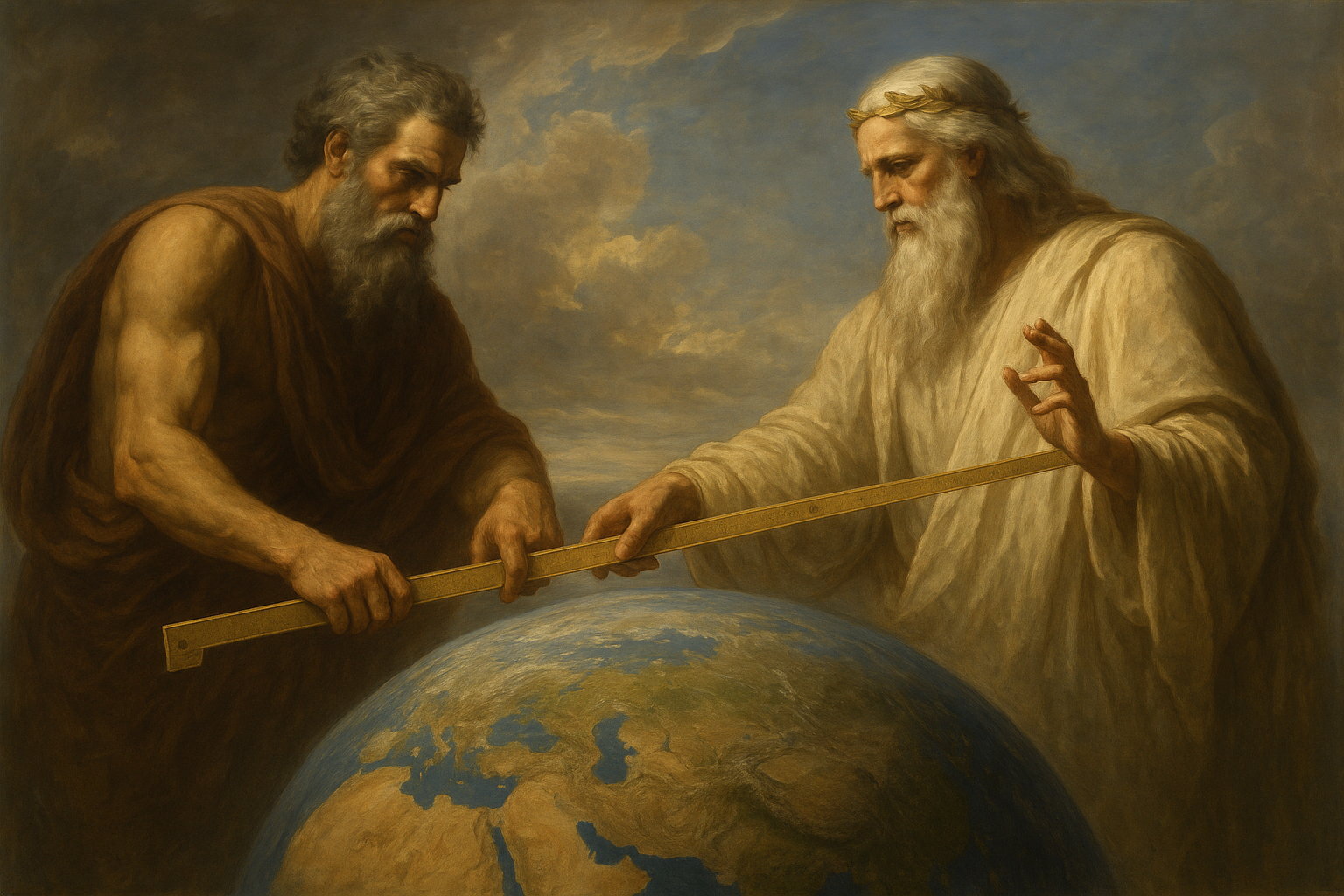
  • When Gods Measured the World – Myth as the first form of science

    When Gods Measured the World – Myth as the first form of science

    When Gods Measured the World: Myth as the First Form of Science

    Throughout history, myths have served as the cornerstone of human civilization, offering explanations for natural phenomena long before the advent of modern science. These stories not only provided comfort and understanding to ancient societies but also laid the groundwork for scientific inquiry as we know it today.

    The Role of Myth in Ancient Societies

    Myths were powerful tools used by ancient cultures to make sense of their environment, human behavior, and the cosmos. The ancient Greeks, for example, attributed natural occurrences to the whims of their pantheon of gods. Thunderstorms were seen as Zeus wielding his mighty thunderbolt, while the changing seasons were explained through the story of Demeter and her daughter Persephone.

    “The universe is full of magical things patiently waiting for our wits to grow sharper.” – Eden Phillpotts

    This quote encapsulates how myths were perceived: as magical narratives awaiting deeper understanding. These narratives laid the theoretical foundations for what would eventually evolve into scientific exploration.

    From Myths to Measurements

    The transition from myth to science was gradual and multifaceted. Many ancient myths contained observational truths that would later be validated by scientific discovery. For instance, the ancient Egyptians’ myth of the Sun God Ra traveling across the sky each day is an early recognition of solar patterns, which would later form the basis of astronomy and timekeeping.

    • Babylonian Astronomy: The Babylonians were amongst the first to record planetary movements, blending mythology with early scientific study. They believed their gods dwelt among the stars, prompting them to meticulously chart celestial bodies.
    • Native American Cosmology: Many Native American tribes used richly metaphorical stories to explain and predict natural events like eclipses and seasonal changes.

    Science as a Successor to Myth

    Some may wonder how myth compares to science in terms of validity and utility. It is crucial to understand that science is, in many respects, a natural successor to myth. While myths relied on narrative coherence and community acceptance, science insists on objective validation and universal applicability.

    According to historian of science, Richard Dawkins, “Science replaces private prejudice with publicly verifiable evidence.” What began as a means of storytelling and cultural transmission would eventually evolve into an empirical method of understanding the universe.

    Cross-cultural Connections and the Scientific Method

    Interestingly, several myths across different cultures suggest a universal quest for knowledge. The Sumerians told of Enki, god of wisdom, who guarded the divine tablet of the Me. Hindus have a similar concept in Saraswati, the goddess of wisdom who resides over knowledge and the arts. These analogous characters point to an intrinsic human desire to understand and measure the world.

    The scientific method, as it developed, was in many ways an organized, goal-oriented continuation of this mythical pursuit of knowledge. It provided a structured way to ask questions, collect data, and draw conclusions—the same processes that myths had informally undertaken centuries before.

    Myth: A Stepping Stone to Enlightenment

    While myths are often relegated to the realm of ancient history, they continue to influence modern culture and inspire contemporary science. Joseph Campbell, a notable scholar of mythology, once remarked, “Myths are public dreams, dreams are private myths.” This perfectly captures how myths and science are intertwined in our continuous effort to chart the unknown.

    Modern-day physicist and cosmologist, Neil deGrasse Tyson, articulates a similar sentiment: “The good thing about science is that it’s true whether or not you believe in it.” Yet, he also acknowledges that myths laid the ground upon which scientific inquiry was built.

    Conclusion

    In revisiting these ancient narratives, we not only gain insight into the development of human understanding but also appreciate the mythological roots of empirical science. Myths were the first form of science, guiding our ancestors’ understanding of the world and inspiring the methods through which we explore it today. In acknowledging this, we learn that the quest for knowledge is as timeless as the stars themselves, eternally linked through stories that measure, explain, and ultimately celebrate the mystery of existence.