Tag: pilgrimage

  • Ecospiritual Pilgrimage

    Ecospiritual Pilgrimage

    Ecospiritual Pilgrimage: A Journey Back to Nature

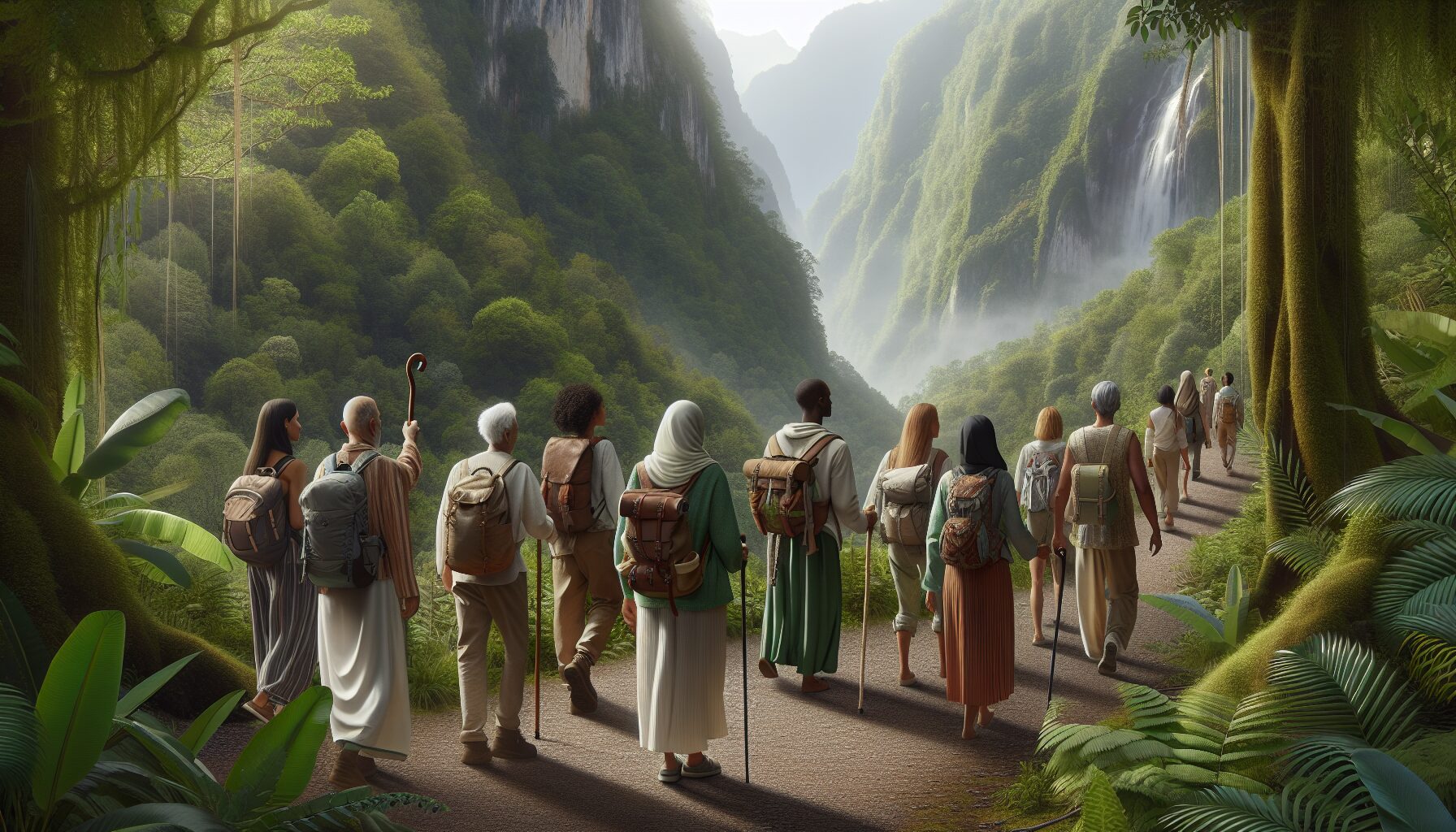
    In the ever-accelerating modern world, the search for meaning and tranquility often drives individuals to seek solace in nature. Ecospiritual pilgrimage is a burgeoning movement that combines this quest for environmental spirituality with a deep reverence for the natural world. It is a journey that transcends mere travel, fostering a profound connection with the earth and the divine.

    Understanding Ecospirituality

    Ecospirituality is a spiritual ideology that integrates ecological awareness with spiritual beliefs. It is derived from the understanding that the earth is interconnected with all living beings, and it encourages a sacred relationship with the environment. As Gottlieb notes in A Greener Faith: Religious Environmentalism and Our Planet’s Future, “Ecospirituality prompts a shift from merely viewing nature as a backdrop to regarding it as an active participant in spiritual practice.”

    The Rise of Eco-Pilgrimages

    Eco-pilgrimages are journeys undertaken with ecological mindfulness, often to sacred natural sites. Unlike traditional pilgrimages, which focus on religious endpoints, ecospiritual pilgrimages emphasize the journey itself, encouraging reflection and mindfulness along the way. As interest in sustainability and environmental stewardship grows, more people are drawn to these journeys.

    “The earth has music for those who listen.”
    – William Shakespeare

    Notable Ecospiritual Destinations

    • The Camino de Santiago, Spain

      The Camino de Santiago is a well-known route with numerous paths, all converging at the shrine of Saint James in Santiago de Compostela. In recent years, it has drawn not only religious pilgrims but also those seeking a spiritual connection with nature. Travelers often speak of the profound spiritual awakenings they experience as they traverse the diverse landscapes of Spain.

    • Mount Kailash, Tibet

      Considered sacred by several religions, including Hinduism, Buddhism, and Jainism, Mount Kailash is both a physical and spiritual challenge. Pilgrims circumnavigate the mountain in a ritual known as the kora, reflecting upon their personal and environmental relationships as they do so.

    • Glendalough, Ireland

      St. Kevin’s monastic site at Glendalough in the Wicklow Mountains is as much a spectacle of natural beauty as it is a historic religious settlement. Surrounded by lakes and forests, it provides an ideal setting for reflective walks and meditations on eco-theology.

    • Uluru, Australia

      A sacred site for the Anangu people, Uluru is not just a geological wonder but a center of spirituality deeply connected to indigenous understanding of the land.

    Preparing for an Ecospiritual Pilgrimage

    Preparation for an ecospiritual pilgrimage involves more than just practical arrangements. Potential pilgrims are encouraged to engage in spiritual preparation, which may include meditation, eco-practices such as tree planting, or reading relevant ecospiritual literature. As author Joanna Macy suggests in A World We Can Trust, “Connecting with the natural world on a spiritual level requires openness, mindfulness, and the willingness to listen.”

    The Transformative Potential of Ecospiritual Pilgrimage

    The nature of an eco-pilgrimage promotes not only personal transformation but also broader ecological consciousness. By stepping away from daily routines and submerging oneself into the natural environment, individuals often gain new perspectives on their relationship with the earth and their impact on it. Pilgrims report feeling a heightened sense of environmental stewardship and a renewed commitment to protecting the natural world.

    Challenges and Considerations

    Eco-pilgrimages, while inspiring, are not without their challenges. The cultural and environmental impact of increased foot traffic on sacred and natural sites is a growing concern. Pilgrims and organizers must strive to ensure that these sacred journeys are sustainable and respectful to host landscapes and communities. Travel operations must focus on minimizing waste, conserving resources, and ensuring that local ecosystems are not disturbed.

    Concluding Thoughts

    Ecospiritual pilgrimage offers a path not only to personal enlightenment but also to environmental advocacy. By embarking on these journeys, individuals embrace the divine in nature and cultivate an increased awareness of their role within the ecosystem. As the ancient proverb states, “When we walk upon the earth, we walk with our ancestors.”

    The growing popularity of ecospiritual pilgrimages reflects a communal awakening to the reciprocity between spirituality and ecology—encouraging each person to nurture an intimate and sacred relationship with the planet.


  • Pilgrimage to Gaia

    Pilgrimage to Gaia

    Pilgrimage to Gaia: Embracing Earth Through Ancient Practices

    In a world progressively drifting towards urban isolation and technological dependence, a heartening movement is awakening among those seeking deeper connection with the Earth. This movement, known as the Pilgrimage to Gaia, is a call to individuals to embrace the planet through spiritual journeys, communion with nature, and revitalized ancient practices. The essence of this pilgrimage is not merely in the physical journey but in cultivating a profound relationship with the Earth, akin to the connection our ancestors once cherished.

    The Roots of Gaia: Ancestral Worship and Modern Revival

    The word “Gaia” originally stems from ancient Greek mythology, representing the primal Mother Earth, the goddess who personified the Earth itself. Today, the Gaia hypothesis popularized by scientist James Lovelock suggests that the Earth functions as a self-regulating, complex system—a living entity with the capacity to sustain itself. This notion has inspired countless environmental movements and spiritual explorations.

    Dr. James Lovelock, in his seminal work, “Gaia: A New Look at Life on Earth”, described Gaia as “…a complex entity involving the Earth’s biosphere, atmosphere, oceans, and soil; the totality constituting a feedback or cybernetic system which seeks an optimal physical and chemical environment for life on this planet.”

    Embarking on the Pilgrimage

    The Pilgrimage to Gaia is not confined to geographical boundaries. It begins in the mind, encouraging pilgrims to embrace practices that foster harmony with nature. Such practices encompass:

    • Meditative Retreats in Nature: Participants spend time in wilderness retreats, immersing themselves in serene landscapes to foster mindfulness and inner peace.
    • Ritualistic Offerings and Ceremonies: Borrowed from indigenous traditions, these rituals are undertaken to honor the Earth and establish a reciprocal relationship.
    • Sustainable Living Workshops: Educational sessions that teach sustainable practices like permaculture, renewable energy, and zero-waste living.

    A Spiritual and Environmental Awakening

    The spiritual journey of the Pilgrimage to Gaia aims to mend the disconnect between modern humanity and the natural world. It draws attention not only to individual well-being but to the plight of our planet, resonating with movements like Deep Ecology which emphasize the intrinsic value of nature. As environmental philosopher Arne Naess urged in his work, “the well-being of non-human life on Earth has value in itself, independent of the usefulness of the non-human world for human purposes.”

    As pilgrims immerse themselves in Gaia’s embrace, they contribute to global conversations on climate change and ecological preservation. The pilgrimage serves as a call to action against practices that harm the environment, urging adherence to lifestyles that coexist with nature rather than exploit it.

    “We are the Earth, through the plants and animals that nourish us. We are the rains and the oceans that flow through our veins. We are the breath of the forests and the voice of the ancestors,” – David Suzuki, geneticist and environmental activist.

    The Communal Spirit of the Pilgrimage

    A key element of the Pilgrimage to Gaia is fostering community. Pilgrims engage in shared experiences, building networks of like-minded individuals dedicated to Earth preservation. Communities rooted in these values often echo the ethos of ancient communal life, emphasizing cooperation, shared resources, and collective responsibility.

    Notable multicultural gatherings such as the Spirit of Nature Festival highlight these communal aspects, bringing together diverse voices and perspectives, all united under the banner of Gaia. Workshops, dialogues, and shared rituals at such events provide participants with tools and insights to carry the pilgrimage’s mission forward.

    Concluding Thoughts: Embracing the Journey

    The Pilgrimage to Gaia is more than a journey—it is an aspiration to weave a new cultural narrative that honors the Earth. As more individuals embark on this pilgrimage, carrying its lessons into their daily lives, there lies a hopeful vision for a world where humanity and Earth coexist harmoniously.

    Through this pilgrimage, individuals are reminded that the path to healing our planet begins within. It is a call to remember that each step taken in reverence to Gaia is a step towards a future where Earth’s beauty is cherished by generations to come.

  • Falun Gong and the New Pilgrimage

    Falun Gong and the New Pilgrimage

    In an era where spirituality often meets modernity, Falun Gong has emerged as a unique blend of ancient practices and contemporary beliefs. Often described as a spiritual movement, Falun Gong, also known as Falun Dafa, offers a path that many consider a modern pilgrimage towards personal enlightenment and holistic health.

    The Origins of Falun Gong

    Falun Gong was introduced to the public in China in 1992 by its founder, Li Hongzhi. It is a practice deeply rooted in the ancient traditions of qigong, which involves meditative exercises and moral teachings. According to the official Falun Dafa website, the practice is “guided by the principles of Truthfulness, Compassion, and Forbearance.”

    The Journey of Practice

    Practitioners of Falun Gong often describe their journey as a pilgrimage—not to a physical destination, but towards spiritual purity and mental clarity. The practice involves a series of exercises and meditation techniques designed to cultivate the body and mind.

    • Five sets of exercises, including meditation, to improve energy flow.
    • Adherence to moral and ethical standards, encapsulated in the core tenets.
    • Study of the teachings through books and lectures, primarily by Li Hongzhi.

    According to a 1999 New York Times article, Falun Gong’s teachings have been said to promote a form of self-improvement that many practitioners find deeply transformative.

    Global Spread and Challenges

    While Falun Gong began in China, it quickly spread to other parts of the world, gaining a significant following. However, its journey has not been without obstacles. In 1999, the Chinese government banned the practice, labeling it a “heretical cult” and launching a campaign against its practitioners. This crackdown led to international outcry and increased global awareness of Falun Gong.

    “Falun Gong is a complex, hybrid belief system that combines moral and spiritual teachings with a regimen of exercises,” noted BBC News.

    A Modern Pilgrimage

    Despite challenges, Falun Gong continues to attract followers worldwide, many of whom view their practice as a personal pilgrimage. For these modern pilgrims, the journey is one of self-discovery and spiritual awakening. In a world increasingly marked by materialism and technological advancement, the simplicity and introspection offered by Falun Gong provide a counterbalance.

    As practitioners gather in parks and public spaces worldwide, their silent, synchronized movements tell a story of resilience and faith. The pilgrimage of Falun Gong is not found on a map but within one’s heart, offering a path of peace and clarity in a complex world.