Tag: path

  • Zen of the Mountain Path – Awakening Step by Step

    Zen of the Mountain Path – Awakening Step by Step

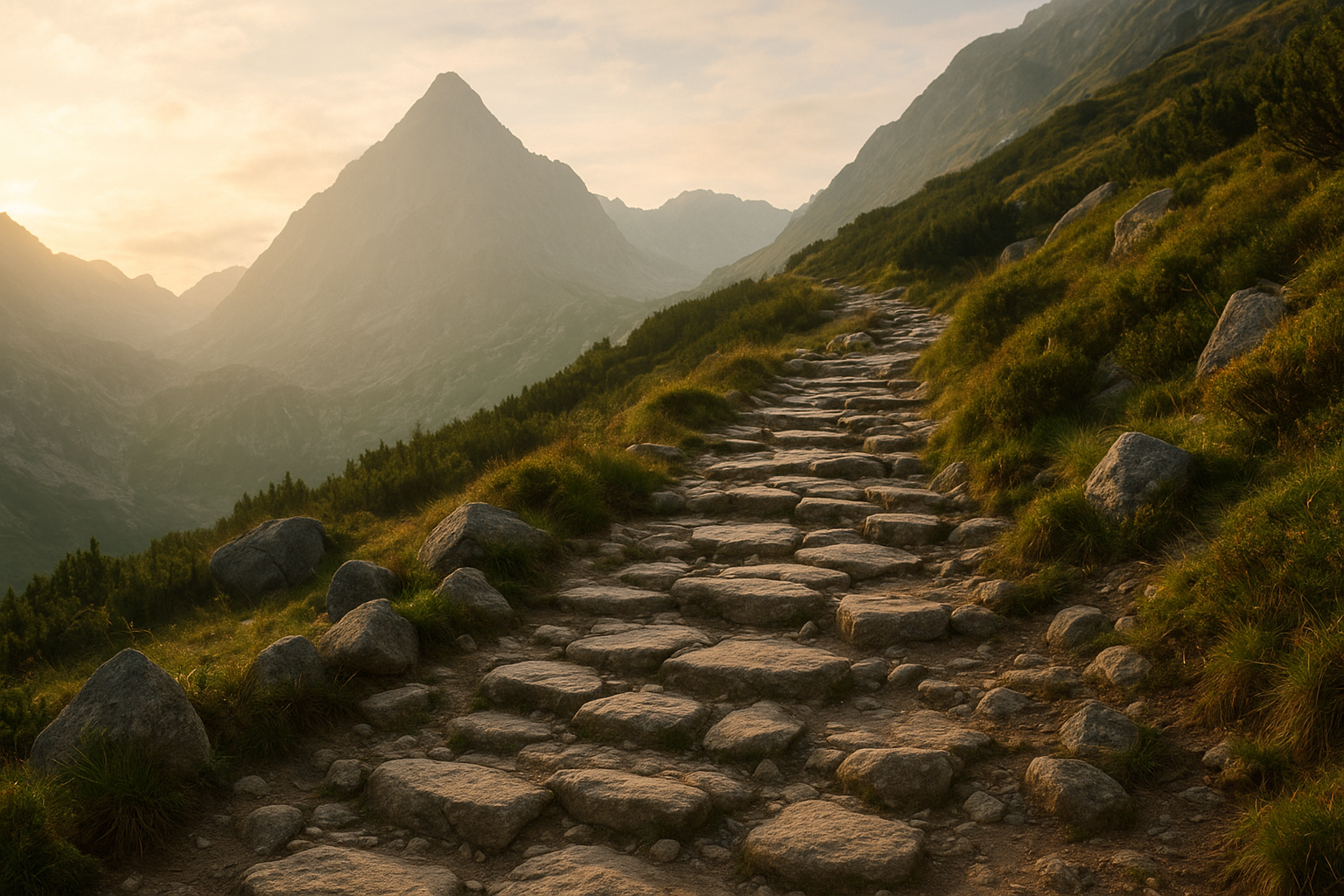
    In the heart of Japan, amidst the silent whisper of pine trees and the ruggedness of unyielding cliffs, lies the Zen path up the revered Mount Koya. This path, winding and steep, is more than just a trail to a picturesque summit. It is a metaphorical journey towards enlightenment, a step-by-step process of awakening that has captured the imagination of many spiritual seekers.

    The Journey Begins

    Every journey up the mountain begins with a single step, much like every journey towards enlightenment. The Zen philosophy teaches us that true enlightenment is not a sudden revelation but rather a gradual awakening, achieved through persistent practice and awareness. The act of climbing, one step at a time, encourages practitioners to focus on the ‘now’, to be present and mindful of each movement.

    “The only Zen you find on the tops of mountains is the Zen you bring up there.” – Robert M. Pirsig

    Meditation, an integral part of Zen practice, finds a perfect partner in the act of walking up a mountain. Many who embark on this pilgrimage engage in walking meditation, a practice that combines the physical act of walking with meditative awareness. This activity demands concentration on the rhythm of footsteps, the breath, and the sensations of the body.

    Lessons of the Path

    • Acceptance of the Present: The mountain path compels acceptance of the present. The challenges of the climb mirror the difficulties of life, teaching us to accept situations with grace and patience.
    • Perseverance: Like life, the mountain presents obstacles. Each step requires endurance and resilience—a lesson in perseverance.
    • Humility: The vastness of the mountain against our human scale induces a humility in the climber, fostering a greater sense of interconnectedness with the world.

    Nature’s Silence and the Inner Voice

    As one ascends further up the path, the noise of the world falls away. This departure from the mundane allows climbers to tune into their inner voice. In Zen, this is a crucial aspect of understanding one’s Buddha-nature. The silence of nature is profound, encouraging introspection and self-awareness.

    Zen monks have long used secluded environments, such as mountains, to cultivate a deeper understanding of their own minds. The great Zen master Dogen Zenji once said, “To study Buddhism is to study the self. To study the self is to forget the self.” The mountains become a student’s life-long mentor, revealing the secrets of the self to those who are willing to listen.

    Reaching the Summit

    Arriving at the summit of Mount Koya, climbers are rewarded not just with breathtaking views but with the profound satisfaction of having completed a spiritual journey. This summit is not the end but rather another beginning—a place to reflect on the journey and prepare for the descent.

    In Zen, the descent is as important as the climb. It symbolizes bringing the gained insights and wisdom back to the ordinary world. The essence of Zen practice lies in carrying the peace of the mountains into the bustle of everyday life.

    Conclusion

    The Zen of the mountain path is a potent reminder of life’s ephemeral nature. It teaches us the value of each step, the importance of the journey over the destination, and the endless process of awakening that life itself presents. As with any good Zen practice, it encourages one to be at peace with the path beneath their feet, no matter how rocky it may be. In the eloquent words of Jack Kerouac, from his writings in The Dharma Bums, “One day I will find the right words, and they will be simple.” The mountain path gives us a glimpse into that simplicity through each deliberate, mindful step.


  • No Temple, No Path – The Zen of Homelessness and Belonging

    No Temple, No Path – The Zen of Homelessness and Belonging

    No Temple, No Path: The Zen of Homelessness and Belonging

    In a world driven by the pursuit of permanence and identity, the notion of homelessness is often viewed as a deficiency. We all crave a place to call home, a sanctuary that anchors us. Yet, for many adherents of Zen Buddhism, the path to enlightenment lies in embracing impermanence and the true nature of existence without fixed attachments. This is exemplified by the concept of No Temple, No Path, a philosophy that explores the intersection of homelessness and a sense of belonging in Zen practice.

    The Zen Garden Without Walls

    Zen Buddhism, which originated as a distinct school in China before spreading to Japan and beyond, emphasizes direct experience and living in the present moment. Its teachings encourage a detachment from material possessions and the traditional markers of success.

    “The whole moon and the entire sky are reflected in one dewdrop on the grass” — Dogen Zenji, founder of Soto Zen in Japan.

    In traditional Zen teaching, there is no need for a physical temple to practice. Instead, the world itself becomes a boundless monastery where every rock, tree, and stream is an object of contemplation. This perspective removes the physical boundaries of practice, fostering a sense of spiritual freedom and unlimited exploration.

    Homelessness as Liberation

    For Zen monks, traditional homelessness is not simply a lack of shelter, but rather a profound liberation from worldly attachments. Monks often renounce worldly possessions to follow the Buddha’s example, seeking the divine within themselves and the universe.

    • Sesshin: Intense meditation sessions that symbolize a temporary renunciation of the world.
    • Kesa: The monk’s robe, representing both poverty and the acceptance of impermanence.
    • Takuhatsu: The act of mendicancy or begging, symbolizing a monk’s reliance on the kindness of others, highlighting the interconnectedness of all beings.

    Through these practices, monks cultivate a deep understanding of the non-duality of existence. By detaching from physical possessions, they come to realize that true security and belonging stem from an inner state of tranquility and wisdom.

    Embracing the Void

    At the heart of the Zen practice is the understanding that life is transient and all worldly attachments are ephemeral. The idea of homelessness is thus reclaimed as a profound state of spiritual awareness. In his book When Things Fall Apart, renowned Buddhist nun Pema Chödrön suggests embracing uncertainty in our lives:

    “We think that the point is to pass the test or to overcome the problem, but the truth is that things don’t really get solved. They come together and they fall apart.”

    By acknowledging the natural ebb and flow of life, Zen practitioners find peace in the void. Through mindfulness practices like zazen (sitting meditation) and kinhin (walking meditation), they learn to be comfortable with uncertainty, much like waves that lap upon the shifting shores of existence.

    The Ubiquity of Belonging

    Belonging, in the Zen tradition, is not about possessing a particular place or identity, but rather recognizing one’s connectedness with all life. This universal belonging is expressed through compassion (karuna) and loving-kindness (metta), essential elements of the Zen path.

    To be homeless in the Zen sense is to walk a path defined not by the places you inhabit, but by your relationships with others and the world. It is the realization that wherever you are, you are never truly alone, but a part of the greater tapestry of existence.

    Conclusion

    The Zen philosophy of No Temple, No Path challenges us to reconsider our understanding of home and belonging. It invites us to see that perhaps our true home is not a place, but a state of being—one that is open, free, and universally connected.

    As we navigate a world that often seems fractured and homeless, let us remember that the true essence of belonging lies within us. By embracing the Zen of homelessness, we can find serenity amid chaos and build a compassionate bridge to others, no matter where we find ourselves.

  • The Pilgrim of Emptiness – A Journey Without Arrival

    The Pilgrim of Emptiness – A Journey Without Arrival

    The Pilgrim of Emptiness – A Journey Without Arrival

    The Pilgrim of Emptiness – A Journey Without Arrival

    In a world of constant movement and ambition, a peculiar traveler chooses a path less traversed, embracing the void and finding meaning in the absence of a destination.

    The Beginning of the Journey

    In the realm of Anderia, where horizons stretch endlessly beyond the eye’s grasp, a solitary figure walks a path defined by the sands left unstepped. Known only as the Pilgrim of Emptiness, this wanderer is a ghostly tapestry woven from the threads of silence and shadow. While most inhabitants of Anderia toil endlessly toward futures filled with golden promises, the Pilgrim is driven by an absence of objectives, a traveler who chases the intangible essence of nothingness.

    The Philosophy of Emptiness

    The Pilgrim’s journey is not one of destinations but of notions esoteric and profound. Embracing the philosophies of ancient sages, who once whispered of the void’s beauty, the Pilgrim explores realms where the absence of substance provides clarity. In the words of Lao Tzu, “

    To the mind that is still, the whole universe surrenders.

    ” It is this stillness that the Pilgrim seeks, a path where the whispers of empty wind carry the wisdom of eons.

    Encountering the Guardians of Purpose

    Throughout the journey, the Pilgrim encounters the Guardians of Purpose, beings fashioned from aspirations and intentions. These enigmatic entities are bound to their purpose with an intensity that burns like unquenchable fire. Many travelers aspire to harness the guidance of these guardians, for they grant clarity in pursuit. Yet, to the Pilgrim, their presence is a reminder of shackles unseen. “What is a path without a beginning or end?” the guardians ask, and the Pilgrim simply replies with a gentle smile, an acknowledgment of their differing existences.

    The Midnight Lake

    One of the Pilgrim’s notable sojourns leads to the shores of the Midnight Lake, a mirror-like expanse that reflects the galaxies above in crystal-clear detail. Here, in the depths of starry reflections, the Pilgrim finds solace and meditation. Legends tell that within its waters lies the essence of time itself, paradoxically still yet ever flowing. It is here that the Pilgrim contemplates the paradox of movement—that even in emptiness, one finds the ceaseless motion of the cosmos.

    Lessons From the Void

    • Embrace Nothingness: In embracing the void, the Pilgrim teaches us the importance of letting go. Where grasping leads to chains, releasing leads to freedom.
    • Find Stillness: To pause is to understand. Just as a pond only reflects perfectly when it is still, so too can the mind show truth when undisturbed.
    • Accept Impermanence: As the Pilgrim walks on, so does the landscape change with the passage of time, a reminder of the ever-evolving world.

    The Path Beyond

    Though the Pilgrim’s journey may appear to lack resolution, it is, in essence, an infinite journey, one without a guiding star nor a rearview mirror. The story of the Pilgrim of Emptiness invites us to ponder the significance of our own paths—whether it is the destination or the journey itself that defines our walk through life.

    As the Pilgrim fades into the endless horizon, we are left with the gentle words of the sage: “

    The journey of a thousand miles begins with one step.

    ” And so it does, in pursuit of the emptiness that is rich with its own treasures, the Pilgrim continues—with no destination but infinite discoveries along the way.

    To understand the duality of pathways both walked and untraveled is to embrace the emptiness of the world as part of a greater entirety. Indeed, the Pilgrim shows us that sometimes, arrival is an illusion, and it is in the deliberate act of wandering that we find our true selves.

  • Path of Clouds – Letting the Journey Be the Destination

    Path of Clouds – Letting the Journey Be the Destination

    Path of Clouds: Letting the Journey Be the Destination

    The environment we live in serves as more than just a backdrop to our lives; it is a continuous journey that invites us to explore and appreciate the world in motion. The path of clouds is a poetic reminder that sometimes the journey itself holds more significance than the destination.

    The Beauty in Transience

    Clouds are ever-changing and offer a unique perspective on transience and dynamism. As John Muir once said,

    “The clearest way into the Universe is through a forest wilderness.”

    Similarly, observing clouds can open our minds to the beauty of the ephemeral and the power of nature’s ongoing processes. Each formation and pattern tells a story of movement, transition, and transformation, urging us to find stillness within ourselves to appreciate this ever-evolving canvas.

    A Lesson on Presence

    Cloud-gazing offers a profound lesson in staying present. In today’s fast-paced world, it’s easy to get caught up in reaching our goals while missing out on the moments that make the journey worthwhile. By taking the time to observe the clouds, we learn to savor life’s moments, no matter how fleeting or subtle they might be.

    Inspiration and Imagination

    • Creativity: Clouds often inspire artists, writers, and dreamers. Their abstract shapes and ethereal movements spark creativity and fuel imagination.
    • Imagination: The human tendency to see shapes and figures in clouds, known as pareidolia, provides endless possibilities for stories and interpretations.
    • Peace of Mind: Watching the clouds drift can also offer peace of mind and a reminder that, like clouds, thoughts and situations in life are temporary.

    Embracing the Journey

    Letting the journey be the destination is about embracing the unpredictability of life and finding meaning in the experience of moving through it. It’s about focusing less on where we are going and more on exploring the scenic routes that lead us there. Consequently, it aligns with the deeper understanding that every occurrence, much like each cloud, has a purpose in shaping who we are and who we become.

    Next time you find yourself hurriedly moving through your day, take a moment to look up. Let the clouds remind you of the path you’re on and the journeys yet to come. Embrace the moment, for it is not the finish line that enriches us, but the steps we take along the way.

  • The Way of Returning – Tracing the Path Back to Source

    The Way of Returning – Tracing the Path Back to Source

    The Way of Returning – Tracing the Path Back to Source

    The Way of Returning: Tracing the Path Back to Source

    “The journey of a thousand miles begins with one step.” – Lao Tzu

    The concept of returning to one’s source is an ancient idea, explored in various cultures and philosophies around the world. It speaks to a universal longing within the human spirit—a desire to reconnect with our beginnings, whether that’s an ancestral home, a spiritual origin, or simply a return to a state of simplicity and peace. As the modern world grows increasingly complex, the attraction of tracing this path back to our roots becomes ever more compelling.

    The Philosophical Underpinnings

    Throughout history, many philosophies and spiritual traditions have emphasized the importance of returning to the source. In Daoism, the notion of wu wei or non-action implies a flow that aligns with the natural order of the universe, suggesting a return to a more primal, untainted state of being. As Lao Tzu also said, “Knowing others is intelligence; knowing yourself is true wisdom. Mastering others is strength; mastering yourself is true power.”

    In Hindu philosophy, the concept of moksha represents liberation from the cycle of birth and death, signifying a return to the divine source. Similarly, in Buddhism, the attainment of Nirvana implies a return to an original, enlightened state, freed from the attachments and illusions of the world.

    “We are not human beings having a spiritual experience; we are spiritual beings having a human experience.” – Pierre Teilhard de Chardin

    Modern Interpretations

    In today’s fast-paced world, the yearning for a return to source is often manifested in trends like minimalism, ecological awareness, and movements such as The Slow Movement. These modern interpretations reflect a collective desire to strip away the excess and complexity of contemporary life, seeking a more meaningful and authentic existence.

    Minimalism encourages individuals to remove clutter not only from their physical spaces but also from their minds and schedules. By doing so, they aim to live a life driven by purpose, free from the distractions of material possessions and unessential commitments.

    • Minimalism: Removing the unnecessary to focus on what truly matters.
    • Ecological Awareness: Reconnecting with the planet to heal and sustain our natural environment.
    • Mindfulness and Meditation: Practices that bring us closer to our true selves and the present moment.

    The Path to Self-Discovery

    Tracing the path back to source is inherently a journey of self-discovery. It involves peeling back layers of conditioning and societal expectations to reveal our innermost selves. It’s about asking the essential questions: Who am I? What is my purpose? How do I align my life with my deepest values?

    One tool to facilitate this journey is meditation. By quieting the mind, meditation offers a glimpse into the core of our being. As the Indian philosopher Jiddu Krishnamurti stated, “Meditation is not a means to an end. It is both the means and the end.” Through meditation, individuals can experience a profound sense of peace and unity with the universe, aligning their personal energies with the greater cosmic flow.

    Challenges and Rewards

    While the desire to return to source is strong, the path is not without its challenges. The journey can be fraught with doubts, distractions, and the ever-present pull of modern life’s demands. However, those who persevere often find profound rewards: a deepened sense of peace, clarity, and connection to something greater than themselves.

    These newfound insights often translate into a more balanced and fulfilling life. As individuals reconnect with their true selves and their environment, they discover the joy of living in harmony with the world and the people around them.

    Final Reflections

    Returning to source is a deeply personal journey, unique to each individual’s experiences and spiritual understanding. Whether through philosophy, meditation, minimalism, or ecological awareness, the path is as varied as those who embark upon it. Yet, the underlying principle remains the same: the quest for authenticity, simplicity, and unity with the essence of life.

    As we continue to navigate the complexities of modern existence, the stories and teachings of those who have walked the path before us serve as invaluable guides. They remind us that, at the core of our humanity, lies a longing to return to the beginning—a sacred place where we are truly at home.

    In the words of the renowned poet T.S. Eliot, “We shall not cease from exploration, and the end of all our exploring will be to arrive where we started and know the place for the first time.”

  • The Pathless Path – Traveling Without Destination in the Spirit of Dao

    The Pathless Path: Traveling Without Destination in the Spirit of Dao

    The desire to travel and explore is intrinsic to human nature. Throughout history, people have set out on great journeys—some to discover new lands, others in search of wisdom, and many more for the sheer joy of adventure. Among these travelers, some choose to embark on journeys without a fixed destination, embracing a concept deeply rooted in Daoist philosophy.

    Embracing the Dao

    Daoism, an ancient Chinese philosophy attributed to Laozi, emphasizes living in harmony with the Dao, which can be translated as “the Way.” Central to this philosophy is the idea of going with the flow of life, embracing uncertainty, and finding contentment in the present moment. Juxtaposed with the modern obsession with goals and performance, Daoism offers a refreshing perspective on travel.

    Laozi famously stated, “A good traveler has no fixed plans, and is not intent on arriving.” This suggests a form of travel where the journey itself is the destination, and where the traveler is open to whatever experiences unfold along the way.

    The Journey Over the Destination

    Embracing a “pathless path” means being open to spontaneity, allowing intuition to guide you rather than a fixed itinerary. This way of traveling can lead to unexpected encounters, deeper connections with the places visited, and a richer appreciation for the diversity of experiences life has to offer.

    • Freedom from Anxiety: Without a rigid plan, travelers can experience freedom from the anxiety usually associated with delays and changes in schedule.
    • A Deeper Connection with the Environment: Staying open to the present moment allows travelers to truly experience their surroundings, from natural landscapes to vibrant cultures.
    • Personal Growth: As travelers adapt to new situations, they often discover more about themselves and their capacities for resilience and adaptability.

    The Modern-Day Pilgrim

    Many modern travelers seek to emulate the pathless path approach in their own way. Resources like spiri.ai offer guidance on how to integrate the principles of spontaneous travel into one’s life. Furthermore, communities of like-minded wanderers encourage and support those seeking a deeper connection with the world through purposeful aimlessness.

    “To be uncertain is to be uncomfortable, but to be certain is to be ridiculous.” – Chinese Proverb

    In essence, the spirit of the pathless path invites us to release our attachments to outcomes and be fully present—a lesson that extends well beyond the realm of travel. By weaving Daoist principles into our journeys, we can rediscover the magic of wandering, letting the world surprise us with its infinite possibilities.

  • Sacred Nomad Codes

    Sacred Nomad Codes

    Sacred Nomad Codes: A Journey Through the Philosophy of Wandering

    Introduction: The Call of the Open Road

    The allure of the open road has always captivated the human spirit. As a species, we’ve been wanderers, driven by curiosity, survival, and the search for meaning. This inherent desire to navigate the world and our existence within it can be encapsulated in the concept of the “Sacred Nomad Codes”—a philosophy that promotes wandering not just as a physical journey, but as a spiritual and existential quest.

    The Philosophy of Sacred Nomadism

    Sacred Nomadism is not just about travel; it is a mindset that embraces uncertainty, impermanence, and the transformative power of exploration. It suggests that life’s greatest answers lie not in the destination, but in the journey itself.

    Key Tenets of Sacred Nomadism

    • Embrace Impermanence: Like the nomads who traverse the deserts, Sacred Nomads understand that change is the only constant. Philosopher Heraclitus once said, “You cannot step into the same river twice,” highlighting the ever-changing nature of life.
    • Seek Meaning Over Material: True wealth for a Sacred Nomad is found in experiences and personal growth rather than material possessions.
    • Live Authentically: Authentic living involves being true to oneself and one’s journey, refusing to be bound by societal expectations.

    The Spirituality of Wandering

    Sacred Nomadism incorporates spiritual perspectives from various traditions, offering a rich tapestry of beliefs and practices that emphasize inner exploration alongside outward journeying. Consider this observation from Marcus Aurelius: “Nowhere can a man find a quieter or more untroubled retreat than in his own soul.” The nomadic path is as much an inward journey as it is an outward one.

    The Nomadic Spirit in Different Cultures

    • Indigenous Perspectives: Many indigenous societies view life as a sacred journey, where movement is essential to connecting with nature and understanding one’s place in the universe.
    • Sufi Mysticism: In Sufism, the metaphor of the journey is prominent. The spiritual path is likened to a desert traverse, seeking union with the divine, reflecting the nomadic spirit of always moving towards a greater truth.
    • Buddhism: Often referred to as the ‘Middle Way’, Buddhism encourages a journey of moderation, avoiding extremes and embracing the path of self-discovery fueled by mindfulness and alertness.

    “To travel is to take a journey into yourself.” — Danny Kaye

    Nomadism in a Modern Context

    In today’s digital age, the concept of nomadism has evolved. The rise of the “digital nomad” reflects a new manifestation of this ancient tradition, infusing the age-old practice of wandering with modern technology’s conveniences.

    Challenges and Opportunities

    Modern nomads face unique challenges such as legal, financial, and logistical hurdles. However, the opportunities to experience global cultures and diverse perspectives have never been greater.

    • Remote Work: The ability to earn a living remotely has empowered many to embrace a nomadic lifestyle, combining work and travel in ways previously unimaginable.
    • Cultural Exchange: Exposure to diverse cultures expands understanding and fosters empathy, encouraging a more interconnected and harmonious world vision.
    • Personal Enrichment: Each destination provides a unique opportunity for growth, learning, and self-discovery, aligned with the tenets of Sacred Nomadism.

    Concluding Thoughts: The Eternal Journey

    The Sacred Nomad Codes remind us that life’s true purpose can often be discovered on the way, not at the end. Nomadism, both ancient and modern, invites us to explore, learn, and evolve continually. In the words of Jack Kerouac, “The road is life.”

    By embracing the path of a Sacred Nomad, we acknowledge that each journey holds the potential for transformation, offering a chance to unravel the mysteries of the world—and ourselves—with each step we take.

  • Walking the Invisible Path

    Walking the Invisible Path

    In the vast realms of fantasy literature and myth, the concept of an invisible path has captured the imaginations of storytellers and audiences alike. This ethereal journey is often more about inner discovery and growth than the physical progression of steps. Just as much a metaphorical journey as a physical one, the invisible path represents a profound quest for truth, enlightenment, and purpose.

    “It is not in the stars to hold our destiny but in ourselves,” William Shakespeare once remarked, highlighting the intrinsic voyage of the self, a central theme to the invisible path.

    The Allure of the Invisible Path

    The idea of traversing an unseen route is appealing because it implies a venture into the unknown, promising a transformation of one’s perspective or sense of self. It offers a narrative ripe with mystery and the potential for discovering hidden truths. This concept is seen across many cultures and literary traditions, often symbolizing the transition from ignorance to enlightenment.

    • Mythological Roots: Many cultures include tales of hidden paths. In Japanese mythology, the Kami or spirits live unseen among humans, often approached through paths known only to the wise.
    • Literary Exploration: Authors like C.S. Lewis in his Chronicles of Narnia series, explore these paths to great effect. The wardrobe in The Lion, the Witch and the Wardrobe serves as an invisible portal to another world.
    • Philosophical Undertones: Such paths are frequently used as symbols for philosophical introspection and spiritual teachings, as seen in works like Hermann Hesse’s Siddhartha.

    Symbolism in the Unseen

    The invisible path is rich with symbolism, often acting as a metaphor for events or stages of life that are not immediately apparent but have a profound effect on our being. Such paths teach us that real change often occurs internally before it is manifested externally, a concept echoed in many spiritual teachings.

    “Not all those who wander are lost,” J.R.R. Tolkien famously wrote in The Lord of the Rings, implying that even paths that aren’t clearly visible lead to discovery and meaning.

    Historical Perspectives

    History is filled with stories of individuals and cultures who have embarked on journeys both physical and spiritual through invisible paths. These journeys often require them to seek knowledge beyond what is seen, to venture into realms of understanding not easily accessible.

    • Spiritual Pilgrimages: Many ancient traditions have paths that are both literal journeys and moral guidelines, such as the routes to sacred sites in pilgrimages.
    • Vision Quests: Native American tribes practice vision quests, where young individuals embark on a solitary journey to seek guidance and knowledge, often traversing unseen spiritual paths.
    • The Alchemist’s Journey: In Paulo Coelho’s The Alchemist, the protagonist Santiago follows a path defined by dreams and omens, illustrating the invisible journey toward one’s ‘Personal Legend’.

    The Invisible Path in Modern Context

    In today’s world, the concept of the invisible path may seem anachronistic, but it remains relevant, especially in personal development and self-discovery. Modern life offers countless invisible paths of its own, often in the form of choices that lead to unexpected growth and opportunities.

    • Career Paths: In the professional world, individuals often find themselves on careers paths that are not linear but invisibly winding, leading to innovations and breakthroughs.
    • Personal Growth: The journey of personal growth is deeply intertwined with the invisible path, as individuals often seek growth and betterment in ways that are not immediately visible to others.
    • Spiritual Growth: Many people engage in meditation and mindfulness practices to navigate their own invisible paths toward spiritual awakening.

    Conclusion

    The allure of the invisible path lies in its universality and deep roots in human culture and consciousness. It symbolizes both the journey and the mystery of life itself. As we move through the myriad experiences that define our existence, the invisible paths we choose determine the tapestry of our lives, guiding us toward unknown possibilities and inner transformations.

    In embracing the path that cannot be seen or easily understood, we embrace the potential within ourselves to change, to grow, and ultimately to find our place in the world. The invisible path is not just a route—it’s a life’s journey, full of wonder and discovery.

  • The Pathless Path

    The Pathless Path

    The concept of a “pathless path” suggests a journey without a predetermined course, embracing uncertainty and the unknown. This idea has been explored in various spiritual and philosophical traditions, encouraging individuals to find their unique way rather than following a prescribed route.

    The Philosophy of the Pathless Path

    In the realm of philosophy, the pathless path challenges the notion of linear progression. It suggests that life is not a straight line but a series of experiences that do not necessarily follow a logical sequence. This idea resonates with the writings of Jiddu Krishnamurti, a philosopher and spiritual teacher who believed that truth is a pathless land. He stated:

    “Truth is a pathless land, and you cannot approach it by any path whatsoever, by any religion, by any sect.”

    Krishnamurti’s teachings emphasize the importance of self-discovery and understanding without relying on external authorities or established doctrines. He encouraged individuals to break free from societal constraints and discover their paths through personal reflection and insight.

    Embracing Uncertainty

    The pathless path is inherently about embracing uncertainty. In a world that often values certainty and predictability, stepping into the unknown can be daunting. However, it is this very uncertainty that allows for growth and transformation. As Alan Watts, a British writer and speaker known for interpreting Eastern philosophy, eloquently put it:

    “The only way to make sense out of change is to plunge into it, move with it, and join the dance.”

    Watts’ perspective highlights the beauty of embracing change and the fluid nature of life. By accepting that there is no fixed path, individuals can explore new possibilities and experiences without fear of failure or judgment.

    Finding Meaning in the Pathless Path

    While the pathless path may seem directionless, it holds the potential for profound meaning. It invites individuals to seek their purpose and passions, rather than adhering to societal expectations. This journey is deeply personal and can lead to a more authentic and fulfilling life.

    The pathless path often involves a process of unlearning and letting go of preconceived notions. It requires courage to question norms and venture into uncharted territory. As Ralph Waldo Emerson famously said:

    “Do not go where the path may lead, go instead where there is no path and leave a trail.”

    Emerson’s words encourage the pursuit of individuality and the creation of one’s trail. By doing so, individuals contribute to the richness and diversity of human experience.

    Conclusion

    The pathless path is a journey of self-discovery, growth, and exploration. It challenges individuals to embrace uncertainty and seek meaning in their lives, free from societal constraints. By choosing the pathless path, one embarks on a transformative journey that can lead to a deeper understanding of themselves and the world around them.