Tag: myth

  • The Myth of Hustle and the Reality of Breakdown

    The Myth of Hustle and the Reality of Breakdown

    The Myth of Hustle and the Reality of Breakdown

    In today’s fast-paced, results-driven society, the concept of “hustle” has become a revered mantra. Many people believe that with enough hard work, determination, and grit, they can achieve their goals and overcome any obstacle. However, this myth of hustle can have devastating consequences when it’s not balanced with self-care, empathy, and understanding.

    • Amy Morin, a clinical psychologist and author, notes: “The hustle culture is based on the idea that we’re all just one big competition. It’s like, if you’re not constantly pushing yourself to be better, faster, stronger, more successful… then what are you doing?”
    • But what happens when this relentless pursuit of success leads to burnout and breakdown?
    • As Dr. Morin continues:
      • “When we’re constantly pushing ourselves, our bodies are getting tired, our minds are getting tired… and we start to feel like we’re just going through the motions.”

    It’s not uncommon for people to ignore the warning signs of exhaustion and stress, convinced that they can simply “power through” and continue on their path. But this denial can have severe consequences, including:

    • Mental health issues such as anxiety and depression
    • Physical symptoms like chronic pain, insomnia, and digestive problems
    • A weakened immune system, making us more susceptible to illness
    • A breakdown in relationships and social connections

    “We need to stop glorifying hustle and start glorifying rest,” says Dr. Morin. “Because when we’re rested, we’re able to think more clearly, make better decisions, and be more productive.”

    The reality is that breakdowns are inevitable. No one can maintain the relentless pace of hustling 24/7 without consequences. It’s essential to recognize the signs of burnout and take proactive steps to prioritize self-care, seek support, and redefine what success means to us.

    “If you’re not taking care of yourself, you won’t be able to take care of others,”

    says Dr. Morin.

    As we reframe our understanding of hustle and the importance of balance, let’s remember that Amy Morin’s words: “We’re not just competing with others; we’re competing with ourselves. We’re trying to be better than we were yesterday.”

    References:

  • Reality Is Not Enough – Why humans generate myth

    Reality Is Not Enough – Why humans generate myth

    The human fascination with myth is as ancient as civilization itself. From the epic tales of Gilgamesh to modern-day superheroes, myths have been woven into the fabric of human culture. But why do humans generate myth? What compels us to create stories that transcend the boundaries of reality?

    The Role of Myths in Understanding the World

    Cultural Anthropologist, Claude Lévi-Strauss, suggested that myths serve as tools to mediate the world around us. In his seminal work, “The Raw and the Cooked”, Lévi-Strauss explained that myths help societies make sense of contradictions inherent in the natural world. By creating narratives that explore these tensions, myths enable people to reconcile differences between humanity and nature, life and death, and chaos and order.

    “Myths are part of the human desire to understand the world and impose order on the chaos of life.”

    — Claude Lévi-Strauss

    Psychological Needs and Myth Making

    The psychologist Carl Jung introduced the concept of archetypes to explain the universal elements found in myths across different cultures. In his view, these archetypes reside in the collective unconscious and manifest through myths and dreams, each echoing a deeper truth about the human psyche. According to Jung, myths serve to connect us to these shared symbols, providing a framework for understanding our own experiences and emotions.

    “The creation of something new is not accomplished by the intellect but by the play instinct acting from inner necessity.”

    — Carl Jung

    Myths as Social Tools

    Beyond understanding the world and ourselves, myths also play a crucial role in shaping social orders and ethics. Legends and fables often carry moral lessons or cultural values, instilling them across generations. In societies, myths can act as a unifying force, fostering a sense of identity and shared purpose.

    • Myths establish historical continuity.
    • They create common ground for communal values and beliefs.
    • Myths can legitimize social institutions and hierarchies.

    The Timeless Appeal of Myths

    In an ever-evolving world, where technological advancements continuously reshape our environment, myths offer a comforting touchstone. They provide a narrative continuity that grounds us amidst change, linking the past with the present and the unknown future. As long as human imagination persists, so too will the creation of myths—affirming that reality, while significant, is not enough.

    For further exploration of how myths continue to influence modern society, consider reading Joseph Campbell’s “The Hero with a Thousand Faces”, where he delves into the monomyth structure that dictates so many of our beloved stories.

  • Myth and Meaning in the Age of Metrics – Living beyond dashboards

    Myth and Meaning in the Age of Metrics – Living beyond dashboards

    “Not everything that can be counted counts, and not everything that counts can be counted.” ― William Bruce Cameron

    In today’s data-driven world, where metrics and dashboards reign supreme, there is a growing concern about the limitations of quantifying every aspect of our existence. In the quest for optimization, businesses and individuals alike rely heavily on numbers to guide decisions and actions. But as we become more dependent on these metrics, it’s essential to ask: What do we lose when we ignore the myth, meaning, and stories that transcend numbers?

    The Lure of Quantification

    The allure of metrics is undeniable. With the aid of digital dashboards, we can track progress, identify efficiencies, and make data-informed decisions. The business sector, in particular, reveres metrics as the ultimate tools for performance evaluation. Key Performance Indicators (KPIs), return on investment (ROI), and engagement rates have become the new lingua franca.

    However, this obsession with quantification often comes at the cost of ignoring the qualitative aspects that enrich our lives. The mythic dimension of human experience, laden with narratives and symbols, offers depth that can’t be reduced to a mere number.

    The Power of Myth and Meaning

    • Symbols Speak Volumes: Mythological symbols and stories provide a shared framework that transcends cultures and generations. Carl Jung noted the idea of the collective unconscious, which taps into the deeper meanings embedded in our psyche.
    • The Narrative Imperative: Narratives give context and meaning to our actions. As anthropologist Clifford Geertz famously stated, “Man is an animal suspended in webs of significance he himself has spun.”
    • Resilience through Storytelling: Stories have the power to transform adversity into resilience. Unlike metrics that can dehumanize, storytelling humanizes, providing a blueprint for navigating life’s complexities.

    Living Beyond Dashboards

    Embracing myth and meaning doesn’t mean abandoning metrics—rather, it requires integrating quantitative data with qualitative insights. This melding of worlds can produce a more holistic understanding of life’s complexities. For individuals and businesses alike, balancing these realms could mean reimagining what success looks like beyond the numbers.

    As the world becomes increasingly reliant on digital dashboards, we must remind ourselves to look beyond them to the myths and narratives that define our humanity. Living fully means accepting the richness of life that can’t always be captured by metrics. In an age obsessed with numbers, let’s not forget the stories that continue to shape our reality.

  • Sacred Stories in a Secular World – Myth after belief

    Sacred Stories in a Secular World – Myth after belief

    In a world that increasingly embraces secularism, the role of sacred stories—myths, legends, and religious narratives—seems to transform. Although fewer people today might adhere to these stories as literal truths, their cultural and psychological significance remains undeniable. As Joseph Campbell, the renowned mythologist, famously said,

    “Myths are public dreams, dreams are private myths.”

    This statement underscores the intertwined nature of societal narratives and individual consciousness.

    The Evolution of Myth

    Myths once served as the foundation for understanding the cosmos and humanity’s place within it. Ancient myths provided explanations for the inexplicable, painting narratives that articulated the morals, values, and existential queries of societies long past. In a more secular context, however, these stories are often scrutinized through the lens of history and science. Does this mean that the age of myth is over, or has it simply evolved?

    Modern Usage and Interpretation

    Today, myths are often reimagined through literature, film, and art. Our modern stories, from superhero sagas to science fiction epics, echo the themes found in ancient tales—good versus evil, the hero’s journey, and the quest for identity. Christopher Vogler, in his work The Writer’s Journey: Mythic Structure For Writers, adapts Campbell’s ideas to the craft of storytelling, illustrating how these timeless patterns continue to captivate audiences.

    • Superhero Films: Characters like Superman and Wonder Woman resonate as modern demigods, embodying the attributes and contradictions that myths traditionally explore.
    • Fantasy Literature: Series such as The Lord of the Rings and Harry Potter draw heavily on mythical archetypes, reviving ancient motifs within contemporary contexts.

    Myth’s Enduring Power

    Despite the dominance of secularism, myths provide more than just entertainment. They play a crucial role in offering moral guidance and fostering community identity. By engaging with these stories, individuals explore complex themes such as morality, sacrifice, and transformation—all vital aspects of the human experience.

    James Hillman, a pioneering psychologist, once noted,

    “We need to think mythologically, to perceive the world in an archetypal way, to experience myth and all that it teaches about being truly human.”

    This approach suggests that even in a secular world, myths can offer profound insights into our shared humanity.

    The continuing impact of these sacred stories demonstrates that while belief systems may change, the human need to find meaning and connection through narrative remains as compelling as ever.

  • Why Myth Refuses to Be Disproven – A defense against literalism

    Why Myth Refuses to Be Disproven – A defense against literalism

    In an era driven by data and scientific evidence, myths often seem outdated, relegated to the sidelines by the advances of technology and rational thought. Yet, myths endure, thriving against the backdrop of literal interpretation. Despite the insistence on empirical validation, myths refuse to be disproven because they serve purposes beyond the scope of literalism—a phenomenon worthy of exploration.

    The Nature of Myth

    Myths, by definition, are traditional stories passed down through generations. They often involve supernatural elements or beings and seek to explain natural or societal phenomena. According to the Stanford Encyclopedia of Philosophy, myths are “traditions of belief, especially those concerning the conceptions of mankind’s earliest environments and the nature of the gods.”

    By understanding myths as cultural narratives that convey fundamental truths about the human condition, we can appreciate why they resist reductionist interpretations. Myths engage with existential questions in ways that transcend the limitations of linear truth.

    Myth as a Vehicle for Truth

    Joseph Campbell, a notable figure in comparative mythology, argued that myths hold truths that resonate on a psychological and archetypal level. In his seminal work, The Hero with a Thousand Faces, Campbell wrote, “Myths are public dreams, dreams are private myths.” This perspective suggests that myths fundamentally deal with the core of human psyche, which is not impaired by the strictures of logical scrutiny.

    “Myth is much more important and true than history. History is just journalism, and you know how reliable that is.” — Joseph Campbell

    Myths encapsulate wisdom that might not fit into a strictly rational framework. They carry emotional and intuitive truths, often portrayed through allegory and metaphor, which evoke profound contemplation of human experiences, morality, and the cosmos.

    Myth in Modern Society

    Despite technological advancement, modern society continues to generate its own myths. Consider the archetype of the “American Dream”—a modern mythological narrative that promises prosperity and success through hard work. This societal myth persists not because every individual achieves it, but because it encapsulates aspirations, hope, and identity.

    Similarly, David Kamp, a contributing editor to Vanity Fair, in his article, “Rethinking the American Dream,” suggests that while the dream may vary from generation to generation, its essential ethos remains an influential narrative in American culture.

    The Limitations of Literalism

    Literalism—the practice of taking words and statements at face value—often falls short of capturing the essence of myth. In religious contexts, literalism can constrain spiritual interpretation, reducing rich allegories to mere disputable facts.

    As seen in the debates around religious texts, literal interpretations commonly fail to capture the symbolic richness intended by the myths. For example, the Biblical creation story is often debated between those who see it solely as literal truth and others who interpret it as a metaphor for existential understanding.

    “For many people, religious belief is anchored more deeply than the rational perception of risk. Human cognition may be more devoted to managing social relationships than abstract logic, or the ability to weigh arguments based purely on facts.” — Kate Douglas, New Scientist

    Such interpretations reflect the need for deeper explorations of context and symbolism—elements that literalism often misses.

    Myth: A Defense Against Literalism

    Because myths engage with the symbolic and transcend the immediate confines of literal interpretation, they provide a defense against the constraints of literalism. Myths open channels to explore meanings that expand beyond empirical boundaries, embracing a fuller understanding of human potential and spiritual experiences.

    Moreover, anthropologists and psychologists, like Carl G. Jung, argue that mythology allows introspection of the human psyche, where ancient stories are reflections of archetypes innate to humanity. Jung believed that confronting these inner archetypes through myths could lead to personal growth and self-awareness.

    Ultimately, myths offer individuals a lens through which to see life’s mysteries. They assure that, despite the rigor and limitations imposed by a purely literal mindset, emotions, beliefs, and imagination maintain their vital place in understanding who we are and the world we inhabit.

    Conclusion: Myth as Timeless Narratives

    Despite the assertions of literalism, myths endure because they are more than factual accounts—they are timeless narratives that reflect deeper human truths. Myths invite us to navigate the complex tapestry of our reality, devoid of empirical evidence but rich in symbolic significance and emotional resonance.

    In defending myth against literalism, we affirm the essential role of imagination and symbolic thought in our collective and individual lives. As we continue to uncover the power of mythological narratives, we may yet discover a constant, unifying thread that connects the ancient past to the present—and beyond.

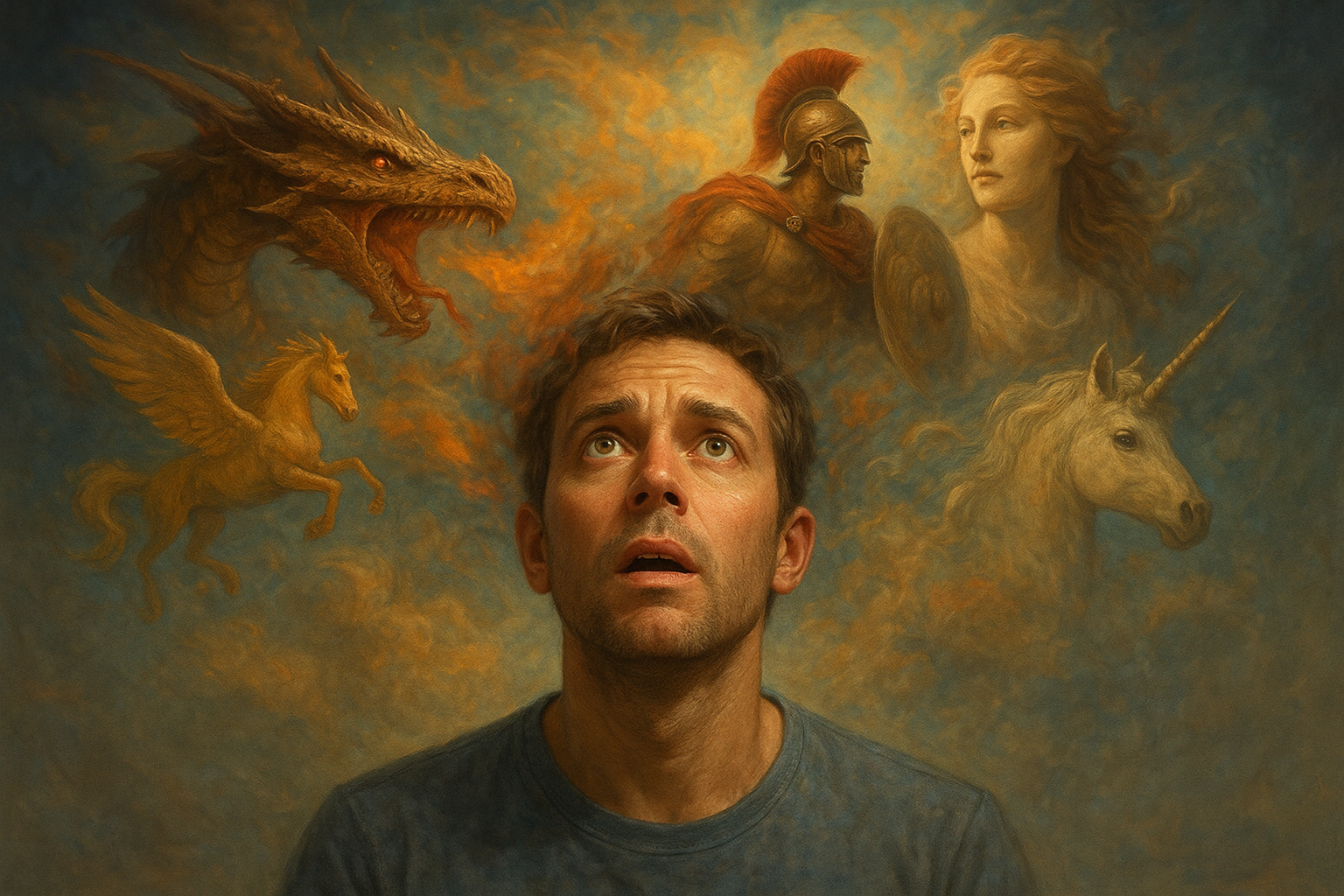
  • Science Explains, Myth Orients – A forgotten division of labor

    Science Explains, Myth Orients – A forgotten division of labor

    Throughout history, humanity has sought to understand the world through a dual approach of scientific inquiry and mythological frameworks. While science helps us explain and predict phenomena based on empirical evidence, myth provides orientation and meaning, offering narratives that shape cultural norms and personal identities. Although distinct, these modes of understanding have complemented each other, playing vital roles in the human experience.

    The Rise of Science

    The scientific revolution of the 16th and 17th centuries marked a significant shift in how we comprehend the natural world. Groundbreaking figures such as Galileo Galilei, Sir Isaac Newton, and later, Charles Darwin, laid the foundation for modern science by emphasizing observation, experimentation, and rational inquiry. This era heralded a move towards explanations based on empirical evidence and logical reasoning, as described by renowned cosmologist Neil deGrasse Tyson:

    “The good thing about science is that it’s true whether or not you believe in it.”

    Science’s triumphs, from understanding gravity to decoding the human genome, have dramatically transformed our world. By explaining the laws governing everything from planetary motion to biological processes, science offers a powerful means to navigate and manipulate the physical universe.

    The Role of Myth

    In contrast, myth has traditionally served as the collective imagination, a tool for societies to articulate values, ethics, and identity. Myths are rich with symbolism and moral lessons, providing a framework that transcends mere factual explanation. Joseph Campbell, a prominent scholar of mythology, pointedly noted the enduring power of myth in his work, The Power of Myth:

    “Myths are public dreams, dreams are private myths.”

    Mythical narratives, from the epic tales of Homer to the spiritual texts of various religions, orient individuals and societies by addressing the existential questions of life: Why are we here? What is our purpose? While science deals with the ‘how,’ myth tackles the ‘why,’ nurturing the psychological and emotional landscapes that science alone may not satisfy.

    Complementary Disciplines

    Despite their differences, science and myth have historically complemented each other. Consider the ancient Greeks, who revered the myths of gods and heroes while also giving birth to scientific thought through philosophers like Aristotle. These cultural narratives provided a cohesive worldview in which scientific pursuits were intricately interwoven with mythological understanding.

    In many indigenous cultures, traditional myths articulate deep ecological insights, reflecting systems of knowledge that guide sustainable living practices. As eloquently stated by Wade Davis, an anthropologist and ethno-botanist, in his Ted Talk:

    “A language is not just a body of vocabulary or a set of grammatical rules. Every language is an old-growth forest of the mind, a watershed of thought, an ecosystem of spiritual possibilities.”

    The Modern Rift

    In the modern world, an inadvertent rift has emerged between science and myth, partly due to the elevation of materialism and the emphasis on technological progress. Many view myths as obsolete or mere stories of primitive people trying to make sense of the world without scientific tools.

    This separation often leads to a societal imbalance, with a strict reliance on science risking a neglect of ethical considerations and spiritual well-being. Historian and philosopher Yuval Noah Harari, in his book Sapiens: A Brief History of Humankind, emphasizes the significance of shared myths in shaping civilizations:

    “You could never convince a monkey to give you a banana by promising him limitless bananas after death in monkey heaven.”

    Such narratives underscore the importance of shared myths in fostering cooperation and cultural cohesion, which purely science-driven perspectives might overlook.

    Reintegrating Science and Myth

    To rectify the current division, a reintegration of scientific and mythological thinking is crucial. The two can exist synergistically, with science offering clarity and possibilities while myth endows these discoveries with meaning and context. As both scientific knowledge expands and global challenges grow, creating new myths that incorporate scientific insights is essential.

    Educational systems can play a central role in cultivating this balance by teaching students to appreciate the strengths and limitations of both science and myth. Encouraging interdisciplinary studies and fostering a critical understanding of various cultural narratives can enhance our ability to address modern ethical dilemmas.

    Conclusion

    In our quest for knowledge and understanding, science and myth represent two indispensable pillars of human thought. Science offers explanations and advancements that change our material world, while myth provides the stories that shape our inner worlds and societal values. By acknowledging and embracing their complementary roles, we can better navigate the complexities of the human condition with wisdom and insight.

    As we move forward in this ever-evolving landscape of discovery, let us be reminded of our ancient division of labor, where how we understand the universe and our place in it is enriched by both science and myth.

  • The Return of the Sacred Narrative – Why myth is resurfacing in a rational age

    The Return of the Sacred Narrative – Why myth is resurfacing in a rational age

    The Return of the Sacred Narrative: Why Myth is Resurfacing in a Rational Age

    In an era dominated by science and reason, one might presume that myths and sacred narratives would find little place. Yet, paradoxically, these age-old stories filled with gods, heroes, and cosmic battles are making a resurgence. But why are these narratives, which have traveled through millennia, finding their way back into contemporary consciousness?

    The Enduring Power of Myth

    The resilience of myth lies in its ability to speak to the human condition. Joseph Campbell, a renowned mythologist, once said, “Myths are public dreams, dreams are private myths.” In myths, we encounter archetypal figures and cosmic dramas that resonate deeply, reflecting our own struggles, desires, and aspirations. They provide a lens through which we can view the complexities and mysteries of life.

    In modern times, we are bombarded with information, much of it technical and logical. However, humans are not purely rational beings. We are also emotional and instinctual. Stories, particularly myths, cater to the part of our psyche that seeks meaning and connections beyond the tangible.

    The Role of Myth in Modern Society

    In today’s society, there is a reinvigorated interest in narratives that offer more than empirical evidence. These stories provide frameworks for understanding human experiences beyond the scopes of logic and science. Here are a few reasons why myths are resurging in today’s rational age:

    • Existential Anxiety: With rapid technological advancement comes existential questions. Stories that address creation, purpose, and the afterlife offer solace amidst uncertainty.
    • Community and Identity: Myths often serve as foundational narratives that shape cultural identity and community. As globalization blurs borders, people turn to myths to understand their place in the world.
    • Ethical and Moral Guidance: Myths often encapsulate moral and ethical lessons, providing a guide to navigating complex social landscapes.
    • Artistic Inspiration: Modern creators draw on ancient myths to craft stories that resonate on both intellectual and emotional levels, from novels and films to art and music.

    Mythology in Popular Culture

    The resurgence of myth is readily apparent in popular culture. Films like “Wonder Woman” and “Thor” tap into ancient narratives of gods and heroes, reimagining them for contemporary audiences. Neil Gaiman’s “American Gods” explores the premise of old gods in a new world, cleverly illustrating the clash between traditional mythologies and modern life.

    “Gaiman uses the legacy of myth to critique modern society…prompting readers to question what we worship, and at what cost.” – NPR

    Similarly, the online gaming world is rife with narratives drawn from mythological systems. Games such as “God of War” delve into Greek mythology, offering immersive experiences where players engage directly with these age-old myths.

    Scientific Mythology: The New Frontier

    Intriguingly, even in the realms of science and technology, mythological narratives find applicability. As Carl Sagan suggested, science itself can be seen as a kind of myth-making. His “Pale Blue Dot” vision is celebrated not only for its scientific insight but also for its poetic, almost mythic, call to cherish our planet.

    Quantum physics and cosmology push the boundaries of the known universe, sparking imagination and inviting parallels with mythological thinking. As these fields explore concepts like multiverses and dark matter, the line between scientific exploration and mythological narrative becomes fascinatingly blurred.

    The Sacred Within the Secular

    Another factor is the resurgence of spirituality in secular guises. The rise of movements such as modern neo-paganism and an increased interest in indigenous spiritual practices reflect a yearning for the sacred amidst a seemingly materialistic world. Many are finding that myth and spirituality offer profound means of connecting with themselves and the universe.

    Consider the popularity of festivals like Burning Man, an event that embodies a kind of myth-making in a community context. People come together to create a temporary mythical utopia, celebrating life through art, music, and storytelling.

    Conclusion: Embracing a Mythic Future

    As we navigate this rational age, it becomes evident that myths have not been replaced by science but have resurfaced in a new form. They beckon us to look beyond the literal and engage with the symbolic. By synthesizing the rational with the mythical, we can cultivate a more holistic understanding of our world.

    As Rollo May, an influential psychologist, beautifully articulated, “Myth is a way of making sense in a senseless world.” Embracing the mythic potential of our age may cultivate richer existential insight and, ultimately, a more meaningful human experience.

  • Myth as Operating System – The symbolic code beneath human cognition

    Myth as Operating System – The symbolic code beneath human cognition

    Myth as Operating System: The Symbolic Code Beneath Human Cognition

    In the realm of human consciousness, myths serve as the unseen processors embedded within our cultural psyche. They function much like an operating system, setting the parameters within which societies understand themselves and their place in the universe. Just as an operating system provides the basic instructions for managing hardware and executing tasks, myths encode the fundamental beliefs and archetypes that shape human cognition and behavior.

    The Nature of Myth

    Joseph Campbell, a renowned mythologist, defined myths as “the secret opening through which the inexhaustible energies of the cosmos pour into human cultural manifestation”. (Source). These narratives are not merely stories of ancient times but are deeply embedded patterns that guide human behavior and understanding. Myths are potent precisely because they resonate with the depths of our psyche, speaking to the universal experiences of being human.

    Myths and Archetypes

    Swiss psychiatrist Carl Jung introduced the concept of archetypes, fundamental human motifs that reside within the collective unconscious. He posited that these patterns are found across cultures and eras, suggesting a universal symbolic language. Jung wrote, “Myths are first and foremost psychic phenomena that reveal the nature of the soul”. (Source)

    • The Hero: Seen in figures like Gilgamesh, Hercules, and even modern heroes such as Luke Skywalker, representing the journey of self-discovery and triumph over adversity.
    • The Wise Old Man: A figure of wisdom and guidance, often appearing as Merlin or Gandalf.
    • The Shadow: Representing the dark, unseen aspects of our personality that must be acknowledged and integrated for personal growth.

    Myth’s Role in Cognitive Framework

    Myths influence cognitive frameworks by providing a symbolic language through which humans interpret their experiences. Anthropologist Claude Lévi-Strauss argued that myth is a language, orchestrated by symbols to convey meaning and to navigate the human experience. According to Lévi-Strauss, “the purpose of myth is to provide a logical model capable of overcoming contradictions”. (Source)

    “It would not be true to say that myth serves to explain the world, but rather it is used to overcome certain contradictions that cannot be resolved through ordinary human actions and thought.”

    Operating Systems of the Mind

    In software, an operating system manages resources and provides services to applications that run on a computer. Similarly, in cultures around the world, myths provide the metaphorical framework needed for individuals to process their life experiences. They offer a way to navigate and make sense of existence, as seen in:

    • World Creation Myths: These myths address fundamental questions of origin and existence, offering a schema within which science and faith can coexist.
    • Mythical Morality Tales: Stories like the Pandora’s Box or the tales of the Buddha offer ethical guidelines, presenting a moral landscape that guides personal and collective behavior.
    • End-of-World Narratives: Myths about apocalypses, like Ragnarök or the Christian Apocalypse, prepare societies to face the inevitability of change and transformation.

    Application in Modern Society

    While contemporary society often views myths as quaint or outdated narratives, their impact remains unmistakably potent. Advertisers and filmmakers, knowingly or unknowingly, utilize mythic structures to craft compelling narratives that touch audiences deeply. For instance, the hero’s journey — a classic narrative template — is the backbone of many modern blockbusters. As mythologist Michael Vannoy Adams notes, “Myth is not what happened in the past. Myth is what happens all the time” (Source), suggesting that myth continues its evolutionary role in contemporary culture.

    The Interplay between Myth and Technology

    In our digital age, it is fascinating to explore how technology itself perpetuates new myths. The myth of the computer as an all-knowing oracle has parallels with ancient deities of wisdom. Furthermore, digital narratives echo mythic structures, reflecting our enduring quest for understanding and mastery over the world. The internet, a vast network of knowledge, can be likened to a modern-day Akashic Record—a mythological compendium of infinite wisdom.

    Conclusion

    Myths provide the symbolic maps needed to navigate the complexities of human consciousness and cultural identity. As operating systems of the psyche, they organize our perceptions of reality and imbue life with meaning. Despite advancements in science and technology, myths remain central to our understanding of the world and ourselves, continually evolving and adapting to meet the needs of each new era.

    By recognizing the mythic frameworks that underlie our cognition, we gain insight not only into ancient narratives but also into the codes that continue to shape our lives. As we explore the intersection of myth, cognition, and culture, we become better equipped to understand the past and present fabric of human experience.

  • Myth vs. Hard Science – Two ways of knowing, not one enemy

    Myth vs. Hard Science: Two Ways of Knowing, Not One Enemy

    For centuries, humanity has relied on various methods to make sense of the world around us. Among these, myth and science have stood out as two of the most profound and influential ways of understanding reality. While they are often seen as opposing forces, a closer examination reveals that they serve different purposes and can complement each other in unexpected ways.

    Understanding Myth: More than Just Folklore

    The term “myth” is often misused to mean a mere falsehood. However, in its original and more nuanced sense, myth constitutes stories that people tell to explain the world and their experience of it. These stories, while not empirically verifiable, convey truths that cannot be easily measured.

    “Myth is much more important and true than history. History is just journalism and you know how reliable that is.” – Joseph Campbell, The Power of Myth

    Myths serve several functions in society. They offer moral guidance, serve as cautionary tales, or create a shared cultural narrative that binds communities together. An example is the Greek myths, which have provided rich material for understanding human nature, virtue, and vice. Such stories might not provide factual history but offer deep insights into human psychology and ethical dilemmas.

    The Role of Hard Science: The Pursuit of Objectivity

    In contrast to myth, science seeks to understand the world through a rigorous method of hypothesis, experimentation, and analysis. Science looks to eliminate bias and achieve objective truths based on empirical evidence. It is characterized by its replicability and falsifiability. The strength of science lies in its ability to explain phenomena in a way that they can be consistently measured and validated.

    As Carl Sagan famously said,

    “Science is not only compatible with spirituality; it is a profound source of spirituality. When we recognize our place in an immensity of light-years and in the passage of ages, when we grasp the intricacy, beauty, and subtlety of life, then that soaring feeling, that sense of elation and humility combined, is surely spiritual.”

    Science’s strength lies in solving practical problems, from curing diseases to unraveling the mysteries of the cosmos. However, it is not equipped to solve existential questions or provide moral guidance. This is where myth complements science, by filling the spaces that scientific inquiry does not reach.

    Complementary Forces: Myth and Science Together

    • Providing Context: Myths give us a narrative framework within which we can place scientific discoveries. They allow us to relate the cold, hard data of science to the human condition.
    • Sparking Creativity and Inquiry: Mythical stories have served as inspiration for scientific exploration. Think of how many inventions and scientific pursuits have been dreamt up first through the lens of mythology or speculative fiction.
    • Making Science Accessible: Complex scientific concepts can sometimes be best understood through the allegorical wisdom present in myths. They make the distant and abstract feel tangible and imminent.

    Richard Feynman, a noted physicist, famously said,

    “The first principle is that you must not fool yourself—and you are the easiest person to fool. So you have to be very careful about that. After you’ve not fooled yourself, it’s easy not to fool other scientists.”

    This speaks to the honesty and discipline inherent in the scientific process. Yet, it doesn’t negate how myth can enrich our interpretation and understanding of scientific facts.

    The Psychological Link

    From a psychological perspective, both myth and science address fundamental human needs: the need to understand, to predict, and to control or influence our environment. They provide a scaffolding on which we can construct our understanding of the self and of the universe. Psychologists like Carl Jung have explored how myths can offer insight into the collective unconscious, acting as mirrors of the human psyche.

    Jung argued that myths are akin to dreams and express the dreams of a society, and as such, they resonate on a deep psychological level. This helps individuals navigate their inner landscapes as much as science helps them understand the external world.

    The Modern Integration of Myth and Science

    In today’s world, where technological advancements occur at a breathtaking pace, it is crucial to maintain a balance between myth and science. Rather than seeing them as enemies, societies can benefit enormously from appreciating each as a critical component of human knowledge.

    • Education Systems: Incorporating both myth and science education can enhance creativity and critical thinking. For example, storytelling methods can be used to teach complex scientific ideas in a way that is engaging and memorable.
    • Cultural Understanding: By acknowledging both methods of knowing, differing worldviews can be reconciled, promoting a richer, more inclusive dialogue about human progress.
    • Innovation: Many of the world’s greatest innovators have been inspired by myth, from Da Vinci’s sketches of flying machines dreaming of Icarus to modern astronauts inspired by celestial myths.

    Conclusion

    In a world rife with information yet starved of wisdom, both myth and science offer invaluable tools. Instead of competing for supremacy, they should be recognized as parts of a comprehensive approach to discovery and understanding. Each advances human knowledge in unique ways:

    • Myth connects us to our past, cultural heritage, and psychological depths.
    • Science propels us forward, opening new doors to the future.

    By transcending the simplistic dualism of myth versus science, we can embrace a more integrated view that celebrates human curiosity in all its forms.

    In our quest for knowledge, may we never lose sight of either the narrative arcs of myth or the profound discoveries of science. In the words of Neil deGrasse Tyson,

    “We are part of this universe; we are in this universe, but perhaps more important than both of those facts is that the universe is in us.”

    Such a realization captures the essence of both myth and science, offering a fuller picture of our place in the cosmos.

  • The Lie of Pure Objectivity – Why myth never pretended to be neutral

    The Lie of Pure Objectivity – Why myth never pretended to be neutral

    In the modern world, where data reigns supreme, the idea of pure objectivity is often considered the holy grail of understanding. Whether in science, journalism, or everyday decision-making, objectivity is hailed as the path to truth. Yet, this pursuit of pure objectivity is a myth itself, for objectivity does not exist in a vacuum; it is laced with subjectivity and bias, often disguised as neutrality.

    The Origins of Objectivity

    Objectivity, as we understand it today, emerged in the 19th century alongside the development of professional journalism and scientific inquiry. According to Wikipedia, journalistic objectivity is founded upon the principles of fairness, neutrality, and the absence of bias. However, many argue that true objectivity is unattainable because all information is inevitably filtered through personal, cultural, and historical lenses.

    Renowned media scholar Jay Rosen highlights this point, stating:

    “Objectivity is a trust mechanism erected by journalists to align with the anxious expectations of an audience that wants to know if the game is clean.”

    This quote emphasizes how objectivity is often more about appeasing the audience than genuinely presenting unbiased information.

    The Myth of Neutrality

    Myths have existed throughout history, serving as vehicles of cultural expression. They never claimed objectivity; instead, they are imbued with the values, beliefs, and experiences of the cultures that created them. As scholar Northrop Frye wrote, myths provide a narrative structure to the human experience, often blending fact with fiction to convey deeper truths.

    The divine tales of ancient Greeks, the epic poems of Norse sagas, and the intricate stories of Indigenous cultures are all examples of myths that embrace subjectivity to express cultural truths. These narratives acknowledge their biases and perspectives, offering wisdom rather than factual accuracy.

    The Infiltration of Bias

    • Confirmation Bias: Individuals tend to favor information that confirms their pre-existing beliefs. In media and science, this bias can skew the objectivity, as researchers and journalists may subconsciously select information that corroborates their views.
    • Cultural Bias: Every culture interprets the world through its unique framework of beliefs and practices. What is deemed objective in one culture may not hold the same status in another.
    • Linguistic Bias: The language used to convey information can subtly influence audience perception, even when attempts to remain neutral are made. The words chosen to describe an event or phenomenon can carry connotations that impact objectivity.

    Embracing Subjectivity for Greater Truth

    Instead of striving for an impossible ideal, embracing subjectivity may lead to a richer understanding of the world. Acknowledging biases can enhance transparency and foster a more critical evaluation of information. Scholars like Thomas Nagel argue that diverse perspectives contribute to a fuller picture, stating:

    “The pursuit of objectivity is both impossible and undesirable, for it is through the subjective that we access and appreciate the objective world.”

    In journalism, for example, recognizing the subjectivity of storytelling can allow for more nuanced reporting. Advocacy journalism, which openly acknowledges its biases, often provides deeper insights into complex social issues, challenging the status quo and sparking dialogue.

    The Path Forward

    As we advance further into the age of information, the lie of pure objectivity becomes clearer. Like myths of old, our narratives today are intertwined with subjectivity. By valuing transparency and acknowledging our biases, we can move beyond the confines of supposed neutrality and achieve a more comprehensive understanding of the world.

    Thus, the myth of objectivity transforms into an opportunity to embrace multicultural, multifaceted perspectives. This approach not only enriches our intellectual landscape but also fosters empathy and tolerance, connecting us across the diverse tapestry of human experience.