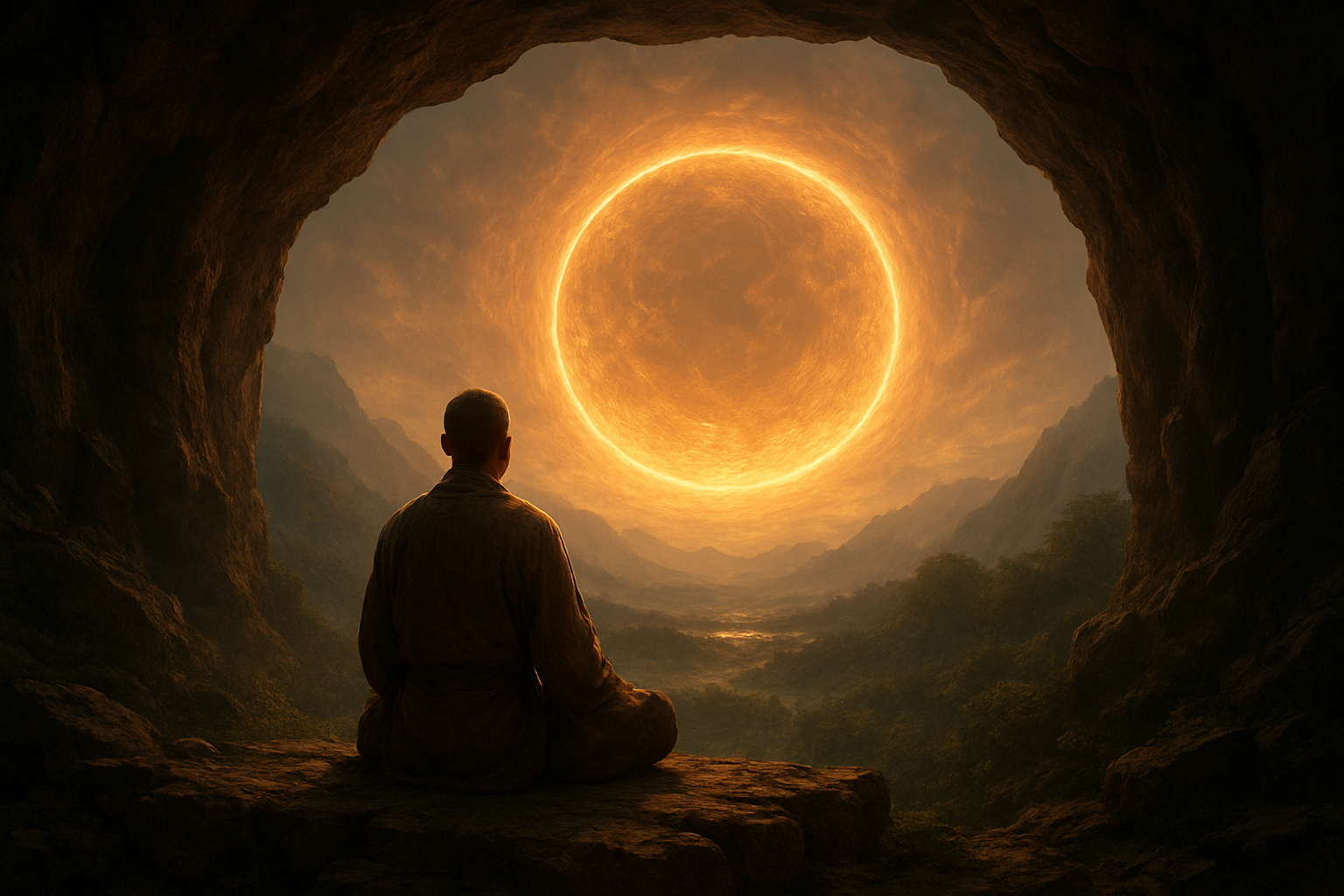
Return to Origin: The Primordial Dao Reawakened
Throughout history, humanity has sought to understand its place within the grand tapestry of existence. In this journey, ancient philosophies often offer profound insights. One such wisdom tradition is Daoism, a philosophy and way of living that traces its roots back to ancient China. It speaks of a return to simplicity, alignment with nature, and an understanding of the life force, or Dao, that flows through and around all things.
The Essence of Daoism
At the heart of Daoism is the concept of the Dao (or Tao), often translated as “The Way.” This path is not merely a set of moral codes or religious doctrines, but a living, breathing approach to life and the universe. The Dao De Jing, attributed to the sage Laozi, encapsulates this philosophy in its elegant verses. As Laozi remarked,
“The Dao that can be told is not the eternal Dao; the name that can be named is not the eternal name.” – Laozi, Dao De Jing
This foundational text beckons us to transcend the limitations of language and conceptual thought, inviting us into direct experience and understanding of the natural flow of life.
The Primordial Dao and the Return to Origin
Central to Daoist thought is the concept of returning to the origin – a metaphorical homecoming to the pure and untainted state of being. In the Daoist worldview, this means reconnecting with the uncarved block, or the state of pu, which reflects simplicity and potential. Embracing the primordial Dao involves:
- Embracing Simplicity: Stripping away the unnecessary complexities of life and focusing on what is essential.
- Harmony with Nature: Understanding our intrinsic connection to the natural world and living in balance with it.
- Non-Action (Wu Wei): Paradoxically, this does not imply inactivity but rather aligning actions with the natural flow to achieve optimal outcomes with minimal effort.
These principles reflect the unchanging truths of the Dao, reminding us that true wisdom lies in simplicity, and true power in subtlety.
The Reawakening of Primordial Dao in Modern Times
In today’s fast-paced world, where technological advancements and societal changes rapidly alter the landscape of our lives, the primordial Dao holds significant relevance. The current global shift towards sustainability, mindful living, and well-being echoes a yearning for the primordial wisdom of our ancestors.
Sustainability and the Dao
One cannot overlook the environmental crises that threaten the fabric of life on Earth. Daoism’s emphasis on harmony with nature aligns with modern ecological movements. Concepts such as integrated agriculture and permaculture resonate with Daoist practices, underscoring responsible stewardship of our planet.
Mindfulness and Simplicity
Mindfulness practices, popularized in recent decades, echo Daoist meditation techniques aimed at achieving clarity and presence. The practice of dao yin—an ancient form of Daoist yoga and meditation—focuses on directing the flow of energy, or qi, throughout the body.
In this light, returning to the Dao represents a paradigm shift from consumption-driven living to one imbued with intentional action and simplicity. As noted by Alan Watts, a philosopher who helped popularize Eastern philosophy in the West, “This is the real secret of life—to be completely engaged with what you are doing in the here and now. And instead of calling it work, realize it is play.”
The Path Forward
While the fullness of the Dao cannot be contained within words alone, engaging with its principles offers potent avenues for personal and communal transformation. By embracing the return to origin, individuals and societies can benefit in numerous ways:
- Enhanced Mental Well-being: By cultivating a sense of inner peace and resilience.
- Community Harmony: Encouraging cooperation and cohesion through shared values aligned with the Dao’s teachings.
- Resilient Ecosystems: Practicing environmentally aligned living that nurtures rather than depletes.
Conclusion: Embracing the Dao
The journey back to our origins offers a way of seeing and being that is deeply necessary in our contemporary world. In embracing the primordial Dao, we open ourselves to a life of more fluidity, authenticity, and interconnectedness. Even as we advance technologically and socially, a stabilizing force remains in our return to these ancient yet timeless principles.
The Dao teaches us that life, in its myriad forms, is already perfect as it is. Our task is not to mold it to our desires but to appreciate and flow with its rhythms, finding ourselves along the way. The return to origin is less about going back, rather a conscious progression towards our truest form, recognizing and reawakening the intrinsic Dao within us all.