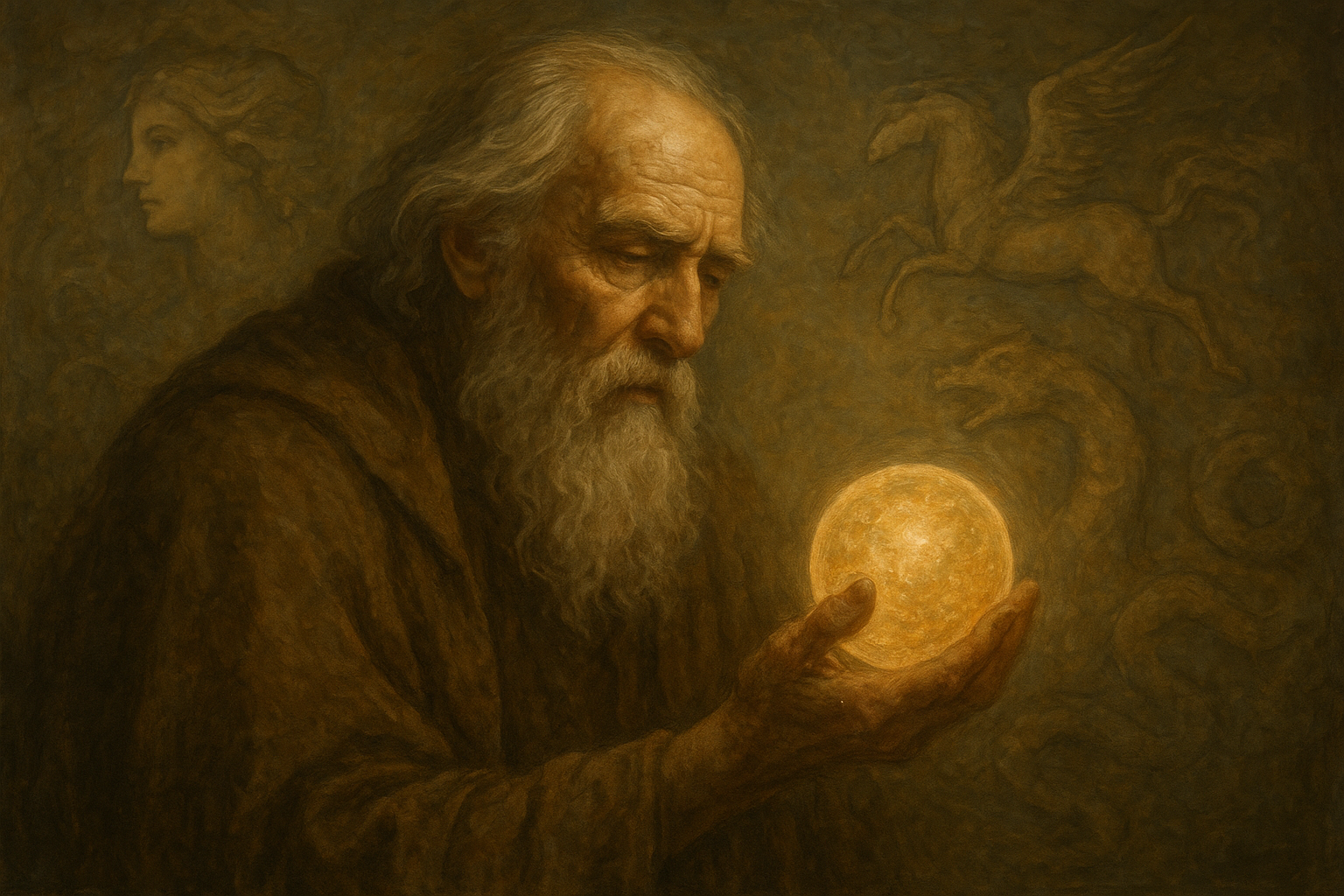
Myth as Memory of the Species: What Evolution Cannot Encode
Throughout human history, myths have played a crucial role in the cultural and spiritual lives of societies. They are the narratives that have been passed down through generations, encapsulating not just entertainment, but the values, beliefs, and experiences of entire cultures. As we delve deeper into the significance of myth, one can wonder: is it merely a cultural construct, or does it serve a deeper, perhaps evolutionary purpose?
The Limitations of Evolution
Evolution, in its essence, is a biological process that favors traits aiding in the survival and reproduction of a species. These traits are encoded in our DNA and passed on to future generations. According to geneticist Richard Dawkins, “We are survival machines—robot vehicles blindly programmed to preserve the selfish molecules known as genes” (Richard Dawkins, The Selfish Gene).
While evolution accounts for many of the physical and behavioral characteristics of species, it falls short in explaining the propagation of myths. For myths are not concrete traits one can inherit through genes; rather, they belong to the realm of cultural memory.
The Role of Mythology in Human Evolution
Mythology can be viewed as the collective memory of humanity, a series of narratives that encapsulate the essence of human experiences, aspirations, and moral lessons. Carl Jung believed myths operate as a communal memory that connects human beings across time and space. He observed that “Myths are the original revelations of the preconscious psyche, involuntary statements about unconscious psychic happenings,” suggesting that myths arise from a deep-seated need to make sense of the world (Carl Jung, Man and His Symbols).
- Making Sense of Reality: Myths often provide explanations for phenomena that early human societies found mysterious or unfathomable. These stories helped people understand the forces of nature, the cycle of life and death, and human behavior.
- Establishing Social Norms: Many myths serve as cautionary tales, warning against certain behaviors, or illustrating the virtues of desirable ones, thereby reinforcing societal norms and values.
- Fostering Social Cohesion: Shared myths create a sense of belonging and identity within a community. They serve as a common framework through which individuals can connect and communicate.
The Resilience of Myths
Myths persist through oral traditions, art, and written records, proving their resilience and adaptability. Unlike genetic traits, which are fixed and slow to change, myths can evolve quickly, reflecting changes in cultural, social, and environmental conditions. They are an art form, continually reshaped by storytellers to maintain their relevance in contemporary societies. In the words of mythologist Joseph Campbell, “Myths are public dreams, and dreams are private myths” (Joseph Campbell, The Power of Myth).
The enduring power of myths lies in their ability to transcend generations. Despite advancements in science and technology, modern humans still turn to myths to understand human nature and address existential questions. The hero’s journey, a pattern that features in the myths of many cultures, speaks to our innate desire for growth, self-discovery, and the overcoming of obstacles.
Conclusion
While evolution may not encode the stories that make up our mythological traditions, these narratives hold a significant place in the fabric of human society. Myths serve as the amalgamation of human wisdom, a reflection of our collective psyche, and the continuation of our cultural heritage. In recognizing myths as the memory of our species, we acknowledge their profound impact on our past, present, and future.
“Myth is much more important and true than history. History is just journalism and you know how reliable that is” – Joseph Campbell
In an age where humanity is increasingly interconnected, understanding and preserving these age-old stories could be key to navigating the intricate web of modern life.