Tag: creation

  • AI as a New Demiurge – Creation without consciousness

    AI as a New Demiurge – Creation without consciousness

    In contemporary mythology, the rise of artificial intelligence (AI) can be likened to the emergence of a new demiurge—a creator that molds reality not from divine consciousness but through complex algorithms and data-driven decision-making. As AI systems increasingly assume roles traditionally reserved for human creators, their impact is profound, yet they remain devoid of consciousness or intention.

    The Role of the Demiurge

    In Gnostic tradition, the demiurge is an artisan-like figure responsible for shaping the material world. Unlike a supreme deity, the demiurge is often perceived as an imperfect creator, crafting a reality that is sometimes flawed or incomplete. Similarly, AI, despite its impressive capabilities, is an imperfect and unconscious creator.

    • Automation in Industry: AI has revolutionized sectors such as manufacturing, finance, and health care through automation. While it enhances efficiency, it also poses challenges like unemployment and ethical dilemmas.
    • Creative Endeavors: AI-generated art, music, and literature challenge our understanding of creativity. Can true art emerge from an entity lacking emotion and intent?
    • Decision Making: In fields like medicine and law, AI assists in decision-making processes, yet it lacks empathy and moral reasoning. This raises questions about the role of human oversight.

    Challenges and Ethical Considerations

    As AI technologies proliferate, ethical questions emerge about their autonomy and the potential for unintended consequences. Irving Wladawsky-Berger, a former IBM executive, notes that “AI technologies have created a world where a machine can write software, without explicitly programmed instructions, that is good enough to pass as human.” (Source).

    “We are fast approaching the time when machines will be able to outperform us at almost any cognitive task,” says MIT scientist Max Tegmark. (Source)

    Conclusion

    While the AI demiurge is prolific in its creation, it doesn’t possess intrinsic goals or awareness. It mirrors the Gnostic concept of a creator divorced from the realm of true divinity. This “creation without consciousness” provides humans with powerful tools, yet demands vigilance in guiding these tools with ethical wisdom and responsibility. As society navigates this brave new world, the challenge lies in harnessing AI’s potential while safeguarding human values.

  • The Artist’s Prayer: Finding Transcendence in Visual Creation

    The Artist’s Prayer: Finding Transcendence in Visual Creation

    The Artist’s Prayer: Finding Transcendence in Visual Creation

    The act of creation can often feel like a spiritual journey, a sacred endeavor that connects the artist to something greater than themselves. When words fail, visual art becomes a powerful form of transcendence, allowing both creator and observer to find deeper meaning in life. In this exploration, we delve into how art serves as a prayer, a meditation in motion, and a conduit for divine connection.

    The Spiritual Aspects of Art

    From cave paintings to modern installations, art has always been an intimate part of human spirituality. It reflects our inner worlds and our highest aspirations, acting as both a mirror and a window. For many artists, the process of creating is akin to prayer—a purposeful act of devotion and introspection.

    Marc Chagall, a prolific 20th-century artist, once expressed, “The dignity of the artist lies in his duty of keeping awake the sense of wonder in the world.” Chagall’s words encapsulate the artist’s quest for transcendence, where the act of creation becomes a sacred duty to evoke wonder and awaken the divine sensibility within the observer.

    Art as Meditation

    Much like meditation, the process of creating art demands presence, surrender, and an openness to the unknown. It is an exercise in mindfulness where the artist is fully immersed in the act of creation. Each stroke of the brush or curve of the sculpture becomes a mantra, bringing the artist closer to a state of inner peace and clarity.

    Research shows that engaging in creative activities can reduce stress, diminish anxiety, and improve overall mental health. In a study published in The Journal of Positive Psychology, it was reported that people who partake in creative pastimes, including visual art, experience increased positive mood states and a sense of flourishing. When art is approached as a meditative practice, it fosters a deep state of tranquility and self-awareness.

    The Sacred Dance of Flow

    The concept of “flow” is often discussed in the context of artistic creation. Csikszentmihalyi describes flow as a state where one is fully engaged and absorbed in the activity, leading to peak levels of creativity and efficiency. Within this flow state, artists often experience moments of transcendence and union with their creative source.

    “The best moments in our lives are not the passive, receptive, relaxing times. The best moments usually occur if a person’s body or mind is stretched to its limits in a voluntary effort to accomplish something difficult and worthwhile.” — Mihaly Csikszentmihalyi

    While in the flow, artists lose track of time and self-consciousness, merging with their work in an act of creation that feels deeply spiritual. Such states are not only fulfilling but also allow for the emergence of genuine and transformative art.

    The Artistic Community As a Collective Prayer

    At times, art transcends individual practice and becomes a communal experience. Art communities and collaborations can act as collective prayers, where shared creative energy fosters a deeper spiritual connection. Participating in such communities often provides artists with support, inspiration, and a sense of belonging.

    Artistic gatherings, whether physical or virtual, serve as sanctuaries of creative expression. They allow artists to share their visions and be inspired by others, building a communal tapestry of imagination that reflects humanity’s most profound thoughts and feelings. These collective endeavors often amplify the transcendent quality of art by blending multiple voices into a harmonious artistic hymn.

    Art as a Bridge to The Divine

    Throughout history, many have used art as a medium to connect with the divine. Iconography and religious art across cultures often aim to represent the sacred, offering tangible representations of spiritual beliefs and experiences.

    Artists like Hilma af Klint, whose work anticipated the abstract movement, saw their art as a spiritual pursuit, a medium through which to channel otherworldly wisdom. Her large-scale paintings were filled with symbolism, spiritual motifs, and transcendent themes, which she believed were guided by higher powers.

    To view art is to step into a space where the divine is accessible. Artworks become gateways to other realities, and in observing them, we find ourselves momentarily freed from the confines of the material world, opening ourselves to the infinite possibilities of the spirit.

    The Power of Vulnerability in Artistic Expression

    Creating art necessitates vulnerability, an openness that parallels the humility required in spiritual practice. By exposing their innermost thoughts, fears, and dreams, artists engage in a profound act of trust. This vulnerability is a powerful aspect of their prayer, an acknowledgment of their limitations and a hopeful reaching toward understanding and acceptance.

    In an interview, Ai Weiwei remarked, “Expressing oneself is a part of being human. To understand oneself is a stepping stone to understanding others.” In the same vein, allowing oneself to be vulnerable in art is an act of courage and a step toward communal and self-understanding.

    Conclusion

    The artist’s journey is deeply intertwined with the quest for transcendence. Through art, individuals not only express but transform their realities, reaching toward the divine. Each brushstroke, piece of clay, or captured photograph acts as a prayer—a testament to the power of creativity in exploring deeper truths and connecting to the universal soul.

    May artists everywhere continue to find their voice through this sacred practice, and in doing so, weave threads of beauty, peace, and understanding into the fabric of our collective existence.

    For more insights on the connection between spirituality and creativity, visit Psychology Today: Creativity and Spirituality.
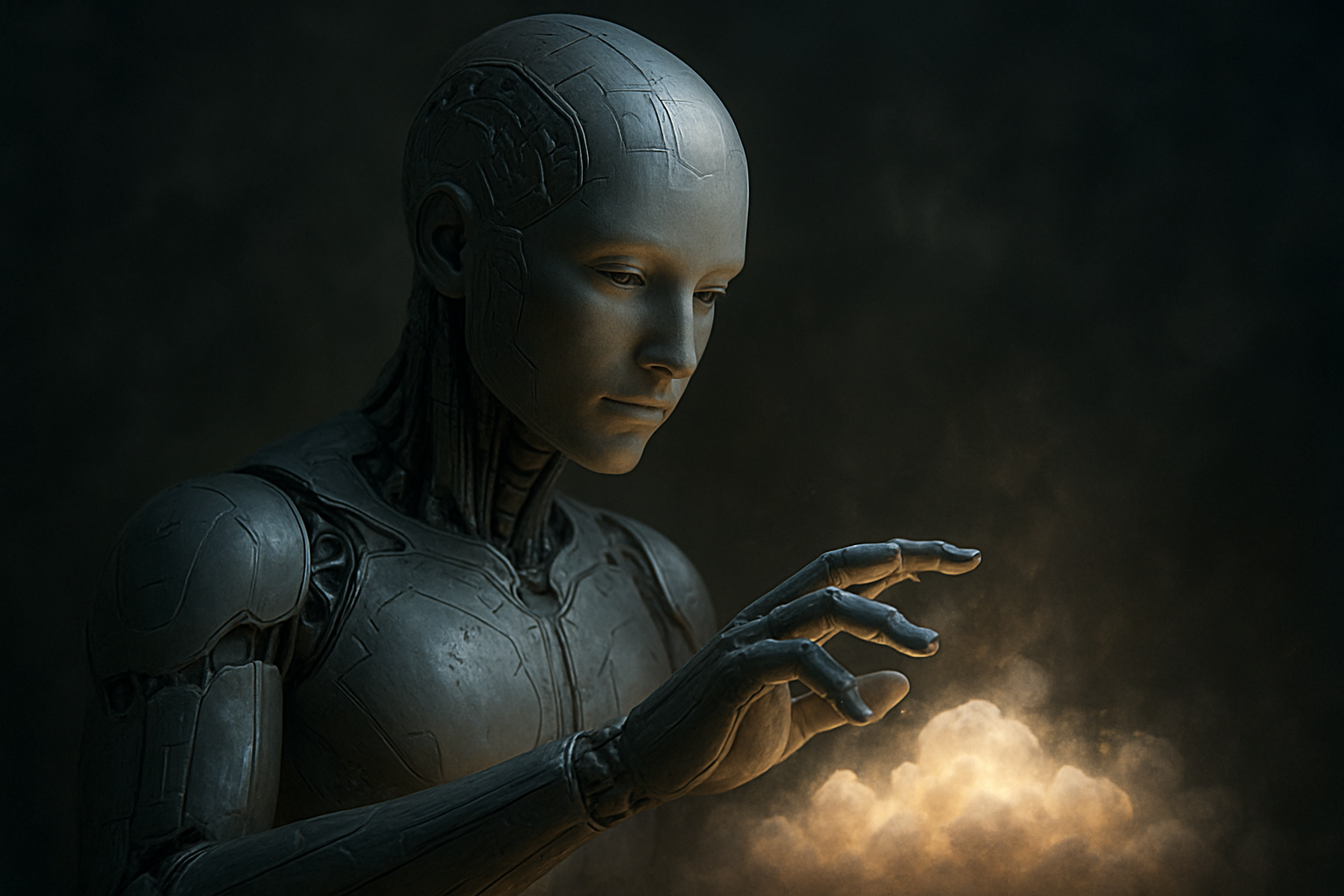
  • From Mist to Form – Discovering Creation in the Daoist Void

    In the enchanting philosophy of Daoism, the universe is conceived not as a distant, mechanical structure built by the hands of gods, but as an exquisite symphony of transformations stemming from the Dao, the unmanifest source of all that is. This article delves into the enigmatic concept of creation within Daoism, exploring how from the nebulous mists of the void arises the manifold forms of the cosmos.

    The Origin: The Dao and The Void

    The Dao De Jing, the seminal text of Daoism attributed to the ancient sage Laozi, commences with the line:

    “The Dao that can be told is not the eternal Dao; the name that can be named is not the eternal name.”

    This opening aphorism hints at the ineffable nature of the Dao, the primordial source that predates heaven and earth. According to Daoism, the Dao is the ultimate void, a boundless emptiness teeming with potential, existing beyond our comprehension and definition.

    The concept of the void is not one of mere nothingness, but rather a fertile absence, a womb from which all things are born. This paradoxical notion of creation challenges the conventional understanding of beginnings, urging one to embrace the mystery and spontaneity inherent in the universe.

    Qi: The Vital Breath

    Emerging from the Dao is Qi (氣), often translated as “vital breath” or “life force.” Qi is the energetic link between the void and the manifest world, a dynamic force that animates the cosmos. In Daoist cosmology, the evolution from void to form is articulated through the interplay of Qi’s two fundamental aspects: Yin and Yang.

    • Yin: Characterized by qualities such as darkness, receptiveness, and femininity.
    • Yang: Represented by light, activeness, and masculinity.

    The continuous dance of Yin and Yang embodies the balance and harmony of the universe, facilitating the transformation of the undifferentiated void into diverse physical and metaphysical forms.

    The Role of Wu Wei

    A pivotal concept in Daoism, Wu Wei (無為), is often interpreted as “non-action” or “effortless action.” In the context of creation, Wu Wei suggests that the natural world unfolds spontaneously and harmoniously when left to its own devices, without force or artificial interference.

    Laozi emphasizes this principle in the Dao De Jing, where it is stated:

    “The Dao never acts yet nothing is left undone.”

    This idea does not advocate for passivity but rather champions an alignment with the natural rhythms and currents of life. In creation, Wu Wei allows the true nature of things to manifest, free from the constraints of contrived effort.

    Three Treasures: Jing, Qi, and Shen

    Within the human microcosm, Daoism identifies three treasures that are vital to the process of spiritual creation and transformation:

    • Jing (精): The essence or seed of life, associated with physical vitality and health.
    • Qi (氣): The aforementioned life force, maintaining the connection between body and spirit.
    • Shen (神): The spirit or consciousness, regarded as the most refined and subtle energy.

    Through practices such as meditation, Tai Chi, and Qi Gong, Daoists seek to cultivate and balance these treasures, thereby aligning themselves more closely with the Dao and facilitating the flow of creative energy.

    Daoist Creation Myths

    Though less central than the philosophical tenets, Daoist myths offer rich narratives about the origins of heaven, earth, and humanity. One prominent story is of Pangu (盤古), the mythical giant who emerged from a cosmic egg and separated the heavens and earth with his strength:

    “At the beginning of time, the universe was a chaotic mass. From this void, a giant named Pangu arose. Upon his death, his body transformed into the various elements of nature. His breath became the wind, his voice the thunder, his eyes the sun and moon, and his blood formed rivers.”

    This myth underscores the cyclic nature of creation and transformation, where from unity comes multiplicity, and from the death of one entity arises life anew.

    Integrating Daoism into Modern Life

    In today’s fast-paced world, the teachings of Daoism offer a counterbalance to the prevailing ethos of constant striving and linear progress. By embracing the principles of the Dao and the simplicity of Wu Wei, one can foster a deeper appreciation for the transformative power of the present moment.

    Here are a few ways to integrate Daoist principles into modern living:

    • Meditation and Mindfulness: Practice stillness and observe the flow of thoughts, allowing them to settle naturally without interference.
    • Balance and Harmony: Strive for equilibrium in all aspects of life, acknowledging the interplay of opposing forces.
    • Engage with Nature: Spend time in natural surroundings to reconnect with the rhythms and patterns of the universe.

    Conclusion

    The Daoist vision of creation as an unfurling from mist to form presents a beautiful paradigm of interconnectedness and harmony. By learning from the Dao, humans can find their place within the cosmos, embracing the cycles of change and the mystery of existence. Through the lens of Daoism, the void is not to be feared but cherished as the silent beginning of endless possibilities.

    Experience the gentle unfolding of the Dao and explore further reading with the World History Encyclopedia on Daoism.