Tag: between

  • The Difference Between Escapist and Restorative Meditation

    The Difference Between Escapist and Restorative Meditation


    The Difference Between Escapist and Restorative Meditation

    The Difference Between Escapist and Restorative Meditation

    “Meditation has been practiced for thousands of years as a means to achieve inner peace, improve focus, and reduce stress.” – Jon Kabat-Zinn

    In the realm of meditation, two popular approaches often come under discussion: escapist and restorative meditation. Both methods offer unique benefits and it is essential to understand their differences to reap the most significant rewards from your practice.

    Escapist Meditation

    Escapist meditation, as the name suggests, aims to transport you away from your current reality and into a state of detachment from daily life. Techniques such as concentration meditation and mindfulness can be considered escapist forms, focusing on single-pointed concentration or observing thoughts without judgment.

    “Meditation is not evasion; it is a shield.” – The Dalai Lama XIV

    Restorative Meditation

    On the other hand, restorative meditation seeks to enhance our connection with the present moment while fostering a sense of inner calm and well-being. This approach includes practices like loving-kindness meditation, body scan meditation, and yoga nidra, which focus on compassion, relaxation, and self-awareness.

    • Concentration meditation: Focusing the mind on a single object or thought.
    • Mindfulness: Observing thoughts and emotions without judgment.
    • Loving-kindness meditation: Cultivating feelings of love, compassion, and goodwill towards oneself and others.
    • Body scan meditation: Scanning the body for areas of tension and releasing them through focused attention.
    • Yoga nidra: A guided relaxation technique that brings the body to a deep state of rest while keeping the mind aware.

    “Meditation is not about becoming highly evolved. It’s about waking up, coming out of the trance of unawareness.” – Jon Kabat-Zinn

    Ultimately, both escapist and restorative meditation have their merits, and the most effective practice may depend on your specific goals and preferences. By exploring various techniques and finding what resonates with you, you can unlock the transformative power of meditation in your life.

  • The Middle Path Between Discipline and Collapse

    The Middle Path Between Discipline and Collapse


    The Middle Path Between Discipline and Collapse

    The Middle Path Between Discipline and Collapse

    “Balance, as can be found in nature, is the key to long-term survival and prosperity.” – Lao Tzu

    In the realm of human civilization, the concept of balance has always been a crucial factor for growth and sustainability. One such aspect that demands a delicate balance is the relationship between discipline and collapse, two forces that, when mismanaged, can lead to stagnation or catastrophe.

    The Pillars of Discipline:

    • Structured Routine: Regularity in activities provides a sense of order and predictability, fostering productivity and reducing stress levels.
    • Boundaries: Establishing boundaries helps individuals focus on essential tasks, preventing burnout and maintaining work-life balance.
    • Accountability: Setting personal or collective goals and being held accountable for their achievement promotes self-discipline and encourages continuous improvement.

    The Cracks in Discipline:

    However, an overemphasis on discipline can lead to rigidity, stress, and eventual burnout. As the renowned psychiatrist Karl Menninger once said, “The capacity to be alone is the distance between dependency and independence.” In this context, too much discipline can hinder personal growth by stifling creativity, exploration, and self-discovery.

    The Path Towards Balance:

    • Flexibility: Embracing change and adapting to new situations is crucial for maintaining a balance between discipline and flexibility.
    • Empathy: Understanding others’ perspectives can help foster patience, compassion, and emotional intelligence—essential traits for creating harmonious relationships and environments.
    • Self-care: Prioritizing mental, physical, and emotional wellbeing is essential to maintain a balanced and sustainable lifestyle over the long term.

    “The art of life lies in a constant readjustment to our surroundings.” – Kakuzo Okakura


  • Magical Realism – When the mythic spills into the mundane.

    Magical Realism – When the mythic spills into the mundane.


    Magical Realism – When the mythic spills into the mundane

    In the quiet corners of our lives

    “Where the ordinary meets the extraordinary, there lies the realm of Magical Realism.” – Gabriel García Márquez

    • Confessional fragment: In moments when my thoughts wander, I find myself ensnared by the subtle tapestry of magic that weaves through our everyday lives.
    • It is in these silent whispers that we discover the enchantment hidden within the mundane – a dance between the mythic and the real.
    • And so, I invite you to embark upon this journey with me, as we explore the wonders of Magical Realism.

    Breath-spaced sections

    • I. The line between worlds: The essence of Magical Realism lies in the blending of reality and fantasy, as if the mythic spills effortlessly into the mundane.
    • II. Whispers from the ether: In literature, these stories are often rooted in everyday settings and characters, yet they brim with a sense of otherworldliness.
    • III. The magic within us all: Magical Realism challenges us to question the boundaries between what is possible and impossible, inviting us to believe in the extraordinary potential within ourselves.

    Silence

    “There are no ordinary moments. They’re all magical.” – Neil Gaiman

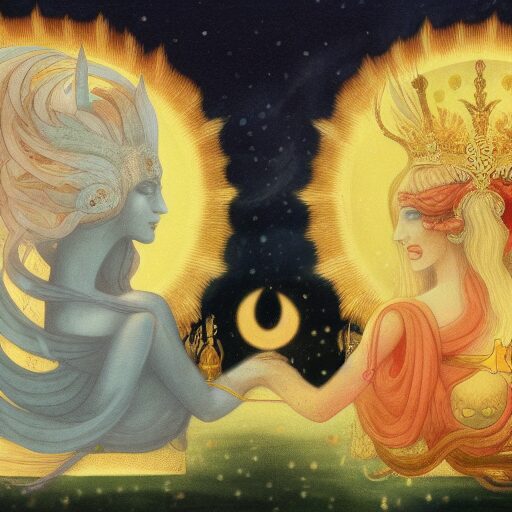
  • Solar Kings and Lunar Queens – The celestial marriage in mythic thought.

    Solar Kings and Lunar Queens – The celestial marriage in mythic thought.

    Solar Kings and Lunar Queens – The Celestial Marriage in Mythic Thought

    In the realm of mythology, the union between solar kings and lunar queens has been a recurring theme across various cultures and civilizations. This celestial marriage is often seen as a symbol of divine harmony and balance.

    • Hindu Mythology: In Hindu mythology, the solar king Surya and the lunar queen Chandra are depicted as husband and wife. Their union is said to have produced the 27 stars in the night sky.
    • Chinese Mythology: In Chinese mythology, the solar king Di Jun and the lunar queen Chang E are paired together. This celestial marriage represents the balance between day and night, as well as the harmony between heaven and earth.
    • Greek Mythology: The ancient Greeks associated the solar king Helios with the goddess Selene, who is often depicted as a lunar queen. Their union was said to have produced the 30 days of the month.

    “The celestial marriage between the solar king and the lunar queen represents the eternal harmony between day and night, light and darkness, masculine and feminine,” says mythologist Joseph Campbell, in his book “The Hero with a Thousand Faces.”

    Solar Kings and Lunar Queens: A Study of Celestial Marriage in Mythology (PDF)

    The symbolism of the solar king and lunar queen’s union extends beyond the realm of mythology. It has been interpreted as a metaphor for the balance between opposing forces, such as masculine and feminine energies.

    “The marriage between the solar king and the lunar queen is a powerful symbol of the sacred union between opposites,” says mythologist Marie-Louise von Franz, in her book “The Golden Ass.”

    Conclusion:

    The celestial marriage between solar kings and lunar queens has been a recurring theme throughout mythology. This union represents the eternal harmony between day and night, light and darkness, masculine and feminine. As we continue to explore the symbolism of mythic thought, it becomes clear that the solar king and lunar queen’s union holds deep significance for our understanding of the human experience.

    Read more about Solar Kings and Lunar Queens

  • Hard Science and Soft Humans – A mismatch we ignore

    Hard Science and Soft Humans – A mismatch we ignore

    Throughout history, the relationship between science and humanity has been one of profound importance and complexity. As society progresses, the reliance on scientific discoveries and technological advancements continues to grow. However, the dynamic interplay between hard science and the softer aspects of human existence—our emotions, ethics, and social structures—often reveal a discord that remains largely unaddressed.

    The Nature of Hard Science

    Hard science refers to fields of study like physics, chemistry, and engineering that are often characterized by rigorous methods and empirical validation. According to the American Association for the Advancement of Science (AAAS), these disciplines emphasize objective data and mathematical precision (AAAS).

    “Science is not only a disciple of reason but, also, one of romance and passion.” ― Stephen Hawking

    Despite their achievements, hard sciences often struggle to incorporate the unpredictable and qualitative nature of human behavior, which can lead to misalignments when applied to societal issues.

    The Essence of Soft Humans

    On the other hand, the term “soft humans” encompasses the human-centric aspects of life: emotions, ethics, culture, and societal norms. These factors govern how individuals and groups interact, influencing decisions in often non-linear and subjective ways.

    Renowned philosopher Karl Popper highlights this complexity: “We are not students of some subject matter, but students of problems. And problems may cut right across the borders of any subject matter or discipline.” This suggests that addressing human issues requires a multidisciplinary approach that hard sciences alone may not adequately provide.

    The Disconnect Between the Two

    • Objective versus Subjective: The fundamental goals of hard sciences focus on objective truths, while human experiences are deeply subjective. This dichotomy often leads to challenges in applying scientific findings to ethical and social frameworks.
    • Quantitative versus Qualitative: Hard sciences thrive on quantifiable data, yet much of human experience is qualitative, nuanced, and not easily measured.
    • Predictable versus Unpredictable: Scientific models depend on predictable patterns, but human behavior can be capricious and varied, rarely fitting neat models.

    An example of this mismatch can be seen in the implementation of Artificial Intelligence (AI). While AI algorithms can process data at unprecedented speeds, they lack the empathy and ethical understanding that guide human decision-making, leading to potential misuse and ethical dilemmas.

    Bridging the Gap

    Despite these challenges, there’s a growing need to blend hard sciences with human-centered approaches. This synergy can be facilitated by:

    • Integrative Education: Education systems that integrate hard sciences with humanities can equip future professionals with the tools to navigate complex societal issues.
    • Interdisciplinary Research: Encouraging collaboration between fields such as economics, psychology, and computer science can foster holistic solutions to global challenges.
    • Ethical Frameworks: Developing and adhering to ethical guidelines ensures that scientific advancements align with societal values.

    “Science can flourish only in an atmosphere of free speech.” ― Albert Einstein

    The integration of soft skills with hard science does not diminish the importance of scientific rigor; rather, it enhances the applicability of scientific discoveries by ensuring they serve humanity effectively and ethically.

    Case Studies

    There are several noteworthy instances where the fusion of hard science with an understanding of human factors has yielded significant benefits:

    • Medicine: Personalized medicine, which tailors treatment to individual genetic, environmental, and lifestyle factors, exemplifies the integration of biology with patient-centered care.
    • Environmental Science: Sustainable development requires scientific insights combined with a deep understanding of socio-economic contexts, as seen in initiatives like the Paris Agreement.
    • Public Policy: Effective policymaking often necessitates the bridging of scientific evidence with social priorities, ensuring that policies are both feasible and beneficial on a human level.

    These examples underscore that when hard sciences are applied with consideration for the human condition, the outcomes are not only technologically advanced but also socially and ethically robust.

    Conclusion

    The coexistence of hard science and soft humans in today’s world presents unique challenges and opportunities. While the empirical foundations of the sciences provide undeniable advancements, there is a crucial need to remember the unpredictable and qualitative aspects of human life. Bridging this gap is not just beneficial but essential for the holistic advancement of society.

    As we move towards an increasingly interconnected global society, nurturing the interplay between science and humanity will help ensure that progress is sustainable, equitable, and evolved. By recognizing and addressing the mismatch between hard science and human complexity, we can lay the foundation for a future where knowledge and empathy work hand in hand to solve the world’s most pressing problems.

  • The Map Is Not the Territory – Mythic truth versus factual accuracy

    The Map Is Not the Territory – Mythic truth versus factual accuracy

    The Map Is Not the Territory: Mythic Truth versus Factual Accuracy

    The phrase “The map is not the territory” rings true in both the realms of geography and philosophy. Originally coined by philosopher Alfred Korzybski, it suggests that our interpretations of reality, like maps, are merely representations and not the reality itself. This concept beckons us to explore the distinction between mythic truth and factual accuracy in our understanding of the world.

    Understanding Mythic Truth

    Mythic truth refers to the notion that certain stories, symbols, or traditions hold significance beyond their factual content. They resonate on a level that connects individuals to larger cultural or spiritual narratives. As Joseph Campbell, famed mythologist, states, “Myths are public dreams, dreams are private myths.” This suggests that myths provide shared societal dreams, offering insights into fundamental human experiences and desires.

    Consider the story of the Tortoise and the Hare. Factually, we know animals don’t race in this manner, yet the story imparts valuable life lessons about perseverance and humility. This is the power of mythic truth—its ability to convey truths about human behavior and society through storytelling.

    Factual Accuracy: The Need for Precision

    On the other hand, factual accuracy emphasizes precise, verifiable information. In science and history, this attention to detail ensures that theories and narratives are reliable reflections of reality. In an age of information overload, the need to distinguish between fact and fiction becomes imperative for informed decision-making and maintaining trust in various societal institutions.

    “The good thing about science is that it’s true whether or not you believe in it.” – Neil deGrasse Tyson

    Tyson’s words highlight the intrinsic value of verified facts in a scientifically driven world. While factual accuracy provides us with clarity and assurance, it’s also imperative to understand that it isn’t the sole way to perceive truth.

    Balancing Myth and Fact

    The challenge lies in striking a balance between these two domains. While facts help ground us in reality, myths offer us rich, qualitative insights into our existence. In personal development, both should be embraced to lead holistic lives.

    Integrating mythic truth with factual accuracy allows us to appreciate both the poetic and practical aspects of existence. As Korzybski’s phrase reminds us, our modeled interpretations, whether mythic or factual, can never capture the full essence of reality. Instead, recognizing the interplay between these elements can lead to a deeper, more nuanced understanding of the world.

    Ultimately, balancing both perspectives enriches our worldview, positioning us to navigate the complexities of life with both wisdom and knowledge.

  • The Geometry of Grace: Order and Meaning in Abstract Art

    The Geometry of Grace: Order and Meaning in Abstract Art

    Abstract art, often seen as a puzzling yet evocative form of artistic expression, thrives on its ability to convey deep emotions and concepts through the geometry of color, form, and line. Its beauty lies in its open-endedness—the capacity to allow individual interpretations while maintaining an intrinsic order within its apparent chaos.

    The Concept of Abstract Art

    Abstract art represents a divergence from traditional representation, seeking instead to capture the essence of ideas and emotions. As Wassily Kandinsky, one of the pioneers of abstract art, once stated, “Color is a power which directly influences the soul.” (Goodreads). This quote encapsulates the philosophy of abstraction: to eliminate the mundane and elevate the invisible.

    Geometry: The Backbone of Abstract Expression

    Geometry plays a pivotal role in abstract art, as precise shapes and patterns bring harmony and balance to the otherwise formless expressions. Consider the works of Piet Mondrian, whose compositions of grids and primary colors have become emblematic of the De Stijl movement. Mondrian’s belief that “the truly modern artist is aware of abstraction in an emotional sense” (pietmondrian.com) highlights the harmony between emotion and order achieved through geometric abstraction.

    Order and Meaning in Chaos

    Through geometric abstraction, artists manipulate fundamental shapes to draw viewers into a realm where chaos and order coexist. This balance is evident in the works of artists like Kazimir Malevich, whose Black Square challenged perceptions by stripping art down to its most elemental form—a single square. As Malevich suggested, abstract art expresses, “the supremacy of pure feeling.” (Tate).

    “The straight line belongs to man, the curved one to God.” — Antoni Gaudí

    This quote by Antoni Gaudí further emphasizes the divine rhythm abstract art can depict through its geometric structures, offering viewers an experience that transcends the visual to touch the spiritual and emotional.

    The Personal and Universal

    Abstract art’s flexibility allows for personal interpretation, where one can find unique meanings and connections. For some, a series of angular lines may suggest narrative tension, while for others, they might symbolize the structures of modern life or the simplicity hidden within complexity.

    In its pursuit of the essence beneath surface forms, abstract art taps into a universal dialogue between the seen and unseen, the ordered and the chaotic. It invites viewers to explore these realms of emotional and intellectual discovery, forming a bridge between the conscious and the unconscious.

    Through the geometry of grace, abstract art continues to challenge and inspire, proving that within the abstract lies a profound and resonant order waiting to be discovered.

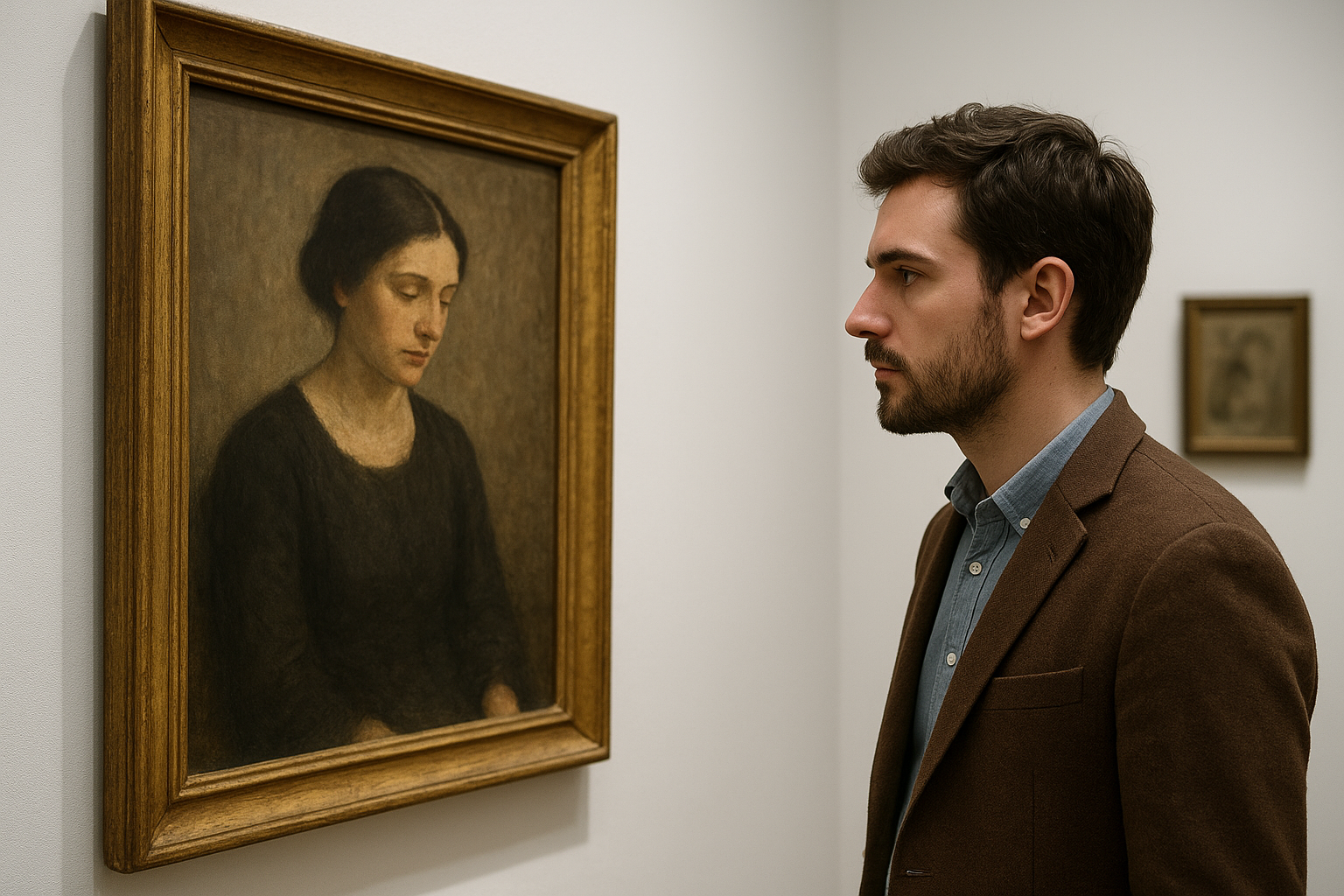
  • The Silent Conversation: The Relationship Between Viewer and Art

    The Silent Conversation: The Relationship Between Viewer and Art

    The enduring connection between viewer and art is a silent conversation, a dialogue without words that transcends time and space. This relationship is not merely an emotional journey but a transformative experience that offers profound insights into the human condition. As Vincent van Gogh aptly stated, “I am seeking, I am striving, I am in it with all my heart.” This sentiment encapsulates the immersive experience that art invites a viewer into—a search for meaning, beauty, and truth.

    The Historical Context

    Since the dawn of civilization, art has been a medium for expressing human experiences and emotions. From the cave paintings of Lascaux to the grandeur of the Renaissance, art has served both as personal reflection and societal commentary. Each piece, a mirror, reflects the time and culture from which it springs, yet it also reaches forward to speak to future generations. The Metropolitan Museum of Art describes this journey through history as a continuous narrative that connects humanity.

    The Viewer’s Role

    A viewer stands before a piece of art not as a passive observer but as an active participant. In the words of Marcel Duchamp, “The viewer completes the work of art.” This interaction brings art to life and breathes meaning into its form. The viewer’s perceptions, emotions, and experiences meld with the artist’s intentions, creating a unique interpretation.

    • Emotional Response: The initial impact of a piece of art often triggers an emotional reaction. This can range from joy, sadness, or tranquility to confusion or even discomfort, each valid and reflective of the viewer’s personal narrative.
    • Analytical Engagement: Beyond emotional response, viewers often engage with art on an intellectual level, seeking to understand the techniques, mediums, and historical context employed by the artist.
    • Reflective Interaction: Finally, art often prompts introspection, allowing viewers to reflect on their own lives and the broader human experience.

    The Artist’s Intention vs. Viewer Interpretation

    The relationship between artist intent and viewer interpretation is complex and often varies widely. While artists may imbue their work with specific meanings or messages, these are not always directly transferrable to viewers. This discrepancy opens the door for personal interpretations that can be as diverse as the viewers themselves.

    “What is art but a way of seeing?” – Saul Bellow

    This quote from Saul Bellow encapsulates the subjective nature of art appreciation. As the viewer engages with the piece, they apply their own framework of understanding, informed by their life experiences and cultural background.

    Case Study: The Silent Conversation in Modern Art

    Modern art often exemplifies the silent conversation between viewer and art through its break from traditional forms and narratives. Artists like Jackson Pollock and Mark Rothko create pieces that defy conventional interpretation, demanding viewer engagement for meaning to emerge.

    • Jackson Pollock: Known for his technique of drip painting, Pollock’s work invites viewers to step into a realm of chaos and creation. The seemingly random patterns force an active engagement, asking audiences to find order or narrative within the chaos.
    • Mark Rothko: Rothko’s expansive color fields are less about depiction and more about eliciting emotional states. Viewers often find themselves enveloped in the contemplative silence of his paintings, encouraging a personal dialogue with the work.

    The Silent Conversation in Different Art Forms

    While paintings and sculptures offer palpable interactions, other art forms such as music, theater, and digital art also engage viewers in unique conversations.

    • Music: Like visual art, music facilitates a deep emotional and psychological engagement. Tracks and symphonies narrate stories without words, allowing listeners to conjure images and feelings in response to rhythms and melodies.
    • Theater: This live art form creates an immediate dialogue between performers and audience, with each performance adding new dimensions to the storyline, colored by audience interaction.
    • Digital Art: In our digital era, new art forms challenge traditional viewer perceptions. Interactive and virtual reality art installations invite viewers to become part of the artwork, actively shaping their experiences.

    Conclusion

    Whether confronting the haunting eyes of Frida Kahlo’s self-portraits or the serene landscapes of Claude Monet, viewers engage in a silent conversation with art—a dialogue that transcends generations. This relationship is dynamic, shaped by the ever-changing perspectives each viewer brings. Much like life itself, the conversation with art is ongoing and evolving, tapping into our innate human desire for expression and connection.

    As we continue to engage with art, let us embrace Pablo Picasso’s insight: “Art washes away from the soul the dust of everyday life.” In this ever-changing dialogue, we find solace, challenge, and ultimately, a deeper understanding of ourselves and the world around us. Thus, the silent conversation continues, inviting us to explore, question, and reflect on the infinite canvases of human experience.

  • Revisiting the Relic: Modern Artists Engaging with Old Masters

    Revisiting the Relic: Modern Artists Engaging with Old Masters

    In the dynamic world of contemporary art, there is a resonant reverberation of the past that artists cannot ignore. The dialogue between modern creators and the Old Masters serves as a bridge between centuries, where traditional techniques meet avant-garde experimentation. This conversation across time not only enriches the modern artist’s palette but also breathes new life into historical works.

    Reinterpretation and Innovation

    Modern artists are increasingly drawn to the works of legendary figures such as Leonardo da Vinci, Rembrandt, and Caravaggio. They see these masterpieces not just as relics of art history, but as living sources of inspiration. As noted by art critic Jonathan Jones in The Guardian, “The way today’s artists engage with the past is often unsettling, surprising, and transformative.”

    • Appropriation: Some artists adopt elements from classic artworks, embedding them into new contexts to create unexpected juxtapositions. British artist Tracey Emin, for instance, integrates drawings reminiscent of Egon Schiele into her work to evoke raw emotion.
    • Subversion: By reimagining revered pieces through a contemporary lens, artists challenge the viewer’s perceptions. For example, Kehinde Wiley’s portraits replace noble European figures with young African American men, effectively engaging in a dialogue about race and representation.
    • Homage: Many artists pay tribute to the techniques and styles of the Old Masters while injecting their personal narratives. Artist Jenny Saville is known for her lush, painterly works that echo the grandeur of Renaissance art while exploring modern themes of identity and the body.

    The Impact of Technology

    Today’s artists utilize technology to further explore the intricate tapestries laid down by the Old Masters. Digital art and machine learning open new gateways to understanding and reinterpreting classical works. Art historian Martin Kemp states in an article for The New York Times, “This fusion of art and technology not only expands the creative horizons but also encourages a deeper appreciation of historical art.”

    “In revisiting the past, modern artists are not just mimicking what has been done but are actively building upon it to create something pertinent to our time.”

    Ultimately, the ongoing interplay between modern artists and Old Masters illustrates the timeless nature of art. It exemplifies how creativity transcends boundaries, both temporal and stylistic, and highlights the enduring power of the past to inform and inspire the present.

  • Iconoclasts and Insights: The Clash of Modern and Traditional Faith

    Iconoclasts and Insights: The Clash of Modern and Traditional Faith

    Faith, as a profound aspect of human existence, has been a source of comfort, community, and conflict throughout history. In the contemporary epoch, a fascinating dichotomy emerges between traditional adherence and modern interpretations. This clash, while rooted in age-old practices, thrives in the dynamic environment of modern society. In examining both sides, we gain insights into the evolving nature of belief and spirituality.

    The Foundations of Traditional Faith

    Traditional faith systems hold significant authority and continuity across generations. Anchored in time-honored beliefs and practices, these systems often serve as bedrock institutions within cultures globally. Such faith manifests through rituals, ceremonies, and doctrines that provide individuals with a grounded sense of identity and purpose.

    • Preservation of Legacy: Traditional faith emphasizes the unbroken transmission of customs and teachings from one generation to the next. The stability and predictability offered through orthodoxy have been pivotal to communities seeking refuge in a world of constant change.
    • Collective Identity: The shared experiences and narratives found within these traditional frameworks foster a strong sense of belonging and unity among adherents.
    • Scriptural Authority: For many, the sacred texts offer divine guidance and dictate the course of ethical and moral life. As it is often asserted: “It is written in the Holy Book,” which signifies the deep-seated reverence for scripture.

    However, modernity’s rapid advancement has sparked a reconsideration of these ancient tenets.

    Modern Faith and the Spirit of Innovation

    Modern faith is characterized by an openness to reinterpret and re-envision traditional beliefs through a contemporary lens. This is propagated by increased globalization, scientific advancements, and the rise of individualism.

    • Individual Spirituality: A growing number of people embrace a personal, rather than institutional, approach to spirituality. As noted in a recent survey by the Pew Research Center, “The proportion of Americans who identify as ‘spiritual but not religious’ has surged, signaling a shift from organized religion to personal spirituality.” (Source: Pew Research Center).
    • Scientific Inquiry: Many modern practitioners seek to harmonize scientific understanding with spiritual belief. They often view the universe’s intricate workings as a testament to greater consciousness rather than a contradiction of faith.
    • Interfaith Dialogues: The rise of interfaith movements exemplifies the modern approach to religious belief. These conversations emphasize universal values such as compassion, equality, and love, extending respect and understanding across diverse religious traditions.

    This convergence of faith and inquiry heralds a new era of innovation while posing challenges to established norms.

    The Intersection and Its Implications

    The clash between traditional and modern faith is not merely academic—it is evident in societal, political, and cultural domains worldwide.

    The Social Dynamics

    At a societal level, tension often arises in communities divided by generational views. Older groups may resist what they see as the erosion of core values, while younger generations may argue for the relevance and adaptation of faith to contemporary issues.

    “The test of a first-rate intelligence is the ability to hold two opposed ideas in mind at the same time and still retain the ability to function,” as F. Scott Fitzgerald poignantly notes. This sentiment captures the challenge faced by many in reconciling these divergent worlds. (Source: Quote Investigator)

    Political and Cultural Repercussions

    In many parts of the world, the friction between traditionalists and modern innovators influences political landscapes, policy-making, and cultural expressions. Legal systems in various countries grapple with issues of religious freedom, secularism, and how to accommodate evolving spiritual views within a traditional framework.

    • Governance and Policy: Countries like India and Turkey exemplify the struggle to balance secular governance with religious conservatism, leading to vibrant public debates and sometimes contentious political environments.
    • Cultural Expressions: Literature, film, and art often challenge traditional religious paradigms, sparking conversations and, at times, controversy.

    Bridging the Divide

    While conflict dominates much of the discourse, the potential for synergy and synthesis between traditional and modern beliefs is both feasible and promising.

    Emerging practices, such as integral spirituality, seek to harmonize conventional religious practices with new age spirituality. They propose an encompassing vision that acknowledges the wisdom of ancient traditions while embracing the insights of modernity.

    • Educational Initiatives: Programs promoting religious literacy and interfaith education contribute to breaking down misconceptions and fostering mutual respect.
    • Community Leadership: Faith leaders who advocate for dialogue and inclusivity often play pivotal roles in nurturing environments where diverse spiritual beliefs can coexist and collaborate.
    • Technology and Connectivity: The digital age has democratized access to religious texts and ideas, enabling individuals to explore various beliefs and practices, thus broadening their spiritual horizon.

    The interaction between the traditional and the modern is not a zero-sum game. Instead, it reflects the vibrancy and diversity of human belief systems. By embracing our differences and seeking common ground, we transcend merely surviving these shifts and begin to thrive through the enrichment such diversity offers.

    Ultimately, both traditional and modern faith framework strives for knowledge, meaning, and understanding—timeless quests of human beings. As we move forward, our ability to navigate these waters with compassion and openness may well define the spiritual landscape of the future.

    This article serves as a reflection on the current state of faith, where the lines between old and new are continually redrawn, offering not just conflict, but tremendous opportunity for growth and understanding in the tapestry of human spirituality.