Tag: ancient

  • The Art of Stopping Before You Collapse

    The Art of Stopping Before You Collapse


    The Art of Stopping Before You Collapse

    The Art of Stopping Before You Collapse: Ancient Wisdom for Modern Times

    “Rest when you’re weary. Refresh and renew yourself, or you will be as useless as a dried-up well.” – Persian saying

    In the fast-paced world we live in today, it is easy to overlook the importance of rest and self-care. However, ancient mythologies provide us with valuable insights on the art of stopping before one collapses.

    The Greek Philosophy of Moderation

    Aristotle, a renowned Greek philosopher, emphasized the importance of moderation in all things. This concept, known as “sophrosyne,” is central to understanding the art of stopping before you collapse.

    “Excess is the parent of violence. Moderation is both the means of health and friendship.” – Aristotle

    The Roman Concept of Moderatio

    Similarly, the Romans valued moderation, encapsulated in their word “moderatio.” Seneca, a famous Roman philosopher, wrote extensively about the dangers of overwork and the importance of balance.

    “It is in times of security that the spirit should be prepared for adversity. When it is at ease that it should be made vigorous.” – Seneca

    The Importance of Rest in Japanese Culture

    In Japan, the concept of “Shukubai” embodies the idea of living harmoniously with nature and adapting one’s lifestyle to the seasons. This philosophy emphasizes rest and relaxation during the winter months when work is less abundant.

    “The art of life lies in a constant readjustment to our surroundings.” – Kakuzo Okakura, The Book of Tea

    By heeding the wisdom of these ancient cultures, we can learn to find balance in our lives and avoid collapsing under the weight of modern-day stressors. Take time for rest, reflect on your needs, and embrace the art of stopping before you collapse.

  • The Neon Pantheon – How superheroes replaced the gods of Olympus.

    The Neon Pantheon – How superheroes replaced the gods of Olympus.

    “`html


    The Neon Pantheon – How superheroes replaced the gods of Olympus

    The Neon Pantheon: A New Age Dawns

    In an era where mythology has taken a modern twist, the pantheons of old have been replaced by a new breed of divine entities – superheroes. As we explore this shift in cultural perspective, it becomes clear that these neon-clad gods have captivated our imagination and filled the void left by their ancient counterparts.

    The Decline of Olympus

    “In ancient Greece, the gods were a central part of daily life. From agriculture to warfare, they held sway over every aspect of existence.”
    – Dr. Eleanor Wyatt, Classics Scholar, University of Athens

    Yet, as the years passed and societies evolved, the gods of Olympus began to fade from popular consciousness. Few still revere Zeus or Aphrodite in their daily lives, instead turning towards more tangible forms of inspiration.

    The Rise of Neon Pantheons

    “Superheroes have become modern myths – stories that resonate with us on a deeply personal level, providing guidance and inspiration in our complex world.”
    – Professor James Morrow, Cultural Anthropologist, New York University

    From Marvel’s Avengers to DC’s Justice League, these contemporary heroes have captured the hearts of millions and found their place amongst the stars. They possess powers that rival those of the ancient gods, yet they are relatable, flawed, and human.

    A New Era of Heroes

    • Accountability: Unlike their Olympian counterparts, superheroes are often held accountable for their actions. This sense of responsibility resonates with a public that values transparency and justice.
    • Heroism through sacrifice: Superhero stories often revolve around selfless acts of courage and sacrifice – qualities that inspire us to be better versions of ourselves.
    • Empowerment: By embodying qualities such as strength, wisdom, and compassion, superheroes provide a powerful example for those seeking to overcome adversity in their own lives.


    “`

  • Zeus: Power, Thunder, and the Anxiety of Being in Charge

    Zeus: Power, Thunder, and the Anxiety of Being in Charge


    Zeus: Power, Thunder, and the Anxiety of Being in Charge

    Zeus: Power, Thunder, and the Anxiety of Being in Charge

    In the vast tapestry of ancient Greek mythology, few figures loom as large as Zeus. As the king of gods, the god of sky and thunder, and the central player in countless epic tales, his legend is a testament to the power and complexity of the human imagination. However, beneath his mighty stature and unwavering authority, Zeus was not immune to the human emotions that drive our stories. One such emotion that stands out is anxiety, a feeling that seems as relevant today as it did millennia ago.

    The Mighty Thunderbolt

    • Known for his fierce thunderbolts, Zeus was a god to be feared and revered. His power was legendary, and he wielded it with a fervor that few could match. However, even the mightiest of gods are not immune to the anxieties of leadership.

    “Mighty is he who has subdued cities and subjected peoples; but more mighty is he who can rule himself.”
    – Plato, Greek philosopher (427 BC – 347 BC)

    The Anxiety of Leadership

    • One of the most poignant examples of Zeus’s anxiety comes from a tale of jealousy and deceit. When Hera, Zeus’s wife and queen of the gods, discovered that he had taken Io, a beautiful priestess, as his mistress, she devised a cruel plan to punish her husband.

    “There are no nations; there are only powerful and powerless people.”
    – Fredrick Nietzsche, German philosopher (1844-1900)

    A God’s Jealousy and Regret

    • To protect Io from Zeus’s wrath, Hera transformed her into a heifer. She then convinced Argus, a giant with a hundred eyes, to guard the heifer day and night. Realizing he could not be with Io without Hera’s knowledge, Zeus asked Hermes, his messenger god, to find a way around Argus.

    “In great positions, one is always nervous.”
    – Napoleon Bonaparte, French military and political leader (1769-1821)

    A God’s Redemption

    • Hermes succeeded in lulling Argus to sleep, allowing Zeus to be reunited with Io. However, the god was filled with remorse for his actions and the anxiety of his transgressions. To ease his guilt, he entrusted Io to the care of Epimetheus, Hera’s brother, while also creating a constellation in her honor.

    Lessons from Ancient Greece

    The story of Zeus and Io serves as a reminder that even the most powerful among us are not immune to anxiety, jealousy, or regret. As we navigate our own lives, it is essential to learn from these ancient stories and strive for balance in our actions and emotions.

  • Olympus Reimagined: Why the Greek Gods Still Speak to the Modern World

    Olympus Reimagined: Why the Greek Gods Still Speak to the Modern World


    Olympus Reimagined: Why the Greek Gods Still Speak to the Modern World


    Olympus Reimagined: Why the Greek Gods Still Speak to the Modern World

    In an era where technology and science reign supreme, one might wonder if ancient mythology still holds relevance. Yet, the Greek gods continue to captivate our imagination, their stories echoing through literature, art, and popular culture.

    Divine Archetypes

    The pantheon of Olympian deities offers a fascinating exploration of human nature. Each god embodies distinct archetypal characteristics that resonate with our deepest fears, desires, and aspirations.

    “The gods are the externalization of our own impulses, our own selves, projected beyond ourselves as objects, as external powers. They are only another name for our own deeper impulses.” – Carl Gustav Jung

    Carl Gustav Jung Quote

    Timeless Lessons

    Through the trials and tribulations of the gods, we find valuable insights about relationships, morality, and the human condition. Their myths serve as cautionary tales, illustrating both the heights of heroism and the depths of folly.

    “The Greek myths were not created to provide us with an explanation of the world or our place in it. They were a way for ancient Greeks to make sense of human behavior, human emotion, and the nature of the gods.” – Dr. Edith Hall

    Edith Hall Quote

    Inspiration for Creativity

    The Greek gods have ignited the imaginations of countless artists, writers, and musicians throughout history. Their myths continue to inspire new works that draw upon ancient themes while offering fresh perspectives.

    “I’ve always been fascinated by mythology, and I believe that the old gods still speak to us through the symbols they embody.” – Rick Riordan

    Rick Riordan Quote

    Connecting with the Divine

    In modern times, many people seek a deeper spiritual connection through the study and practice of ancient rituals and beliefs associated with Greek mythology. Whether one sees themselves as followers of Zeus or Athena, these deities continue to offer solace, guidance, and inspiration.


  • Walking as a Form of Therapy

    Walking as a Form of Therapy


    Walking as a Form of Therapy: Ancient Wisdom and Modern Practice

    Walking as a Form of Therapy: Ancient Wisdom and Modern Practice

    “Walking is man’s best medicine.” – Hippocrates

    This ancient quote by the father of modern medicine, Hippocrates, still holds true today as walking has emerged as an effective form of therapy for both physical and mental well-being.

    The Ancient Connection

    • Greek Philosophers: Aristotle advocated physical exercise, including walking, as a means to promote health and clear the mind.
    • Romans: The Roman philosopher Seneca believed that walking was an excellent way to think and find solutions to problems.

    Modern Evidence

    Science has validated these ancient beliefs, demonstrating that walking can:

    • Improve Mental Health: Walking regularly can help reduce symptoms of anxiety and depression.
    • Boost Cognitive Function: Walking stimulates the brain, enhancing memory and problem-solving skills.
    • Promote Physical Fitness: Regular walking can contribute to weight loss and reduce the risk of chronic diseases like heart disease and diabetes.

    Walking as a Modern Therapy

    “Nature is a therapist.” – Frank Lloyd Wright

    Modern therapy practices often incorporate walking in nature, known as ecotherapy or green exercise. Studies have shown that this practice can significantly improve mood and reduce stress levels.

    So, lace up your shoes, step outside, and follow the footsteps of ancient philosophers for a therapeutic walk through nature.

  • Psychohygiene as a Form of Self-Respect

    Psychohygiene as a Form of Self-Respect


    Psychohygiene as a Form of Self-Respect

    Psychohygiene: A Modern Approach to Self-Respect in Ancient Mythology

    “The secret of change is to focus all of your energy, not on fighting the old, but on building the new.” – Socrates

    In the realm of ancient mythology, self-respect was often embodied through various deities and heroes. However, in today’s fast-paced world, it is essential to adopt modern approaches that cater to our mental wellbeing – one such concept being psychohygiene.

    What is Psychohygiene?

    Originating from the work of Swiss psychiatrist Alfred Adler, psychohygiene refers to the systematic promotion and maintenance of mental health and well-being. It emphasizes self-understanding, self-awareness, and personal responsibility in preserving one’s psychological health.

    Psychohygiene: A Modern Reflection of Self-Respect

    The concept of psychohygiene can be seen as a modern reflection of self-respect in ancient mythology, where heroes and gods were expected to display nobility, integrity, and courage. Just as these virtues were essential for maintaining harmony within societies, psychohygiene plays a crucial role in promoting mental health and fostering self-respect in our contemporary world.

    “Self-respect is the fruit of discipline; the sense of dignity grows with the ability to say no to oneself.” – Mahatma Gandhi

    Cultivating Psychohygiene: A Practical Guide

    • Regular exercise: Regular physical activity has been shown to reduce stress and improve mental health.
    • Mindfulness meditation: Practicing mindfulness can help one become more aware of their thoughts and emotions, promoting self-awareness and emotional balance.
    • Adequate sleep: Getting enough rest is vital for maintaining mental health and fostering a sense of self-respect.

    “Respect yourself and others will respect you.” – Confucius

    By adopting psychohygiene practices, we can cultivate a strong sense of self-respect that not only benefits our mental wellbeing but also resonates with the ancient values of mythological heroes and gods.

  • The Superhero’s Cape – Modern armor for the ancient struggle of good vs. evil.

    The Superhero’s Cape – Modern armor for the ancient struggle of good vs. evil.

    The Superhero’s Cape – Modern Armor for the Ancient Struggle of Good vs. Evil

    In modern pop culture, superheroes have become an integral part of our collective imagination. With their extraordinary abilities and daring feats, they fight to protect the innocent from the forces of evil. But what is it about these caped crusaders that resonates so deeply with us? Is it their superhuman powers or something more profound?

    • The symbolic significance of a superhero’s cape cannot be overstated. It serves as a visual representation of their commitment to justice, their willingness to take risks, and their unwavering dedication to the greater good.
    • “A superhero is born when someone decides that they’re not going to take this lying down,” says Stan Lee, co-creator of iconic superheroes like Spider-Man and The Avengers. “It’s a symbol of what we all strive for: the courage to stand up against tyranny.”
    • The cape itself has its roots in ancient mythology. In Greek and Roman mythology, capes were worn by heroes like Perseus and Hercules as a symbol of their divine right to fight monsters and gods alike.

    “The superhero’s cape is not just a piece of fabric – it’s an emblem of power, of freedom, and of the human spirit’s capacity for heroism.” – Chuck Palahniuk, author of Fight Club

    As we gaze upon the caped crusaders of today, whether on the big screen or in our comic books, we’re reminded that the struggle between good and evil is timeless. It’s a reminder that even in the darkest moments, there are those who will stand tall against injustice and fight for what’s right.

    Explore More

  • The Divine Feminine Rising – From Inanna to Artemis and beyond.

    The Divine Feminine Rising – From Inanna to Artemis and beyond.

    The Divine Feminine Rising – From Inanna to Artemis and beyond

    The concept of the divine feminine is an ancient and universal one, with roots in many cultures and societies around the world. It refers to the symbolic representation of femininity as a sacred and powerful force that underlies all existence. This article will explore the rise of the divine feminine from its earliest recorded manifestations in Mesopotamian mythology to its modern-day reemergence.

    Inanna’s Descent

    In ancient Sumerian mythology, Inanna was the queen of heaven and earth, worshipped as a powerful goddess of love, war, and fertility. Her mythological story is one of empowerment and transformation. According to legend, Inanna descended into the underworld, ruled by her sister Ereshkigal, in order to reclaim her husband Dumuzi’s corpse. This journey represents Inanna’s desire for knowledge, power, and self-discovery.

    Artemis’ Hunt

    In Greek mythology, Artemis was the goddess of the hunt, wilderness, and childbirth. She is often depicted as a maiden with a bow and arrows, embodying the qualities of independence, strength, and protection. As the twin sister of Apollo, she represents the dualities of life: light and dark, masculine and feminine.

    The Triple Goddess

    The concept of the triple goddess, also known as the triple-faced goddess, is rooted in ancient European paganism. This mythological figure represents the three aspects of femininity: maiden (youth), mother (nurturing), and crone (wisdom). The triple goddess embodies the cycles of life, death, and rebirth.

    Modern-Day Revival

    In recent years, there has been a growing interest in reviving the divine feminine through various forms of spirituality and activism. This movement is often associated with feminist and ecological concerns, emphasizing the importance of nurturing and protecting the natural world.

    “The Divine Feminine is not just about women; it’s about the feminine principle that underlies all existence.” – Gloria Steinem

    Contemporary Practices

    In today’s globalized society, there are many ways to connect with the divine feminine. These include:

    • Wicca and witchcraft**: A modern pagan religion emphasizing the cyclical nature of life and the power of femininity.
    • Feminist spirituality**: An approach that recognizes the interconnectedness of all beings, particularly women, and emphasizes self-care and empowerment.
    • Ecofeminism**: A movement that highlights the connection between the oppression of women and the degradation of the natural world.

    Conclusion

    The divine feminine is a timeless and universal concept that has been present throughout human history. Its revival in modern times serves as a reminder of our interconnectedness with nature and each other. By exploring the myths and symbolism associated with this phenomenon, we can gain a deeper understanding of ourselves and our place within the world.

    Read more about the divine feminine

  • Ancient Cosmologies and Modern Physics – Unexpected resonances

    Ancient Cosmologies and Modern Physics – Unexpected resonances

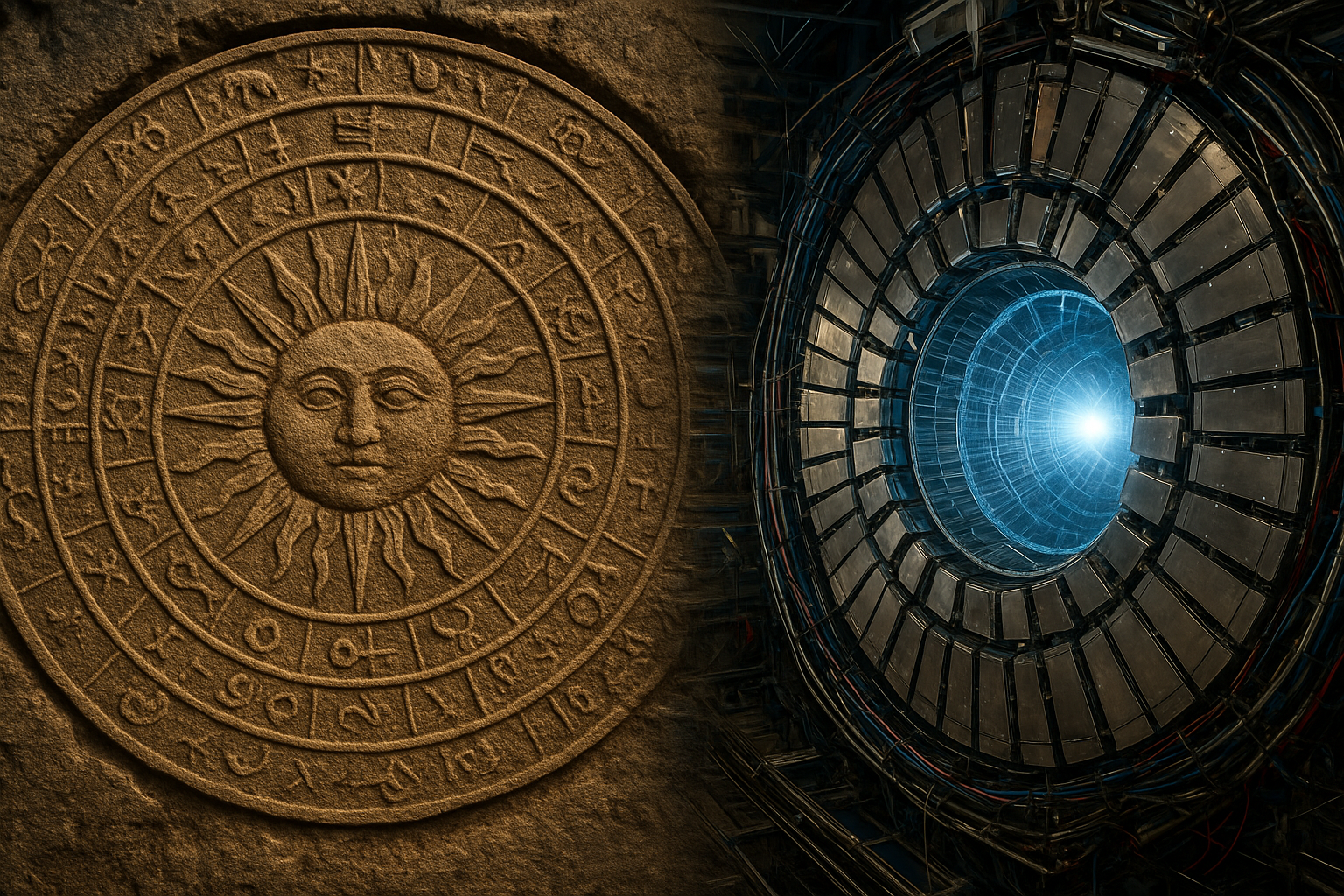
    The interplay between ancient cosmologies and modern physics reveals surprising parallels that compel us to reconsider the wisdom of early civilizations. While the sciences of today are grounded in empirical evidence and stringent methodologies, many of the ancients’ ideas resonate with contemporary scientific discoveries. This article explores these fascinating intersections.

    Cosmologies of the Ancients

    Ancient civilizations sought to understand their world through cosmologies that often intertwined the spiritual with the physical. The Babylonians, for instance, were adept astronomers, their observations forming the bedrock of later celestial navigation. Meanwhile, the ancient Greeks offered a pantheon of theories, the most notable being the geocentric model proposed by Ptolemy, which dominated for centuries.

    In the Eastern world, the Vedic texts of India introduced cyclic models of the universe, a notion echoed in the concept of a constantly expanding and contracting universe. The Māori of New Zealand described the universe’s creation as ‘Te Kore’, the nothing, evolving into ‘Te Po’, the darkness, and ultimately into ‘Te Ao’, the light – an allegorical perspective on cosmic birth that strikingly parallels the universe’s expansion from singularity.

    Modern Physics: New Discoveries, Old Ideas

    With the advent of quantum physics and theoretical cosmology, the universe revealed its peculiarities, often mirroring the strangeness of ancient metaphysical descriptions. One such example is the concept of the multiverse, which echoes the many-world scenarios found in Hindu cosmology, suggesting an eternal cycle of creation and destruction.

    In an interview with Scientific American, physicist Alan Guth, one of the pioneers of the inflationary universe theory, describes the multiverse hypothesis as an outcome of modern cosmological models, “Just as modern cosmology suggests a multiplicity of possible universes, ancient beliefs saw the cosmos as a tapestry far richer than the visible.”

    Quantum Entanglements with Ancient Belief

    Quantum mechanics has provided some of the most startling insights into the fabric of reality. The phenomenon of quantum entanglement suggests that particles can be interconnected in ways that transcend space and time, an idea echoed in many indigenous cosmologies. For instance, the Indra’s Net concept from Buddhist philosophy, describes a vast net, whereby each node is a reflection of all others, a metaphor for interconnectedness that modern physics now observes through quantum entanglement.

    The Cosmos and Human Understanding

    The Anthropic Principle, a philosophical consideration that observations of the universe must be compatible with the conscious life that observes it, also finds antecedents in ancient thought. Many ancient cultures positioned humans as an integral part of the cosmos, not in an egocentric sense but as participants in a grand cosmic dance. This is mirrored today in modern physics, which increasingly acknowledges the observer’s role in the universe’s functioning.

    The renowned physicist John Archibald Wheeler speculated on this balance by suggesting, “We are participators in bringing into being not only the near and here but the far away and long ago.” His perspective underscores the human element in our universe’s narrative, similar to the interconnected frameworks that ancient cosmologies endorsed.

    Reconciling Wisdom

    “The most beautiful thing we can experience is the mysterious. It is the source of all true art and science.” — Albert Einstein

    Einstein’s reflection captures the mysterious allure that both ancient cosmologies and modern physics offer humanity. While ancient beliefs personified this mystery in divine or mythological narratives, modern physics offers mathematical abstraction. Yet, the goal remains the same: to fathom the unfathomable.

    Despite their varied approaches, both systems share a profound insight: the universe is a mesmerizing enigma, best approached with humility and an acknowledgment of our limited understanding. The unexpected resonances between ancient cosmologies and modern physics deepen this appreciation, encouraging a philosophical openness that may pave the way for future revelations.

    In revisiting and respecting the ideas of our ancestors, who viewed the cosmos with wonder, we may discover that the boundary between ancient wisdom and modern knowledge is not as rigid as once thought. As we continue to explore the universe, those timeless ancestral voices offer comfort and insight, reminding us that the questions, more than the answers, are what propel us forward.

  • From Oracle to Algorithm – What we lost when prediction became automated

    From Oracle to Algorithm – What we lost when prediction became automated

    From Oracle to Algorithm: What We Lost When Prediction Became Automated

    Throughout history, humans have sought ways to predict the future. From ancient oracles to sophisticated algorithms, our methods may have evolved, but the underlying desire remains the same: to gain insight into what lies ahead. However, as prediction has become more automated, we’ve lost something profound—an element of mystique, humanity, and cultural richness.

    The Age of Oracles

    In ancient times, oracles were revered as sacred intermediaries between the divine and mortal worlds. The Oracle of Delphi, one of the most famous oracles in ancient Greece, served as a powerful and central figure. The Pythia, the high priestess of the Temple of Apollo, would deliver cryptic prophecies believed to be divinely inspired.

    “Know thyself,” reads the inscription at the Temple of Apollo at Delphi, underpinning the oracular tradition—self-awareness as a path to enlightenment.

    Oracular traditions were not confined to Greece alone. Across the globe, various cultures turned to their own forms of prophecy:

    • The I Ching: A divination text in China that involves the casting of coins or yarrow sticks to reveal insights about the future.
    • The Druids: In Celtic societies, these priestly figures used natural signs and symbols to interpret future events.
    • Shamans: In indigenous cultures, shamans would enter trance states to communicate with spirits to divine the future.

    These traditions were not just about predicting the future; they were rituals deeply embedded in cultural and religious meanings. An oracle’s pronouncement was a communal event, a shared experience that brought people together.

    Prediction in the Modern Era

    With the advent of the Age of Enlightenment, reliance on mystical oracles began to decline. The rise of scientific reasoning encouraged empirical methods and a rational understanding of the world. However, the human need to foresee the future only shifted form, leading to the development of early statistical methods.

    Fast forward to the 20th century, and prediction entered the realm of computation. Algorithms, initially simple in structure, started to shape how we approached forecasting everything from weather patterns to economic trends. The introduction of machine learning and artificial intelligence pushed predictive capabilities to unprecedented heights, enabling the continuous analysis of massive data sets beyond human scope.

    The Age of Algorithms

    Today, algorithms touch every part of our lives. Recommendation systems suggest what we should watch next on streaming platforms. Financial algorithms decide on creditworthiness. Google’s Machine Learning Algorithms track user behavior to predict search trends, as explored in detail in a piece on Wired.

    “We are in the midst of a golden age of machine learning and artificial intelligence. Algorithms can now accurately predict when we’re sick, where we’re going, what we’ll buy next, and even whom we might date,” states Wired Magazine.

    The Pitfalls of Automation

    While automation has its advantages, predicting outcomes faster and more accurately than any human oracle could, it also comes with inherent downsides:

    • Loss of Context: Algorithms rely heavily on data input, but they often miss the nuanced understanding of human behavior and cultural contexts.
    • Ethical Concerns: Automated predictions can lead to biased outcomes if the algorithms are trained on skewed data sets, as examined in a study published in PNAS.
    • Lack of Human Touch: While algorithms are efficient, they lack empathy and a personal touch that ancient oracles imbued into their prophecies.
    • Reduction of Shared Experience: Predictions have become private and individual, stripping away the communal aspect that once played a significant role in interpreting prophecies.

    The Spiritual and the Secular

    The transition from oracles to algorithms reflects a broader cultural shift from the spiritual to the secular. While algorithms present a scientific approach to prediction, some argue that this transition has contributed to disenchantment—where the mystical and the mysterious are overshadowed by the empirical and the calculated.

    Yet, even in an era dominated by technology, the allure of the mystical persists. Astrology, tarot readings, and other forms of divination continue to thrive, signifying a persistent human yearning for spiritual insight.

    A Future Synthesis?

    Rather than viewing oracles and algorithms as opposing entities, perhaps the future lies in a synthesis of the two—a blend of automated prediction grounded in human values and ethical considerations. The technology firm IBM Research suggests integrating AI’s analytical prowess with human empathy to create more balanced predictive models that account for human complexities.

    In conclusion, while algorithms provide efficiencies and advancements in prediction, acknowledging the spiritual and communal dimensions of ancient practices could lead to a more holistic future of forecasting. By recognizing what we have lost, we may yet find a way to regain it in a contemporary context.

    “The greatest danger of the future is that we will turn our imaginations over to machines,” philosopher Jaron Lanier warns in his discussion about the ethics of AI.

    The journey from oracle to algorithm tells us much about our collective passage through time, a narrative that holds as much about our future as it does about our past. As we stride forward, let us carry with us the wisdom of both worlds.